
Daniel Comboni
Comboni Missionaries
Institutional area
Other links
Newsletter
Palm Sunday and of the Passion of the Lord – Year A: Entering Holy Week
“On this day the Church commemorates Christ the Lord who enters Jerusalem to accomplish his paschal mystery,” says a liturgical note. With Palm Sunday and of the Passion of the Lord we begin Holy Week, also called the Great Week. (...)
Entering Holy Week
Palm Sunday and of the Passion of the Lord
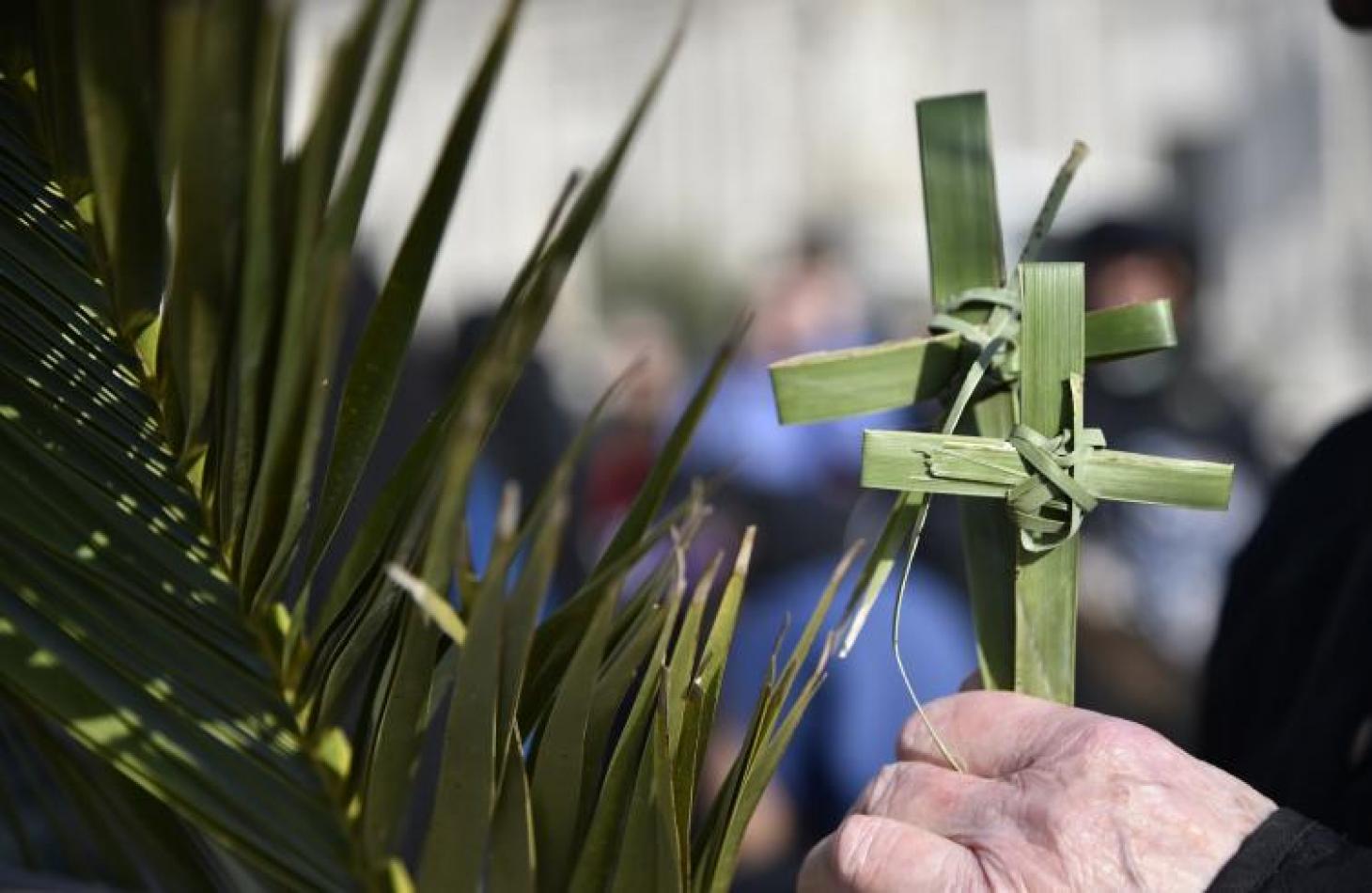
Matthew 21:1–11 (Blessing of the palms)
Matthew 26:14–27:66 (Passion of the Lord)
“On this day the Church commemorates Christ the Lord who enters Jerusalem to accomplish his paschal mystery,” says a liturgical note. With Palm Sunday and of the Passion of the Lord we begin Holy Week, also called the Great Week. This Sunday has two aspects, that is, two clearly distinct parts. The first: the rite of the palms, followed by the procession, marked by joy and enthusiasm. The second: the Eucharist, with the proclamation of the Passion, characterised by sorrow, failure and death.
Palm Sunday: the donkey and its colt
Meditating on the Gospel of the blessing of the palms (Matthew 21:1–11), we turn our attention to two unusual protagonists: the donkey and its colt. The messianic identity of Christ calls for a profound change of mindset. For this reason Jesus takes up a forgotten messianic prophecy, which presents a humble and gentle Messiah who prefers the donkey, a beast of burden, to the horse: “Behold, your king is coming to you, humble and mounted on a donkey, on a colt, the foal of a beast of burden” (Zechariah 9:9). Jesus is the Messiah who bears our burdens on the cross: “He has taken our infirmities and borne our sufferings” (Isaiah 53:4). Consequently, the Christian too is called to do the same: “Bear one another’s burdens, and in this way you will fulfil the law of Christ” (Galatians 6:2). With a touch of provocation, Silvano Fausti states: “For the whole law of Christ is the law of the donkey”.
Thus, the colt beside the donkey can represent the disciple, that is, each one of us, called to learn from the Master.
Italian theologian Paolo Scquizzato comments in this regard: “When Christianity, the Church, each one of us, knowing that the only way of existence is to live like the donkey, begins to flirt with the ‘world’, with the kings and the powerful of the earth, desiring to live and be like them through power, wealth and success, then a kind of tragic hybridisation will take place. We, made to live like donkeys, will join with the horse, which has always symbolised worldly power, and the result will be that we find ourselves like mules, animals that are foolish but above all sterile.”
To interiorise the account of the Passion
From the joy of the messianic entry we now move to the dramatic heart of the Passion. This account is the oldest part of the Gospels, and we could say it is their backbone. The four evangelists follow the same outline. However, each has his own way of telling it, with different theological and catechetical perspectives and with particular details in their narrative. Saint Matthew emphasises the fulfilment of the Scriptures, especially of the “Suffering Servant” of the prophet Isaiah and Psalm 21 (22). Jesus, before becoming the proclaimed Word, listens to and fulfils the Scripture (Isaiah 50:5).
Here are three points for reflection on Saint Matthew’s account of the Passion:
-
The Lord wants to celebrate Passover with me!
“Go into the city to a certain man and say to him: ‘The Teacher says: My time is near; I will keep the Passover at your house with my disciples’.” A certain man: the anonymity may lead us to think that this man is me! The Lord wants to celebrate Passover with me. He does not come alone, but with his own! What must I do to welcome him? -
My role in this drama?
One way of approaching this long account is to focus on each character who appears in this drama (there are many: around thirty, counting both groups and individuals!) and ask ourselves in whom we see ourselves reflected. Each of us has a role in this drama. Every person involved plays a part in which the Scripture is fulfilled. Which word is fulfilled in me? -
“De-crucifying” God!
The Passion reveals the true face of God. We have made God into a Pharaoh enthroned beyond the stars… and made human beings the subject, the servant, the slave of this God.
Maurice Zundel (1897–1975), one of the greatest mystical writers of the last century, says:
“There is an infinite distance between the account of Genesis and that of the agony of Jesus. The garden of Eden and the garden of Gethsemane are two gardens in which the face of God appears in an extremely different light… In Genesis, evil was disobedience to a command issued by a Sovereign Authority. In the garden of the agony, evil is a mortal wound inflicted on Someone who is defenceless, who cannot defend himself because he is only Love… because he is only Love, to the point of seeking from his disciples a compassion that he does not find, for they are asleep” (from a conference on 1/11/1967).
This reality leads Maurice Zundel to say that “it is no longer a matter of saving humanity, but of saving God” and of “de-crucifying” him, of taking God down from the cross, as Saint Francis wished to do. How can we do this? By working to free today’s crucified ones from the injustice that oppresses them.
In conclusion…
We enter the heart of the liturgical year. After forty days of preparation, we are about to celebrate the mystery of the Passion, Death and Resurrection of Jesus (the Paschal Triduum). A “tremendous” and ineffable mystery, dark and luminous, before which we remain stunned and incredulous: “Who has believed our message?” (Isaiah 53:1). The Church and her children live this week as a “spiritual retreat”, in recollection and prayer, in deep and intimate communion with their Lord.
A blessed beginning of Holy Week, the heart of our faith!
Fr Manuel João Pereira Correia, MCCJ
The way of humility
Joyful acclamations at Jesus’ entrance into Jerusalem, followed by his humiliation. Festive cries followed by brutal torture. This twofold mystery accompanies our entrance into Holy Week each year, as reflected in the two characteristic moments of today’s celebration: the initial procession with palm branches and the solemn reading of the Passion.
Let us enter into this movement, guided by the Holy Spirit, and thus obtain the grace we sought in our opening prayer: to follow in faith our Saviour’s example of humility, to heed his lesson of patient suffering, and thus to merit a share in his victory over the spirit of evil.
Jesus shows us how to face moments of difficulty and the most insidious of temptations by preserving in our hearts a peace that is neither detachment nor superhuman impassivity, but confident abandonment to the Father and to his saving will, which bestows life and mercy. He shows us this kind of abandonment by spurning, at every point in his earthly ministry, the temptation to do things his way and not in complete obedience to the Father. From the experience of his forty days in the desert to the culmination of his Passion, Jesus rejects this temptation by his obedient trust in the Father.
Today, too, by his entrance into Jerusalem, he shows us the way. For in that event, the evil one, the prince of this world, had a card up his sleeve: the card of triumphalism. Yet the Lord responded by holding fast to his own way, the way of humility.
Triumphalism tries to make it to the goal by shortcuts and false compromises. It wants to jump onto the carriage of the winner. It lives off gestures and words that are not forged in the crucible of the cross; it grows by looking askance at others and constantly judging them inferior, wanting, failures… One subtle form of triumphalism is spiritual worldliness, which represents the greatest danger, the most treacherous temptation threatening the Church (De Lubac). Jesus destroyed triumphalism by his Passion.
The Lord truly rejoiced with the people, with those young people who shouted out his name and acclaimed him as King and Messiah. His heart was gladdened to see the enthusiasm and excitement of the poor of Israel. So much so, that, to those Pharisees who asked him to rebuke his disciples for their scandalous acclamations, he replied: “If these were silent, the very stones would cry out” (Lk 19:40). Humility does not mean denying reality: Jesus really is the Messiah, the King.
Yet at the same time the heart of Jesus was moving on another track, on the sacred path known to him and the Father alone: the path that leads from “the form of God” to “the form of a servant”, the path of self-abasement born of obedience “unto death, even death on a cross” (Phil 2:6-8). He knows that true triumph involves making room for God and that the only way to do that is by stripping oneself, by self-emptying. To remain silent, to pray, to accept humiliation. There is no negotiating with the cross: one either embraces it or rejects it. By his self-abasement, Jesus wanted to open up to us the path of faith and to precede us on that path.
The first to follow him on that path was his mother, Mary, the first disciple. The Blessed Virgin and the saints had to suffer in walking the path of faith and obedience to God’s will. Responding with faith to the harsh and painful events of life entails “a particular heaviness of heart (cf. Redemptoris Mater, 17). The night of faith. Yet only from that night do we see the dawn of the resurrection break forth. At the foot of the cross, Mary thought once more of the words that the angel had spoken about her Son: “He will be great… The Lord God will give him the throne of his father David, and he will reign over the house of Jacob forever, and of his kingdom there will be no end” (Lk 1:32-33). On Golgotha, Mary faced the complete denial of that promise: her Son was dying on a cross like a criminal. In this way, triumphalism, destroyed by the abasement of Jesus, was likewise destroyed in the heart of his Mother. Both kept silent.
In the footsteps of Mary, countless holy men and women have followed Jesus on the path of humility and obedience. Today, World Youth Day, I would like to mention all those young saints, especially the saints “next door” to us, known only to God; sometimes he likes to surprise us with them. Dear young people, do not be ashamed to show your enthusiasm for Jesus, to shout out that he is alive and that he is your life. Yet at the same time, do not be afraid to follow him on the way of the cross. When you hear that he is asking you to renounce yourselves, to let yourselves be stripped of every security, and to entrust yourselves completely to our Father in heaven, then rejoice and exult! You are on the path of the kingdom of God.
Festive acclamations and brutal torture; the silence of Jesus throughout his Passion is profoundly impressive. He also overcomes the temptation to answer back, to act like a “superstar”. In moments of darkness and great tribulation, we need to keep silent, to find the courage not to speak, as long as our silence is meek and not full of anger. The meekness of silence will make us appear even weaker, more humble. Then the devil will take courage and come out into the open. We need to resist him in silence, “holding our position”, but with the same attitude as Jesus. He knows that the battle is between God and the prince of this world, and that what is important is not putting our hand to the sword but remaining firm in faith. It is God’s hour. At the hour that God comes forth to fight, we have to let him take over. Our place of safety will be beneath the mantle of the holy Mother of God. As we wait for the Lord to come and calm the storm (cf. Mt 4:37-41), by our silent witness in prayer we give ourselves and others “an accounting for the hope that is within [us]” (1 Pet 3:15). This will help us to live in the sacred tension between the memory of the promises made, the suffering present in the cross, and the hope of the resurrection.
Pope Francis
Palm sunday 2019
Gospel: Matthew 26:14–27:66
All the evangelists devote much space to the story of the passion and death of Jesus. The facts are basically the same, though narrated in different ways and with different perspectives. Each evangelist presents his own episodes and details of choice, underscoring different aspects. These reveal their particular interest in certain aspects of catechesis, considered significant and urgent for their particular community.
Today’s version of the passion is that of Matthew. In our comment, we will highlight only its characteristic aspects.
The first and most important is that Matthew punctuates the whole story with repeated references to the fulfillment of the Scriptures. When it was evening, Jesus sat at table with the Twelve. While they were eating, Jesus utters a phrase, the key to understanding everything that will happen as a result: “The Son of man is going as it is written of him” (Mt 26:24).
Later, in the garden of Olives, when the guards approach to arrest him as if he were a bandit, he reacts by saying, “But all this has happened to fulfill the Scriptures of the prophets” (Mt 26:56).
Matthew notes that even the most marginal details of the passion—for instance, the betrayal of Judas forthirty pieces of silver—were announced by the prophets (Mt 27:9-10).
We especially have a parallel, wanted by this evangelist, between the passion of Jesus and the drama lived out in Psalm 22:
– Like Jesus on the cross (Mt 27:46) this man also turns to the Lord the cry: “My God, my God, why have you forsaken me?” (Ps 22:2).
– He is the object of the same derision: “All who see me make a jest of me; they sneer and shake their heads: He put his trust in the Lord, let the Lord rescue him. If the Lord is his friend, let him help him” (Ps 22:8-9). It is exactly what happened at the foot of the cross and the insults addressed to Jesus were identical (Mt 27:39,41-43).
– Like Jesus (Mt 27:34,48) he thirsts: “My throat is dried up like a potsherd” (Ps 22:16).
– He is surrounded by evildoers and says, “They have pierced my hands and feet” (Ps 22:17). He continues: “They divide my garments among them, casting lots for my raiment” (Ps 22:19). At the foot of the cross, the soldiers that crucified him divided his clothing among themselves (Mt 27:35).
– Finally, like Jesus (Mt 27:50), he also emits a cry (Ps 22:25).
–Such corresponding incidents are numerous. We tend to suppose that the author of the psalm intended an accurate prediction, right down to the detail of what, one day, would happen to the Messiah. It’s not like that.
The striking similarities are due to the evangelist’s theological choice. He wanted to tell about the passion and death of Jesus, bearing in mind the schema set out in this psalm. He did it to assist his readership in going beyond mere record and grasp the deeper meaning of what was happening.
The other evangelists also quote the scriptures, but none with so much insistence. The reason is that Matthew wrote his Gospel to the Jews who had been educated in the catechesis of the rabbis to wait for a victorious, dominating, great and powerful messiah. Given the failure with which Jesus’ life ended, who could have the courage to present him as the messiah?
At the foot of the cross, the priests, scribes and elders challenge to Jesus: “Save yourself! If you are the Son of God, come down from the cross” (Mt 27:40) is to be understood in this light. I am prone to believe in a winner, not a loser.
To the Jews and all those who, even today are shocked by a defeated Messiah, Matthew responds: the Old Testament’s prophecies announce a humiliated, persecuted Messiah that would be put to death. They present him as the companion of every suffering and oppressed person.
God has not miraculously saved Christ from a difficult situation. He has not obstructed the injustice and the death of his Son. He, instead, transformed his defeat into victory, his death into birth, his tomb into a womb from which he was taken to a life without end.
In him God has made it known that he does not overcome evil by hindering it with miraculous intervention, but by taking away its power to harm, even making it a time of growth for people. Letting him be guided and enlightened by the Scriptures—as Matthew tells us to do—it is difficult to assimilate this logic of God. It is difficult to accept that “unless a grain of wheat falls to the earth and dies, it remains alone; but if it dies, it produces much fruit” (Jn 12:24).
A second lesson on which Matthew particularly insists is the repudiation of violence and all use of weapons. Only he reports the words of Jesus to Peter, who tried to defend him with a sword: “Put your sword back into its place, for all who take hold of the sword will die by the sword” (Mt 26:52).
Tertullian, the famous apologist of the first to the second century, commented: “Disarming Peter, Jesus took away the weapons from the hands of every soldier.” A few decades later, the biblical scholar Origin echoed, “We Christians no longer grip the sword; we don’t anymore learn the art of war because through Jesus we have become children of peace.”
The early Christians had no doubt: the disciple of Christ must be willing, like the Master, to give his life for his brothers and sisters, never and not for any reason to kill them.
One of the issues close to Matthew’s heart is the universality of salvation.
Israel cannot consider herself the only and jealous depositary of the promises. She played the role that the Lord has entrusted to her: to prepare the coming of God’s Kingdom. Now she is expected to be first among the guests in the banquet hall (Mt 22:1-6).
Unfortunately, Israel has rejected the invitation. In the early Christian community, it is experienced as a painful laceration, like “a sword that pierces the soul” (Lk 2:35), as “a thorn in the flesh” (2 Cor 12:7).
There are two facts in the passion narrative that only Matthew refers to: the dream of Pilate’s wife and the procurator’s gesture of washing his hands, thus unloading all the blame of Jesus’ death sentence on the Jews (Mt 27:19,24). They express in a symbolic way the drama of this people and the responsibility that she has taken in not accepting the Messiah sent to her by God. The maximum expression of this refusal is the cry: “His blood be on us and on our children” (Mt 27:25).
The nonsensical interpretation of this phrase has had tragic consequences: hatred, absurd accusations, violence and a Christian persecution of the Jews.
The meaning attributed to it by Matthew is totally different. Upset by the misfortunes that had struck the people in the second half of the first century A.D. and culminating in the destruction of Jerusalem, he had isolated the cause of all evil: The Jews had chosen violence and rejected the reign of peace announced by Jesus.
The evangelist wants to warn of the danger of repeating the same mistake. Whoever walks away from Christ to pursue another messiah, trusts in violence, cultivates plans of domination that will always end up in disaster: He allows blood to fall on himself and on his own children.
Only Matthew tells of the extraordinary events that occurred after the death of Jesus: “The earth quaked, rocks were split, the dead were raised to life …” (Mt 27:51-56).
At that time, it was thought that the world was full of iniquity and all awaited the birth of a new world. It was said that, during the transition between the two eras of humanity, the sun would be darkened; the trees would shed blood; the stones would break uttering cries and the dead would be resurrected.
That which Matthew says, therefore, should not be understood as the true account of something that happened on April 7 year 30, but as the affirmation of a theologian who, at the time of Jesus’ death, is aware of the birth of a new world. His is a message of joy and hope, sent to all those who are in anguish and pain and feel enveloped in the darkness of death. The Kingdom of God began when, on the cross, the Lord revealed all his love and his interest in the fate of humankind.
Another incident reported only by Matthew is the death of Judas (Mt 27:3-10).
This disciple is the symbol of all those who, for a time, follow Jesus. Then they become aware that he does not realize their dreams of glory and their thirst for power. They abandon him and even turn against him.
The episode is narrated along the lines of the one true suicide in the Old Testament, that of Ahithophel, a betrayer of David (2 Sam 17:23). It presents shadows and mysteries that will never be clarified from the historical point of view.
If we free ourselves from the stereotypes for a moment, we can experience respect and compassion for the plight of this man. Peter and John and the other evangelists spoke about him in general terms. It seems that, within the group of the apostles, he had no friends. When he saw the only one who loved him go to his death, he must have felt terribly alone in carrying the weight of his mistake. He’s gone, unfortunately, to vent his remorse, his inner torment to the wrong people, the temple priests who used him. If he had turned to Christ, his life would have ended in another way.
Finally, only Matthew speaks of the guards placed in the custody of the tomb (Mt 27:62-66): they are a sign of the triumph of evil. Their presence testifies that the righteous one is defeated, the deliverer silenced, locked forever in a tomb.
It is our experience: evil always gives the impression of being assured of a final triumph, easily becoming the dream of the poor, the weak and the hope of the defenseless for justice.
God, however, ensures his unexpected intervention. His angel will roll back and sit on every stone that prevents the return to life (Mt 28:2). The soldiers, placed to defend injustice and iniquity, will flee in terror from his light (Mt 28:4).
Fernando Armellini
Italian missionary and biblical scholar