
Daniel Comboni
Comboni Missionaries
Institutional area
Other links
Newsletter
2nd Sunday of Easter – Year A: The Easter of Thomas

Today, the second Sunday of Easter, we celebrate… the “Easter of Saint Thomas”, the apostle who was absent from the apostolic community last Sunday! [...]
“My Lord and my God!”
John 20:19–31
Today, the second Sunday of Easter, we celebrate… the “Easter of Saint Thomas”, the apostle who was absent from the apostolic community last Sunday! The Sunday following Easter was called “in albis”, because the newly baptised laid aside the white garment (in albis) worn after baptism during the Easter Vigil. Today it is known as Divine Mercy Sunday, a title introduced by John Paul II on 30 April 2000, the day of the canonisation of Saint Faustina Kowalska. In the 1930s, this Polish nun received revelations in which Jesus asked that trust in God’s mercy be spread and that a special feast be dedicated precisely to the Sunday after Easter.
The Gospel offers us several points for reflection, but let us focus on the figure of Thomas.
Thomas, our twin
His name means “double” or “twin”. Thomas holds a prominent place among the apostles. Perhaps for this reason the Acts of Thomas and the Gospel of Thomas were attributed to him, apocryphal texts from the 2nd–3rd centuries, not part of the biblical canon, but “important for the study of Christian origins” (Benedict XVI, 27.9.2006).
We would like to know whose twin Thomas is. Some scholars suggest it could be Nathanael (Bartholomew). Indeed, this final profession of faith in the Gospel of Saint John, made by Thomas, corresponds to the first, made by Nathanael at the beginning of his Gospel (1:45–51). Moreover, their character and behaviour show certain similarities. Finally, the two names appear relatively close in the list of the Twelve (see Matthew 10:3; Acts 1:13; and also John 21:2).
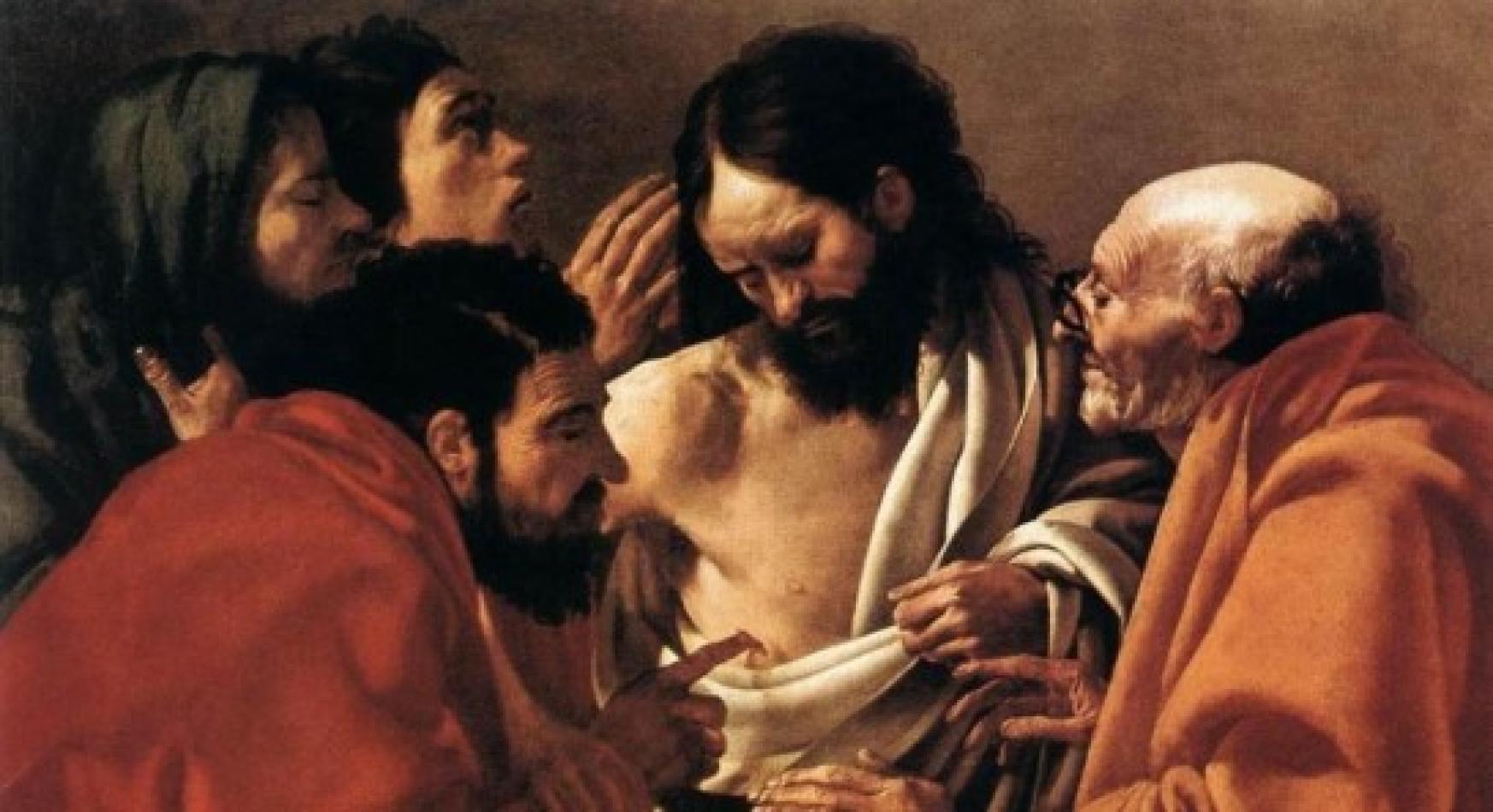
This uncertainty allows us to say that Thomas is “the twin of each one of us” (Don Tonino Bello). Thomas comforts us in our doubts as believers. In him we see ourselves reflected and, through his eyes and his hands, we too “see” and “touch” the body of the Risen One. An interpretation that has its charm.
Thomas, a “double”?
In the Bible, the most famous pair of twins is Esau and Jacob (Genesis 25:24–28), eternal antagonists, expressing the dichotomy and polarity of the human condition. Could it be that Thomas (the “double”) carries within himself the antagonism of this duality?
Thomas is capable of acts of great generosity and courage, as when he says: “Let us also go, that we may die with him!”, after Jesus decides to go to Judea to raise Lazarus (John 11:16). Yet at other times he appears incredulous and stubborn, as we see in today’s Gospel passage, refusing to believe the testimony of his companions who had seen the Lord. Thomas, the generous disciple, carries within him his “twin”, incredulous and obstinate. However, when confronted with the risen Christ, he makes the highest profession of faith.
Thomas is an image of all of us. We too carry within us this “twin”, inflexible and a staunch defender of his own ideas, rebellious and capricious in his attitudes. These two realities or “creatures” (the old and the new Adam) coexist uneasily, in tension, sometimes in open conflict, within our hearts. All of us have experienced the suffering of this inner division.
Yet Thomas has the courage to face this reality. He allows his darker, opposing and unbelieving side to emerge and brings it into confrontation with Jesus. He accepts the challenge posed by his rebellious inner self, which demands to see and to touch. He brings it to Jesus and, faced with the evidence, the “miracle” happens: the two Thomases become one and proclaim the same faith: “My Lord and my God!”
Unfortunately, this is not what often happens with us. Our Christian communities are frequently attended by the “good twins”, compliant but also… passive and lifeless. The fact is that we are not there, during the Eucharistic celebration, in our full entirety. The energetic, instinctive part, the so-called other twin — the one who most needs to be evangelised — does not appear at the encounter with the Lord.
Jesus said that he came for sinners, yet our churches sometimes seem to be frequented rather by the “righteous”, who… do not feel the need to be converted! We are present at the Eucharist, but perhaps out of habit, without real and deep involvement. The one who ought to be converted — our dimension of unbelief or unfaithfulness, that is, our sinful twin — we quietly leave at home. It is Sunday and he takes the opportunity to “rest”, entrusting the day to the “good twin”. On Monday, then, the twin of instincts and passions will be in full form to take command again.
Jesus in search of Thomas
If only Jesus had many Thomases! In the Sunday celebration, it is above all them whom the Lord comes seeking. They will be his twins! God seeks real men and women, who relate to him as they are: sinners who experience in their own flesh the tyranny of instincts. Believers who are not ashamed to appear with this unbelieving and grace-resistant part, but who come to meet the Physician of Divine Mercy and to be healed. It is of these that Jesus makes himself a brother!
The world needs the witness of honest believers, capable of recognising their own errors, doubts and difficulties, and who do not hide their “duplicity” behind a façade of pharisaical respectability. Evangelisation today requires Christians who are authentic persons, not “stiff-necked”, who look squarely at the reality of suffering and who touch with their own hands the wounds of today’s crucified.
In summary, Thomas invites us to reconcile our duplicity in order to live Easter authentically. This involves becoming aware of the division that often dwells within us and, with the help of grace, striving to unify our believing heart. This requires that, at the Sunday Eucharist, our whole person truly be present.
This is what Jesus expresses, in symbolic form, in the apocryphal Gospel of Thomas (nos. 22 and 27): “When you make the two one, when the inside is like the outside and the outside like the inside, and the above like the below, and when you make the male and the female into a single reality (…) then you will enter the Kingdom.”
P. Manuel João Pereira Correia, mccj
GOSPEL REFLECTION
John 20:19-31
Today’s passage is divided into two parts corresponding to the appearances of the Risen One. In the first (vv. 19-23), Jesus communicates his Spirit to his disciples. With that, he gives them the power to overcome the forces of evil. It is the same passage that we will find and will comment on at Pentecost. In the second (vv. 24-31), the famous episode of Thomas is told.
The doubt of this apostle became proverbial. It is often said when one shows some distrust “You’re unbelieving as Thomas.” Yet, in hindsight, he seems to have done nothing wrong: he only asked to see what others had seen. Why demand only from him a faith based on the word?
But was Thomas really the only one to have doubts, while the other disciples would have easily and immediately believed in the Risen One? It does not seem that things went that way.
The Gospel of Mark says that “Jesus appeared to the eleven and rebuked them for their unbelief and hardness of heart because they had not believed those who had seen him risen” (Mk 16:14). In Luke’s Gospel, the Risen Christ addresses the amazed and frightened apostles and asks: “Why are you troubled, and why do doubts arise in your hearts?” (Lk 24:38). In the last page of the Gospel of Matthew it even says that when Jesus appeared to the disciples on a mountain in Galilee (therefore long after the apparitions in Jerusalem), some still doubted (Mt 28:17).
All, therefore, doubted, not only the poor Thomas. How is it then that the evangelist John seems to want to focus on him the doubts that have gripped the others? Let us try to understand.
When John writes (about the year 95 A.C) Thomas was already dead for some time. The episode, therefore, is certainly reported not to put this apostle in a bad light. If his problems of faith were highlighted, the reason is another. The evangelist wants to respond to the questions and objections that Christians of his communities insistently raised. It is the third generation Christians, people who have not seen the Lord Jesus. Many of them do not even know any of the apostles. They find it hard to believe; they are struggling in the midst of many doubts; they would like to see, touch, and verify if the Lord is truly risen. They wonder: what are the reasons that may lead one to believe? Is it still possible for us to have the experience of the Risen Lord? Are there evidences that he is alive? How is it that he no longer appears? These are the questions that we ourselves ask today.
To them, Mark, Luke, and Matthew respond by saying that all the apostles had hesitations. They did not get it right away nor with ease believed in the Risen One. The path of faith was long and tiring also for them, even though Jesus had given many signs that he was alive and had entered into the glory of the Father.
The answer of John is different: he takes Thomas as a symbol of the difficulty that every disciple meets to come to believe. It is hard to know the reason why he chose this apostle. Perhaps because he had more difficulty or took more time than others to have faith.
That which John wants to teach the Christians of his communities (and us) is that the Risen One has a life that escapes our senses; a life that cannot be touched with bare hands or seen with the eyes. It can only be achieved through faith. This also applies to the apostles, who have had a unique experience of the Risen Lord.
One cannot have faith in what is seen. You cannot have demonstrations, pieces of scientific evidence of the resurrection. If anyone wants to see, observe, touch, one must renounce his faith.
We do not say, “Blessed are those who have seen.” For Jesus, however, blessed are those who have not seen, not because it costs them more to believe and thus have greater merits. They are blessed because their faith is the most genuine and the purest. Indeed, it is the only pure faith. While the one who sees has the certainty of the evidence and has irrefutable proof of a fact.
Thomas appears two more times in John’s Gospel and never cuts—we would say—a good figure. He always has difficulty in understanding, equivocating, misinterpreting the words and choices of the Master.
He speaks for the first time when he received the news of Lazarus’ death. Jesus decides to go to Judea. Thomas thinks that following the Master means losing one’s life. He does not understand that Jesus is the Lord of life. Dejected and disappointed, he exclaims: “Let us also go, to die with him” (Jn 11:16).
During the last supper, Jesus talks about the path he is treading, a path that passes through death to be introduced into life. Thomas intervenes again: “Lord, we do not know where you’re going and how can we know the way?” (Jn 14:5). He is full of perplexity, hesitation, and doubt, unable to accept what he does not understand. This is demonstrated for a third time in the episode narrated in today’s passage.
It seems that John enjoys outlining in this way the figure of Thomas. In the end, he does him justice. He puts on his lips the highest, the most sublime profession of faith. His words reflect the conclusion of the disciples’ itinerary of faith.
At the beginning of the Gospel, the first two apostles come to Jesus calling him Rabbi (Jn 1:38). It’s the first step towards the understanding of the Master’s identity. After a short time, Andrew, who has already figured out a lot more, says to his brother Simon: “We have found the Messiah” (Jn 1:41). Nathaniel intuits immediately with whom he deals and says to Jesus: “You are the Son of God” (Jn 1:49). The Samaritans recognize him as the Savior of the world (Jn 4:43), the people acknowledge him as the prophet (Jn 6:14), the man born blind proclaims him the Lord (Jn 9:38), for Pilate he is the King of the Jews (Jn 19:19). But it’s Thomas who says the last word about the identity of Jesus. He calls him: “My Lord and my God” (v.28). It is an expression that the Bible refers to YHWH (Ps 35:23). Thomas is, therefore, the first to recognize the divinity of Christ, the first who comes to understand what Jesus meant when he said: ‘I and the Father are One” (Jan 10:30).
The end of the passage (vv. 30-31) presents the reason why John wrote his book. He spoke of the “signs”—not all, but sufficient ones—for two reasons: to arouse or confirm the faith in Christ and why, through this faith, one comes to life.
The fourth evangelist calls miracles signs. Jesus did not perform them to impress whoever was there. He even had words of condemnation against anyone who did not believe unless he saw miracles (Jn 4:48). John does not tell them to impress his readers, to “show” the divine power of Jesus.
The signs are not evidences, but revelations about the person, nature, and mission of Jesus. One who comes to believe in a robust and long-lasting way, from the material fact, rises to the reality that it indicates. It does not include the sign which, in the distribution of the loaves, does not capture that Jesus is the bread of life, or in the healing of the man born blind, does not recognize that Jesus is the light of the world, or in the resuscitation of Lazarus, does not see in Jesus the Lord of life.
In the epilogue of the Gospel, John uses the word signs in a broad sense: it means all the revelation of the person of Jesus, his acts of mercy (the healing, the multiplication of the loaves) and his words (Jn 12:37). Whoever reads his book and understands these signs clearly confronts the person of Jesus and is invited to make a choice. Whoever recognizes in him the Lord will opt for life and adhere to him.
Here is the only evidence that is offered to one who looks for reasons to believe: the same Gospel. There the Word of Christ resounds, and his person shines. There are no other proofs outside this same Word.
To understand, it is worthwhile to refer to what Jesus said in the parable of the Good Shepherd: “My sheep recognize my voice” (Jn 10:4-5, 27). Apparitions are not necessary. In the Gospel, the voice of the shepherd resonates. For the sheep that belong to him, his unmistakable voice is enough to recognize and to draw it to him.
But where can one listen to this voice? Where does this word echo? Is it possible to repeat today the apostles’ experience on Easter day and “eight days later” (v.26)? How?
We definitely have noticed that both apparitions take place on a Sunday. We also have noticed that those who make the experience of the Risen One are the same (… one more, one less), that the Lord presents himself with the same words: “Peace be with you” (v.21) and that, in both encounters, Jesus shows the marks of his passion. There would be other details, but these four are enough to help us answer the questions we posed.
The disciples are gathered in the house. The meeting to which John alludes is clearly that which happens on the day of the Lord. It’s the one in which every eighth day, the whole community is called for the celebration of the Eucharist. When all believers are gathered together, there appears the Risen One. He, by the mouth of the celebrant, greets the disciples and wishes, as on the evening of Easter, and eight days later: “Peace be with you” (v. 26).
It is the time when Jesus manifests himself alive to the disciples. The one who deserts the meetings of the community like Thomas, cannot have the experience of the Risen Lord (vv. 24-25). He cannot hear his greeting and his word; he cannot accept his forgiveness and his peace (vv. 19,26,23), nor experience his
his greeting and his word; he cannot accept his forgiveness and his peace (vv. 19,26,23), nor experience his joy (v. 20) and receive his Spirit (v. 22). Whoever, on the day of the Lord stays home, maybe to pray alone, can experience God, but not the Risen One, because he makes himself present where the community is gathered.
What does one, who does not meet the Risen One, do? Like Thomas, he will have a need for evidences in order to believe, but he will never obtain them.
Contrary to what one sees depicted in the paintings of the artists, not even Thomas has put his hands into the wounds of the Lord. From the text, it does not appear that he has touched the Risen One. He also gets to pronounce his profession of faith after hearing the voice of the Risen One, along with his brothers and sisters of the community. And the ability to make this experience is offered to Christians of all times, every eight days.
Fernando Armellini
Italian missionary and biblical scholar