
Daniel Comboni
Comboni Missionaries
Institutional area
Other links
Newsletter
6th Sunday of Easter – Year A: Fertilised by the Holy Spirit



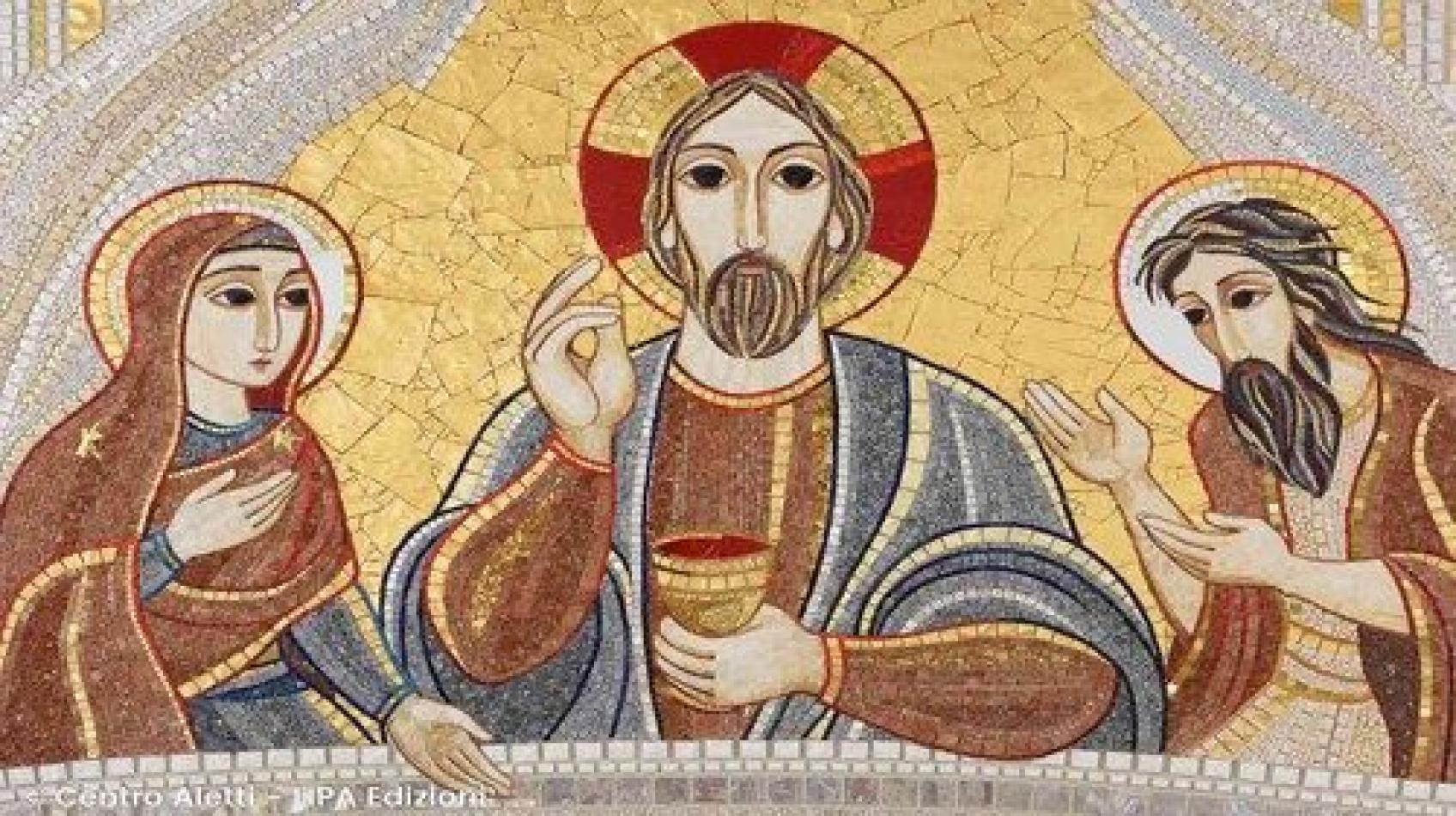
Two weeks of Eastertide remain. Next Sunday we shall celebrate the Ascension of the Lord, and on the following Sunday, Pentecost. The Word of God invites us to turn our gaze towards these appointments. (...)
“I shall ask the Father, and he will give you another Paraclete.”
John 14:15-21
Two weeks of Eastertide remain. Next Sunday we shall celebrate the Ascension of the Lord, and on the following Sunday, Pentecost. The Word of God invites us to turn our gaze towards these appointments.
Today Jesus promises us the gift of the Spirit: “I shall ask the Father, and he will give you another Paraclete to be with you for ever, the Spirit of truth.” Jesus speaks five times of the sending of the Spirit in these farewell discourses. Four times he presents him as the “Paraclete”, a very rich Greek term indicating someone called to stand beside us to help us: a consoler, a defending advocate… Three times he describes him as the “Spirit of truth”.
Love, the “nest” of the Spirit
Jesus links the gift of the Holy Spirit to love: “If you love me…”. Love is the “nest” of the Spirit. The apostle Paul states: “The fruit of the Spirit is love, joy, peace, patience, kindness, goodness, faithfulness, gentleness, self-control” (Galatians 5:22). All these qualities are connected with love.
Today’s Gospel passage highlights love — five times — but, surprisingly, here Jesus speaks of love for his own person. The love which, in the Old Testament, was reserved for God (Deuteronomy 6:4-9), Jesus now claims for himself. John’s Gospel concludes with a threefold request for a profession of love, in which Peter represents each one of us: “Simon, son of John, do you love me?” (John 21:17). What an honour God grants us by asking for our friendship! God has the heart of one in love!
Jesus states that love for him is shown in keeping his commandments: “If you love me, you will keep my commandments.” Why does he speak of commandments in the plural? We may think that he is referring in general to his teachings to be cherished, but above all to the two inseparable dimensions of love: love of God and love of one’s brothers and sisters.
Love is the driving force of life. Saint Augustine said: “Let the root of love be within you, for from this root nothing but good can come. Love, and do what you will!” And the apostle Paul will say: “The love of Christ urges us on” (2 Corinthians 5:14).
“In”, the preposition of love
What draws our attention is Jesus’ insistence on the deep communion created by this love: a true mutual indwelling. “On that day you will know that I am in my Father, and you in me, and I in you.” Even though we find other expressions — “with you”, “beside you”, “among you” — the preferred one is “in you”, “in me”, “in the Father”. This preposition, in — ἐν, in Greek — occurs about 25 times in chapters 14 and 15, evoking deep intimacy, immanence and mutual indwelling.
Our heart is made to be inhabited. Indeed, to be fertilised. In every believer something of Mary’s mystery is renewed, she who “was found to be with child through the Holy Spirit” (Matthew 1:18). Origen of Alexandria, one of the greatest theologians of the first centuries and a father of Christian biblical exegesis (185-253), offers us one of the most powerful images of Christian life: “The Christian, as long as he is in this body, is like a pregnant woman: he carries within himself the Word of God” (In Exodum X, 10). Just as a pregnant woman carries her child in her womb but does not yet see him face to face, so the Christian carries Christ within himself through grace, while still “walking by faith, not by sight” (2 Corinthians 5:7).
Tribulations, difficulties and death itself are the pangs of childbirth. The Christian lives in the world, among people, like a woman pregnant with new life. “And the pregnant woman does not need to make proclamations: it is evident to everyone that there is a new life within her. As for a pregnant woman waiting is the most alive, happiest and most creative period, so it is for us: alive, creative, happy; as the pregnant woman is one and two at the same time, living a life made up of two lives, so the Christian is one and two,” comments Fr Ermes Ronchi.
Learning from the mystics in love
Perhaps we have not sufficiently interiorised this astonishing and wonderful reality: we are God’s dwelling place, inhabited by God, bearers of a new life generated in us by the Holy Spirit. Often we think of God “with” us, “beside” us, or sometimes far away or absent, and we forget that he is “in” us.
The mystics, however, understood this well. I offer the example of a seventeenth-century French mystic: Brother Lawrence of the Resurrection (Laurent de la Résurrection), a lay brother in a monastery of the Discalced Carmelites in Paris. The spirituality he lived and taught was very simple: to cultivate the sense of God’s presence through “the continual practice of this divine presence”, at every moment and in every circumstance, first as a cook and then as a cobbler in a large convent with more than a hundred friars:
“In the bustle of my kitchen, where at times several people speak to me at once about different things, I possess God as tranquilly as if I were on my knees before the Blessed Sacrament. It is not necessary to have great things to do. I turn my omelette in the pan for love of God, and when I have finished it, if there is nothing else left for me to do, I bow down to the ground and adore my God, who has granted me the grace to make it; after which I rise more joyful than a king.”
Although he walked with a limp because of a war wound, Brother Lawrence — “rough by nature and delicate by grace”, according to Fénelon — was punctual and precise in his duties, showing no signs of impatience or haste… But…
“If at times I am a little too absent from this divine presence, God immediately makes himself felt in my soul… with inner movements so charming and so delightful that I am ashamed to speak of them.”
Turn the daily omelette of your life too: it will not always be perfect, but it can always be seasoned with love.
Fr Manuel João Pereira Correia, MCCJ
GOSPEL REFLECTION
John 14:15-21
Even today’s Gospel, like last Sunday’s, is taken from the first of three farewell speeches given by Jesus at the Last Supper. The disciples have understood that Jesus is leaving them. They are sad and they ask themselves how they could continue to be united and to love him if he is gone. Jesus promised not to leave them alone, without protection and guidance. He said that he will pray to the Father, and he will “send the other Paraclete” who will always be with them (v. 16). It is the promise of the gift of that Spirit that Jesus possesses in fullness (Lk 4:1,14,18) and will be infused into the disciples.
Jesus clarifies (vv. 15,17) that the Spirit could be received only by those who are in accord with him, with his plans and his works of love. The world cannot receive it. What is this world to which the Spirit is not destined? Are they the pagans, those far away who do not belong to the group of the disciples or the members of other religions?
The world as Jesus intends it, is not the persons, but those parts in the heart of the person—of each person—wherein darkness, sin, and death reign. Where there is hatred, concupiscence, unregulated passion, there the world is present with its spirit contrary to that of Christ’s. Paul reminds the Corinthians of it as they allowed themselves to be guided by human wisdom.
The Spirit is called by two names. He is called the Comforter (Paraclito) and the Spirit of truth. These are the two functions he exercises on believers. Comforter is not a good translation of the Greek Parakletos. Paraclete is a term taken from the legal language and indicates the one who is called to be beside.
In ancient times, there was no establishment of lawyers; each defendant had to defend himself, trying to bring witnesses to exonerate the allegations. It happened sometimes that some, though not guilty, was unable to prove his innocence or that, despite having committed the crime, deserved forgiveness. For him, there remained one last hope: that in the midst of the assembly there would be a person honored by all for his moral integrity. That blameless person, without uttering any word, would get up and would go to place himself at his side. This gesture is equivalent to an acquittal. No one would have dared to ask for more condemnation. This “defender” is called the “Paraclete” that is, “one who is called to the side of another who finds himself in trouble.”
The meaning of this first title is, therefore, protector, helper, and defender. Jesus promises his disciples another Paraclete, since they already have one, he himself as John explains in his first letter: “My little children, I write you these things so that you may not sin; but if anyone does sin, we have a Paraclete by the Father’s side: the righteous Jesus Christ” (1 Jn 2:1). And Jesus is the Paraclete inasmuch as our advocate with the Father not because he defends us from his wrath, provoked by our sins (the Father is always on our side, as Jesus). He protects us against our accuser, our opponent, and against sin. The enemy is sin, and Jesus knows how to refute and reduce it to impotence.
The second Paraclete’s task is not to replace the first, but to fulfill a mission. In fact, he is sent together with Jesus who “returns” in the midst of his own (v. 18). Jesus is not going away; he simply changed the type of presence, no longer the physical one, but that of the Risen One. He is staying with his disciples is a new way, infinitely more real—even in its invisibility—more lasting and unlimited than before.
The Spirit is the Paraclete because he helps the disciples in their battle against the world, that is against the forces of evil (Jn 16:7-11). John reminds the Christians of his community of this truth so that, in the midst of the difficulties of life, they would not be discouraged, despaired, and would not lose their serenity, peace of heart and joy. The disciple believes in the assistance of the Spirit. He is not afraid, nor broken down even when he has to admit that there are still so many spiritual miseries, frailties, and so many evil inclinations. He is convinced of the strength of the Paraclete and he is sure not to be defeated.
The second title is the Spirit of truth, which sets out another function of the Paraclete. His work in the service of truth is expressed in various ways. Let’s start with the simplest. We all know what happens when a story goes from mouth to mouth. It is subject to deformations, is altered to such an extent as to become unrecognizable.
The message of Jesus is for all people. It must be preached until the ends of the world. Who assures us that it won’t be corrupted, won’t undergo deviant interpretations? Humanly speaking, the venture seems desperate. However, we have the certainty that all will be able to attain from the pure source of the Gospel. It is because in the Church, charged to announce it, the force of the Spirit of truth promised by Jesus is working.
His service to the truth is not limited to this part that we could call negative. He does not impede only errors that are introduced in the transmission of the message of Christ. He performs another positive function: he introduces the disciples to the fullness of the truth. There are truths that Jesus has not explicitly dealt with or that has developed in all its details because the disciples were not able to understand them (Jn 16:12-15). He knew that, along the centuries, there would arise new problems and questions. Where would authentic responses, conformed to his thoughts, be found?
Jesus promises the intervention of the Spirit also at this level: He is charged to introduce the disciples to the discovery of the whole truth. He will not say anything new or contrary to him. He will help to capture his message to the very end, until the very last consequences. The duty of Christians is to remain open to the impulse of the Spirit who always reveals new things. He is, by his nature, the one who renews the face of the earth (Ps 104:30). It is a sin against the Spirit (and very grave indeed cf. Mt 12:31) to oppose the renewal, to refuse the innovations that favor the life of the community, that bring people closer to Christ and to the brethren, that increase the joy and peace, that help people to pray better and free the heart from useless fears.
Those who stubbornly remains attached to already obsolete and worn out religious traditions, who are not diligently given to the study of the Word of God, who do not accept updating of rites, formulae, liturgical gestures, who give old answers to new problems, who do not accept with joy the discovery of biblical exegesis, they place themselves in opposition to the Spirit of truth.
For the evangelist John, the term truth has a more profound meaning. It indicates God who manifests himself in Jesus. He is the truth (Jn 14:6) because the total revelation of God is realized in him. To refuse him is a lie; it is a choice contrary to his truth. Satan, the enemy of the truth, the father of lies (Jn 8:44) is all that far from Christ.
The Spirit acts in an opposing way: he introduces the truth, acts in the intimacy of each person and does so, freely; he tends to choose Christ and adheres to his plans. He is like the wind that brings up towards upper grounds and brings in an irresistible way to salvation. It is difficult to imagine that the impulse of the Holy Spirit fails to introduce everyone in truth. Why doubt, however tenuous that doubt is, that this divine impulse towards life is stronger than the world, still present in each of us?
Fernando Armellini
Italian missionary and biblical scholar