
Daniel Comboni
Comboni Missionaries
Institutional area
Other links
Newsletter
Solemnity of Corpus Domini – Year A: Man hu? What is it?
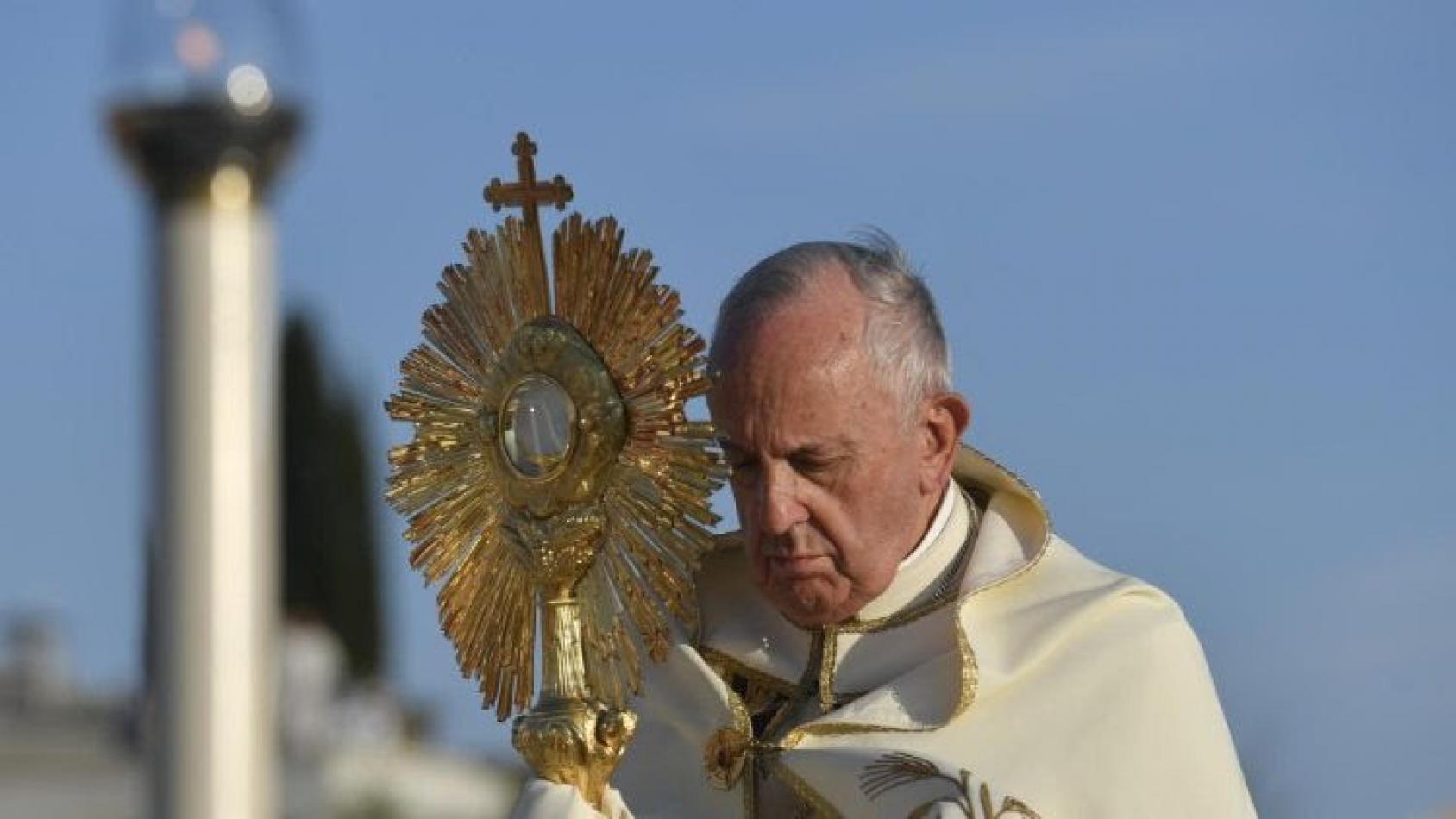
Sixty days after Easter, on the Thursday following the Solemnity of the Most Holy Trinity, the Church celebrates the Solemnity of the Most Holy Body and Blood of Christ — according to the Missal of Paul VI — also known as the feast of Corpus Christi, according to traditional usage. It is one of the three most solemn Thursdays of the liturgical year: Maundy Thursday, Ascension Thursday and Corpus Christi Thursday. [...]
“I am the living bread which came down from heaven.”
John 6:51-58
Sixty days after Easter, on the Thursday following the Solemnity of the Most Holy Trinity, the Church celebrates the Solemnity of the Most Holy Body and Blood of Christ — according to the Missal of Paul VI — also known as the feast of Corpus Christi, according to traditional usage. It is one of the three most solemn Thursdays of the liturgical year: Maundy Thursday, Ascension Thursday and Corpus Christi Thursday. For pastoral reasons, in many countries this solemnity is transferred to the Sunday following the Most Holy Trinity. Although Eastertide has already come to an end, this chronological reference establishes a profound link between the feast of Corpus Christi, Easter and the Solemnity of the Most Holy Trinity.
The origins of this feast date back to the thirteenth century. Born within the context of the Eucharistic devotion that developed in Belgium, particularly through the inspiration of Saint Juliana of Cornillon, it was extended to the whole Church by Pope Urban IV in 1264. The Eucharistic miracle of Bolsena, which took place the previous year, was also of great significance in this process. Through these signs, the Lord wished to strengthen the Church’s faith in his real presence in the sacrament of the Holy Eucharist, precisely at a time when some were calling it into question.
Eucharistic miracles are numerous, many of them documented over the centuries. Saint Carlo Acutis, a teenager who died at the age of 15 (1991-2006), was an enthusiastic promoter of them. A great lover of the Eucharist, he called it “the motorway to heaven”.
1. “Remember… Do not forget!”
The first word that resounds in our ears in today’s readings is: Remember. “Remember all the way which the Lord your God has led you these forty years in the wilderness” (Dt 8:2). It is a most timely and urgent invitation for us, women and men of a generation often inclined to forget the past, alienated in the present, uprooted from history and, consequently, little attentive to a future that does not offer an immediate return.
This cultural tendency also risks undermining Christian identity. Nelson Mandela said: “Memory is the fabric of identity.” A Christian, and a Christian community, that do not cultivate the memory of God and of his works risk losing their own identity. If the people of Israel did not keep alive the memory of the liberating God, they would be tempted to return to “Egypt” and fall back into a new slavery. That is why Moses, in Deuteronomy, insists so strongly on the pair listening/remembering (cf. Dt 6:4-10,12; 8:2,14,18).
The Eucharist is our memorial par excellence: “Do this in memory of me. For as often as you eat this bread and drink the cup, you proclaim the death of the Lord until he comes” (cf. 1 Cor 11:23-26). Of a community that celebrates the Eucharist without memory warming the heart, one must ask whether it has not “abandoned its first love” (Rev 2:4). Trapped in the present, the impulse towards awaiting the Lord who comes is then lost. The invocation of the Spirit and the bride — “Come!” — no longer rises to our lips (Rev 22:17). Hope grows faint and the meaning of Christian life is lost.
2. One bread, one body
The second reading underlines the profound link between the Eucharist, the Church and the community: “Because there is one bread, we, though many, are one body” (1 Cor 10:16-17). The communal dimension of the Eucharist was particularly emphasised after the Second Vatican Council: “No Christian community can be built up unless it has […] as its root and centre the celebration of the Most Holy Eucharist” (Presbyterorum Ordinis, 6).
I do not know to what extent this awareness has been assimilated by our liturgical assemblies, if we look even only at the physical dispersion of the faithful in our churches. At times one has the impression that the Eucharist is still, for some of us, an “individual affair”, a kind of spiritual “consumer good”.
Since 13 October 2020, because of illness, I have not been able to receive communion directly in the Body and Blood of Christ. Celebrating Holy Mass every day with my confrères has led me to reflect more deeply on the communal dimension of the Eucharist: one Bread and one Body. This Body is the Church, it is the community. Christ gives himself to the whole Body. My confrères are the body to which I belong and which, also on my behalf, receives the Body of Christ. This applies to me as it does to all Christians who celebrate the Eucharist.
3. Manna, man hu? What is it?
The manna that nourished the people of Israel in the wilderness is a figure of the Eucharist, the Bread essential for our survival. Traditionally it is held that the term manna comes from the question man hu?, that is: “What is it?”, which the Israelites asked themselves, full of wonder, when they saw it come down from heaven.
Well then, Jesus tells us today: “This is the bread that came down from heaven” (Jn 6:58). He is the true manna. The Jews who listened to him were scandalised. We are not — perhaps, unfortunately! We take all this for granted. But how seriously do we take it?
The eyes of the body see a small and fragile piece of bread. But the eyes of the heart, the eyes of faith, what do they see? This is truly something we must ask ourselves. We cannot underestimate the influence of a secularised mentality, often allergic to the dimension of mystery, nor that of a reductive view of the Eucharist, which risks obscuring its real presence.
May the Lord open our eyes, as he did with the two disciples of Emmaus, so that we may recognise him in the breaking of the Bread.
Spiritual exercise for the week
-
Before receiving communion, look with awe and wonder at the Bread placed in your hand and ask yourself: Man hu? What is it? And the Lord will answer you: It is my Body!
-
Meditate on these provocative questions of Pope Francis:
“If we look around us, we realise that there are many offers of food that do not come from the Lord and that apparently satisfy us more… Each one of us, today, can ask: and me? Where do I want to eat? At which table do I want to nourish myself? At the Lord’s table? Or do I dream of eating tasty foods, but in slavery? Furthermore, each one of us can ask: what is my memory? That of the Lord who saves me or that of the garlic and onions of slavery? With which memory do I satisfy my soul?” (19 June 2014).
Fr Manuel João Pereira Correia, MCCJ
The Sacrament of Memory
John 6:51-58
On this Solemnity of Corpus Domini, the idea of memory comes up again and again. Moses says to the people: “You shall remember all the way which the Lord your God has led you…. Lest… you forget the Lord your God, who fed you in the wilderness with manna” (Dt 8:2, 14, 16). Jesus will tell us: “Do this in memory of me” (1 Cor 11:24). Saint Paul will tell his disciple: “Remember Jesus Christ” (2 Tim 2:8). The “living bread, come down from heaven” (Jn 6:51) is the sacrament of memory, reminding us, in a real and tangible way, of the story of God’s love for us.
Today, to each of us, the word of God says, Remember! Remembrance of the Lord’s deeds guided and strengthened his people’s journey through the desert; remembering all that the Lord has done for us is the foundation of our own personal history of salvation. Remembrance is essential for faith, as water is for a plant. A plant without water cannot stay alive and bear fruit. Nor can faith, unless it drinks deeply of the memory of all that the Lord has done for us. “Remember Jesus Christ”.
Remember. Memory is important, because it allows us to dwell in love, to be mind-ful, never forgetting who it is who loves us and whom we are called to love in return. Yet nowadays, this singular ability that the Lord has given us is considerably weakened. Amid so much frantic activity, many people and events seem to pass in a whirl. We quickly turn the page, looking for novelty while unable to retain memories. Leaving our memories behind and living only for the moment, we risk remaining ever on the surface of things, constantly in flux, without going deeper, without the broader vision that reminds us who we are and where we are going. In this way, our life grows fragmented, and dulled within.
Yet today’s Solemnity reminds us that in our fragmented lives, the Lord comes to meet us with a loving “fragility”, which is the Eucharist. In the Bread of Life, the Lord comes to us, making himself a humble meal that lovingly heals our memory, wounded by life’s frantic pace of life. The Eucharist is the memorial of God’s love. There, “[Christ’s] sufferings are remembered” (II Vespers, antiphon for the Magnificat) and we recall God’s love for us, which gives us strength and support on our journey. This is why the Eucharistic commemoration does us so much good: it is not an abstract, cold and superficial memory, but a living remembrance that comforts us with God’s love. A memory that is both recollection and imitation. The Eucharist is flavoured with Jesus’ words and deeds, the taste of his Passion, the fragrance of his Spirit. When we receive it, our hearts are overcome with the certainty of Jesus’ love.
The Eucharist gives us a grateful memory, because it makes us see that we are the Father’s children, whom he loves and nourishes. It gives us a free memory, because Jesus’ love and forgiveness heal the wounds of the past, soothe our remembrance of wrongs experienced and inflicted. It gives us a patient memory, because amid all our troubles we know that the Spirit of Jesus remains in us. The Eucharist encourages us: even on the roughest road, we are not alone; the Lord does not forget us and whenever we turn to him, he restores us with his love.
The Eucharist also reminds us that we are not isolated individuals, but one body. As the people in the desert gathered the manna that fell from heaven and shared it in their families (cf. Ex 16), so Jesus, the Bread come down from Heaven, calls us together to receive him and to share him with one another. The Eucharist is not a sacrament “for me”; it is the sacrament of the many, who form one body, God’s holy and faithful people. Saint Paul reminded us of this: “Because there is one bread, we who are many are one body, for we all partake of the one bread” (1 Cor 10:17). The Eucharist is the sacrament of unity. Whoever receives it cannot fail to be a builder of unity, because building unity has become part of his or her “spiritual DNA”. May this Bread of unity heal our ambition to lord it over others, to greedily hoard things for ourselves, to foment discord and criticism. May it awaken in us the joy of living in love, without rivalry, jealousy or mean-spirited gossip.
Now, in experiencing this Eucharist, let us adore and thank the Lord for this greatest of gifts: the living memorial of his love, that makes us one body and leads us to unity.
Pope Francis