
Daniel Comboni
Comboni Missionaries
Institutional area
Other links
Newsletter
16th Sunday in Ordinary Time – Year A: Three Scandalous Parables!

‘The kingdom of heaven is like…’. After the parable of the sower, which we heard last Sunday, today’s Gospel presents us with three more parables that reveal the mystery of the presence of the kingdom of heaven among us. We are in chapter 13 of the Gospel according to Matthew, in what is commonly known as the ‘discourse in parables’. (...)
Three Scandalous Parables!
Matthew 13:24–43: the parables of the darnel, the mustard seed and the leaven
‘The kingdom of heaven is like…’. After the parable of the sower, which we heard last Sunday, today’s Gospel presents us with three more parables that reveal the mystery of the presence of the kingdom of heaven among us. We are in chapter 13 of the Gospel according to Matthew, in what is commonly known as the ‘discourse in parables’.
Jesus continues to speak through the wisdom of parables, which is accessible to everyone, because the kingdom of God is not an abstract reality enclosed within philosophical concepts or theological formulations. It is a living reality, close to all who have ‘eyes to see’ and ‘ears to hear’.
1. The parable of the wheat and the darnel: the scandal of evil!
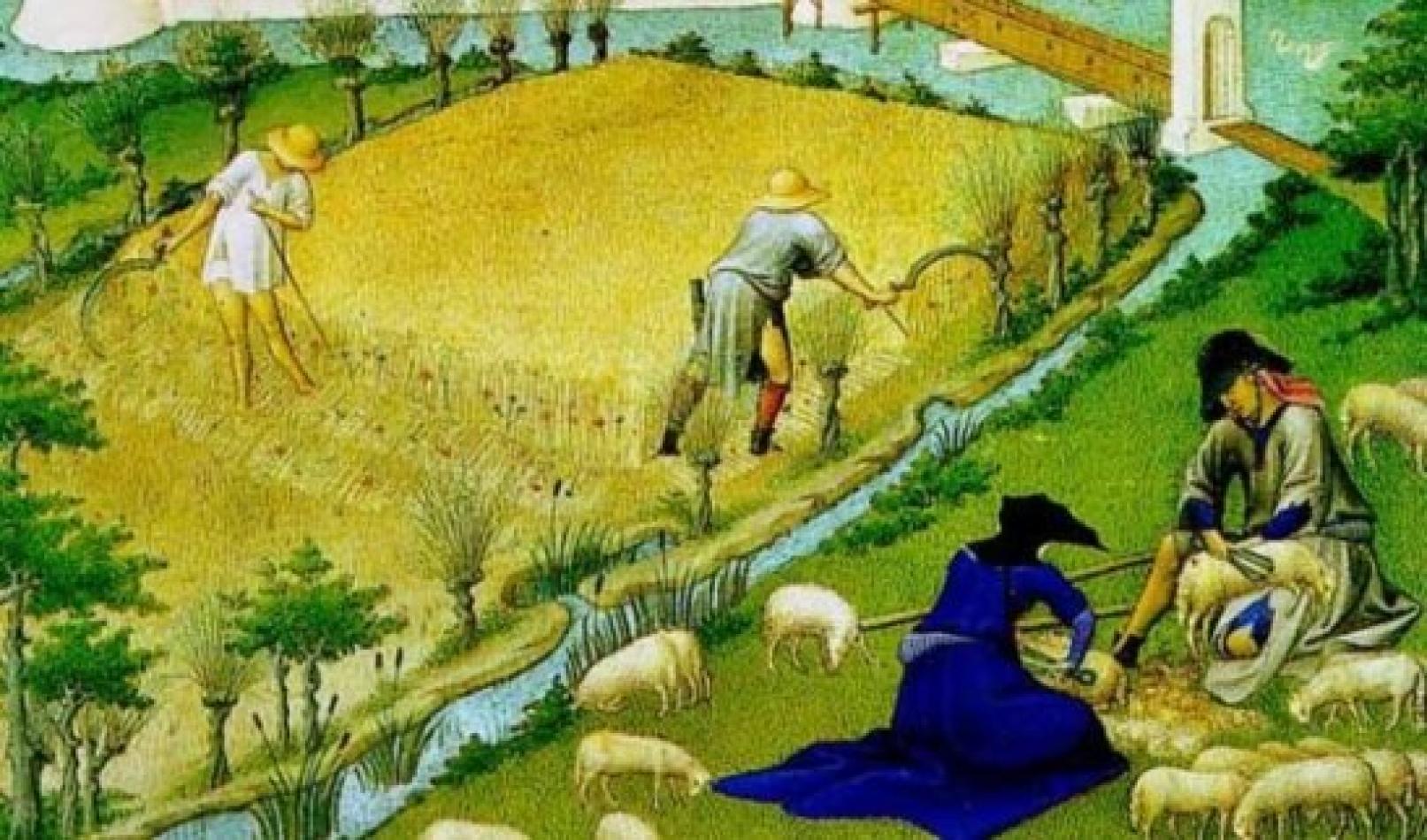
A field, the sowing of good wheat and the unpleasant surprise of darnel! Darnel is a plant that closely resembles wheat, but its dark grains are toxic and can have narcotic effects. The text speaks of ‘darnels’ in the plural, as though to remind us how numerous are the forms in which evil manifests itself in the field of the world.
We too know this bitter surprise very well: in the reality of the world, the Church, the family and our own lives.
Our first reaction is to question the landowner: ‘Sir, was it not good seed that you sowed in your field? If so, where does the darnel come from?’ Sowing the seed was, after all, the responsibility of the master of the house. Are you not, Lord, the Creator of a beautiful and good world? Where, then, does evil come from? God is almost always the first to be accused in our complaints.
Our second reaction is immediate: ‘Do you want us to go and pull it up?’ We want a field cleared of every weed! But the landowner’s answer is disconcerting: ‘No, because when you weed out the darnel you might pull up the wheat with it. Let them both grow together until the harvest.’
But how can this be?! Does the prophet not say, ‘Your people will all be righteous’ (Isaiah 60:21)? Did John the Baptist not say that the axe was already laid to the root of the trees and that the Messiah would come to baptise with fire, to gather the wheat and burn the chaff in a fire that would never go out (cf. Matthew 3:10–12)?
The apostles ask for an explanation of the parable, perhaps not because they have failed to understand it, but because they find it difficult to accept. And so do we!
Our dream, in a certain sense, is the dream of the prophet Elijah and of John the Baptist: to burn the darnel and the chaff immediately. Yet, as Saint Augustine reminds us, God alone truly knows those who belong to him. Good and evil, in fact, do not coexist only in the world; they also pass through the heart of each one of us. To uproot evil too hastily might mean wounding or destroying the good that is still growing.
There have never been any shortage of ‘zealots’ in the history of the Church. How many condemnations, pronounced without discernment, have ended up treating everyone alike and causing tragic consequences! This is why God reserves the role of judge for himself. God’s judgement seeks to justify and save; ours, all too often, condemns and kills.
2. The parable of the mustard seed: the scandal of smallness!
Immediately afterwards, Jesus adds another parable: ‘The kingdom of heaven is like a mustard seed […] the smallest of all the seeds, but when it has grown it is bigger than the other plants in the garden and becomes a tree.’
The black mustard plant of Palestine, from which a very flavoursome condiment is obtained, can grow into a large shrub, reaching a height of three or even four metres, especially in the region around the Sea of Galilee. Through the contrast between ‘the smallest of all the seeds’ and ‘the largest of the garden plants’, Jesus wishes to emphasise the astonishing growth of the kingdom of God.
There is, however, something unusual about this comparison. Mustard is a tenacious, almost invasive plant: its tiny seeds spread easily and reach everywhere. Moreover, in the Bible, mustard appears only in the words of Jesus, in this parable and in his teaching about the faith capable of moving mountains (cf. Matthew 17:20).
Perhaps Jesus is also alluding to the prophecy of Ezekiel 17:22–23, in which God takes a tender shoot from the top of a cedar and plants it on a high mountain of Israel. It becomes a magnificent cedar, beneath whose branches all the birds come to dwell, symbolising the peoples of the earth.
Yet the smallness of the mustard seed could not satisfy the expectations of Jesus’ listeners, who were awaiting a visible, powerful and imposing messianic kingdom. This smallness scandalises us too, because we would prefer clearer and more extraordinary signs of God’s presence.
3. The parable of the leaven: the scandal of humility!
‘He told them another parable: “The kingdom of heaven is like the leaven a woman took and mixed into three measures of flour, until the whole batch was leavened.”’
Three measures of flour correspond to about forty kilograms: an enormous quantity, capable of feeding a great many people. Yet that entire mass is made to rise by a small amount of leaven, which works silently and disappears into the dough.
The kingdom, hidden within history, is leavening the world. It is a discreet, humble, gentle and mysterious presence, which contrasts with our desire for visibility, our longing to be recognised and our wish to matter in public life.
The kingdom, by contrast, makes no noise.
This is God. This is love!
For our reflection this week
Let us now try to apply these parables to our lives.
The parable of the darnel warns us against the temptation to demand a community made up exclusively of perfect people. This temptation can reveal itself in our intolerance towards those who make mistakes, but also in our perfectionism, which is unable to accept our personal limitations.
Do I believe in God the Father, who is patient and merciful towards everyone?
The parable of the mustard seed warns us against the temptation of greatness. In our imagination, God is above all the Almighty; yet, in Jesus, he made himself as vulnerable as we are.
Do I believe in Jesus, who made himself small and chose humble means to establish the kingdom?
The parable of the leaven warns us against the temptation of seeking attention and prominence. It invites us to act with humility and without seeking recognition.
Do I believe in the action of the Spirit, who is quietly leavening the dough of the world?
Fr Manuel João Pereira Correia, MCCJ
GOSPEL REFLECTION
Matthew 13:24-43
With three other parables, Jesus gradually reveals the mystery of the kingdom of heaven. The first—that of the wheat and the tares (vv. 24-30)—gets an explanation (vv. 36-43) as that of the last Sunday’s sower. This is a preacher’s sermon at the time of Matthew. The two other parables—that of the mustard seed and the leaven (vv. 31-33)—are told to emphasize the irresistible force of good. The retake of vv. 34-35 was said in vv. 10-17 which clarifies the reason why Jesus speaks in parables. Let’s look at the main parts of the passage.
Where does the weed come from? (vv. 24-30).
The already existing evil—which humans have never been able to give a satisfying answer—is a distressing problem. In addition to this, Matthew’s Christian communities had to deal with a second one, no less serious. Fifty years had passed since the death and resurrection of Jesus. They looked around themselves and realized that evil was still present and continued to increase and flourish. Why is it that the kingdom of heaven, inaugurated by Jesus, never had a total and immediate success?
The question was embarrassing. Someone formulated it in ironic and provocative terms: “Since our fathers in faith died, everything still goes on, as it was from the beginning of the world” (2 Pt 3:4).
The enigma of the existence of evil demands an explanation. The evangelist gives it with a parable of Jesus.
The first character in the scene is the owner. He represents God. He is the one who sows or in any event, the one responsible for the quality of the seed, defined as “good” (v. 24). This is not a mundane adjective. It explicitly recalls the refrain that is repeated ten times in the first chapter of Genesis: “And God saw that it was good.” Everything that God has done was good: not in the sense that cataclysms and natural disasters did not happen, that there was no pain, sickness, and death, but it was all good because it perfectly suited to fulfill the plans of the Lord.
Creation is good as the seed of the word announced by Jesus is good.
The second character is the enemy. He represents the logic of this world, the anti-evangelical mentality. He comes at night and, while everyone is asleep, sowing tares, a kind of weed very similar to grain. It grows to a height of 60 cm and produces an ear containing blackish grains; its roots are intertwined with those of the wheat and are impossible to eradicate without tearing that too.
It is when the minds are numbed from sleep when vigilance is loosened when one abandons oneself to dissipation and frivolity that the enemy finds a way to hack into the field to sow evil. An oversight is enough, and one ends up adapting to current morality. The principles of this world are assimilated. It is not easy, at first, to become aware of what happened. Evil, in fact, often disguises itself as “an angel of light” (2 Cor 11:14). Later on, when one looks at the results, he becomes aware of the germ of death that penetrated into the minds and hearts. That’s why Paul advises: “You know what hour it is. This is the time to awake for our salvation is now, nearer than when we first believed. The night is almost over and the day is at hand” (Rom 13:11-12).
The third characters are the servants. We find them amiable because they represent us. Their reaction—a mixture of astonishment and bewilderment in finding the presence of the darnel—is what we experience when we realize the existence of evil in the world, in the Christian community, in every person. The exciting dialogue with the master is moving. It shows their interest in the field, their commitment to production. They do not seem strangers but family members.
It is at this point that the central message of the parable is inserted: their passion for the cause of good involves them to the point of proposing a reckless action. They are taken by impatience, the anxiety of immediately getting rid of the darnel. They have no hesitation; they want an immediate and strong intervention.
The owner does not lose control; he keeps calm. He is not surprised about the incident. He is not moved and does not share their restlessness. The perspective of God is represented in his answer (which occupies more than a third of the story). In this world, good and evil are not separated. They are destined to grow together until the end.
Why can’t the times be speeded up? If God is almighty why does he not immediately eliminate every trace of evil?
Perhaps, he is not as omnipotent as we imagine. The Bible never gives him this title. It calls him powerful (Lk 1:49) or Pantokrator (Rev 1:8), which does not mean “one who can do what he wants,” but “the one to whom nothing gets out of hand.” The human being is free and God wanted to start “a love story” with him from which he could also come out defeated. His project contemplates the presence of evil, which must be serenely accepted, as a component of life. Believing that he is Pantokrator means feeding the belief that he will cleverly lead this “love story” with every person and that the last, decisive and winning word, however, will be his.
The presence of weeds in us than in others enormously irks. It costs us to admit that “there is no righteous man on earth who always does good and never sins” (Ecl 7:20). We would like to lull ourselves in the illusion of being perfect. We would like to have a confirmation of the high image that we have made of ourselves. Evil is not to be justified, of course, but Jesus urges us to consider it with the calm and patient eyes of God.
The amazing growth of the kingdom of heaven (vv. 31-35).
In the parable of the wheat and the weeds, other two short ones follow. They are called “twins” because they contain the same message: the disproportion between the small beginning and the unexpected, an amazing final result. A grain of mustard seed, almost invisible, gives rise to a shrub that can reach four feet in height; a few grams of yeast makes fifty pounds of flour rise. The contrast is enormous.
It’s not the invited who enjoys the present prestige and foretastes the future triumphs of the Church, which began with a group of unskilled fishermen who themselves were impure and sinful people. In time, it became a prevailing structure which is respected, feared, appreciated, and noticed. It’s not even an announcement of the progressive and relentless Christianization of the whole world.
As the preceding parable urged for patience and trust, these two are an invitation for optimism arising from the certainty that in the Spirit and the Word of Christ—although insignificant in the eyes of the world—the irresistible force of God is present.
The evangelist concludes the three parables with a reflection on the goal which Jesus wanted to achieve: to unveil God’s project for the world since the moment of creation (vv. 34-35).
The serene acceptance of evil does not mean disengagement (vv. 36-43).
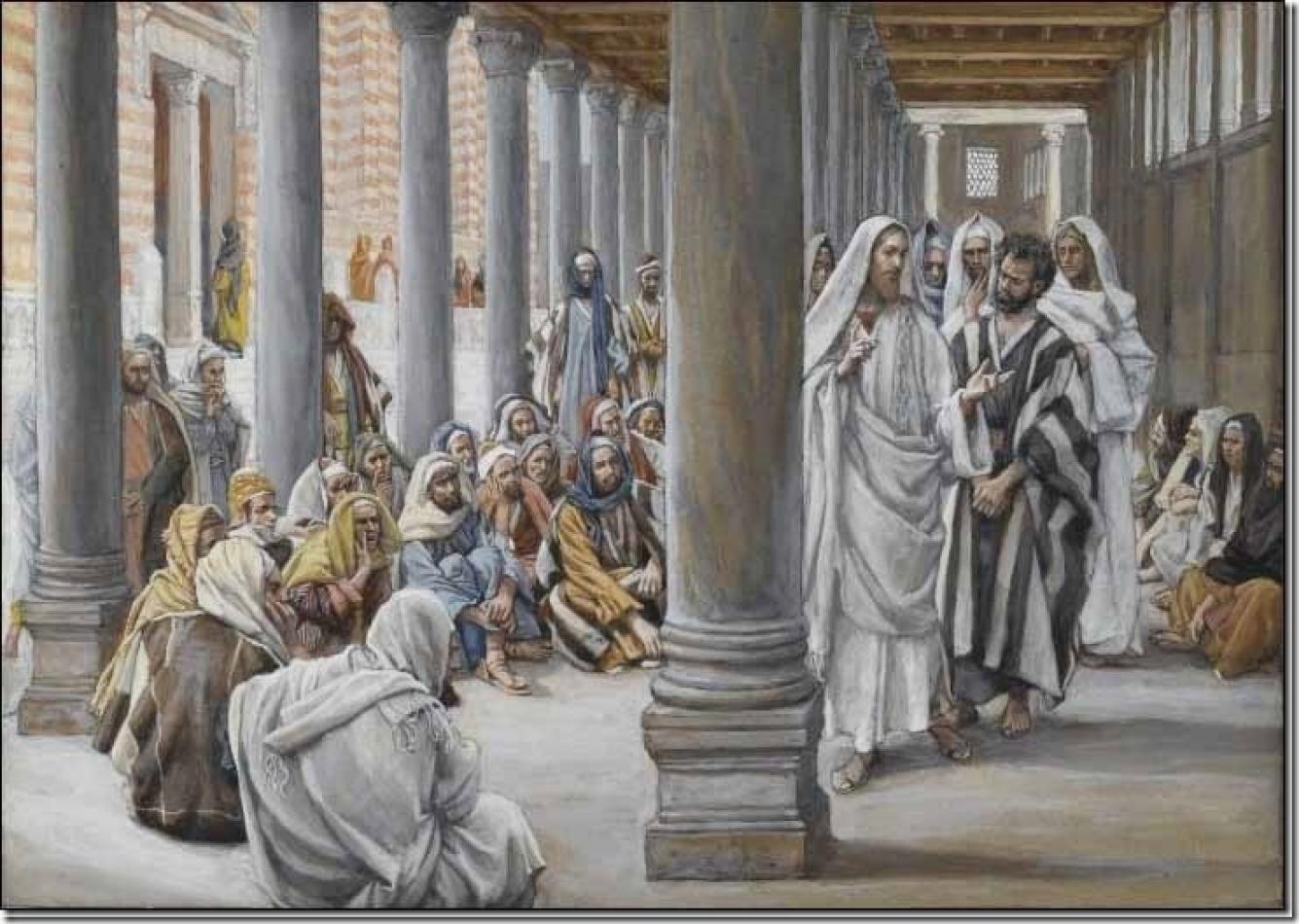
The scene changes. Jesus is no longer on the boat, but at home. He does not turn to the crowd, but to the small group of disciples. It is the evangelist’s way of introducing the application of the parable.
Reading these verses one can notice that the situation it refers to is completely changed: the characters are no longer the same; the parable becomes an allegory; the seed is not the logic of the kingdom, and the tares the opposite, but they seem to be the good and bad individuals; the field is not the world, but the reign of the Son of man; the message, above all, is not the same: first the master invited servants to accept with serenity the existence of evil next to the good. Then he scolded the servants’ intolerance. Now he seems to let himself be taken up by the frenzy of “putting hands to the fire” (v. 42).
This is—as we revealed—a catechesis addressed to the community of Matthew at the end of the first century. Probably, after the first few decades of great fervor, the Christians were a bit more relaxed and did not take seriously the commitments of their baptism. What must be done? The evangelist felt the need to shake them, to recall them to the seriousness of life. He did so, using the language of the preachers of his time. He was a Jew, spoke to the Jews, and to make himself understood he could only resort to images comprehensible to his people, such as fire, the fiery furnaces, weeping, gnashing of teeth, the harvest, the angels, the devils. These awesome metaphors, commonly used by the rabbis, cannot be repeated today without adding any necessary explanations.
It’s not correct to extract from them conclusions regarding the end of the world and the judgment of God. Matthew was not giving information. He did not intend to describe what will happen to sinners in the future but was addressing an urgent, heartfelt call to his Christians.
One thing is certain: whoever does evil, ruins his life. As for the future, more than making the allegories (where clearly the eastern fertile imagination took over) absolute, it is better to dwell on what the Holy Scripture explicitly says that God is father “who wants all to be saved” (1Tim 2:4). “He did not send his Son into the world to condemn the world, but through him, the world is to be saved” (Jn 3:17).
And what about the fire? God knows a single fire: his Spirit descended on the disciples at Pentecost (Acts 2:3), handed over by the Risen Lord on Easter Sunday as a destructive force of sin (Jn 20:22-23). It is the fire alluded to by Jesus: “I have come to bring fire upon the earth and how I wish it were already kindled” (Lk 12:49). It is the unstoppable flame that will burn—this is the good news—all traces of weeds in the heart of every person, leaving only the good grain, the only one that will be admitted in the future world.
At the time of harvest “all the scandals and operators of iniquity” will be collected and thrown into the fiery furnace. It’s not a threat of punishment, but a good announcement: the fire of God, his Spirit will one day wipe out all forms of evil. In the kingdom of heaven, now in its completion, there will not be anyone doing iniquity.
READ: Our God is a god of mercy, strength, justice, prudence, and patience. In our moments of wordless grief, the Spirit of God within us intercedes for us. Jesus captures the various perfections of God through the parables of the Kingdom.
REFLECT: We are often embarrassed and distraught by the evil we find within ourselves. The good and the bad seem to co-exist within us and we despair. We then try to annihilate it. Perhaps we need to be compassionate to ourselves: let us accept ourselves with the good and the bad within us. It will help us open ourselves without reservation of shame before God whose grace will work like yeast and transform us in the fullness of time. It will also help us be compassionate and less judgmental towards others.
PRAY: Let us embrace both the good and bad in us and others so that we can truly be people of reconciliation.
ACT: Try to overcome the human tendency to be afraid or even hate those who are not like us. Refuse to worry. God is in charge.
Fernando Armellini
Italian missionary and biblical scholar