
Daniel Comboni
Comboni Missionaries
Institutional area
Other links
Newsletter
25th Sunday in Ordinary Time – Year A: A scandalous generosity
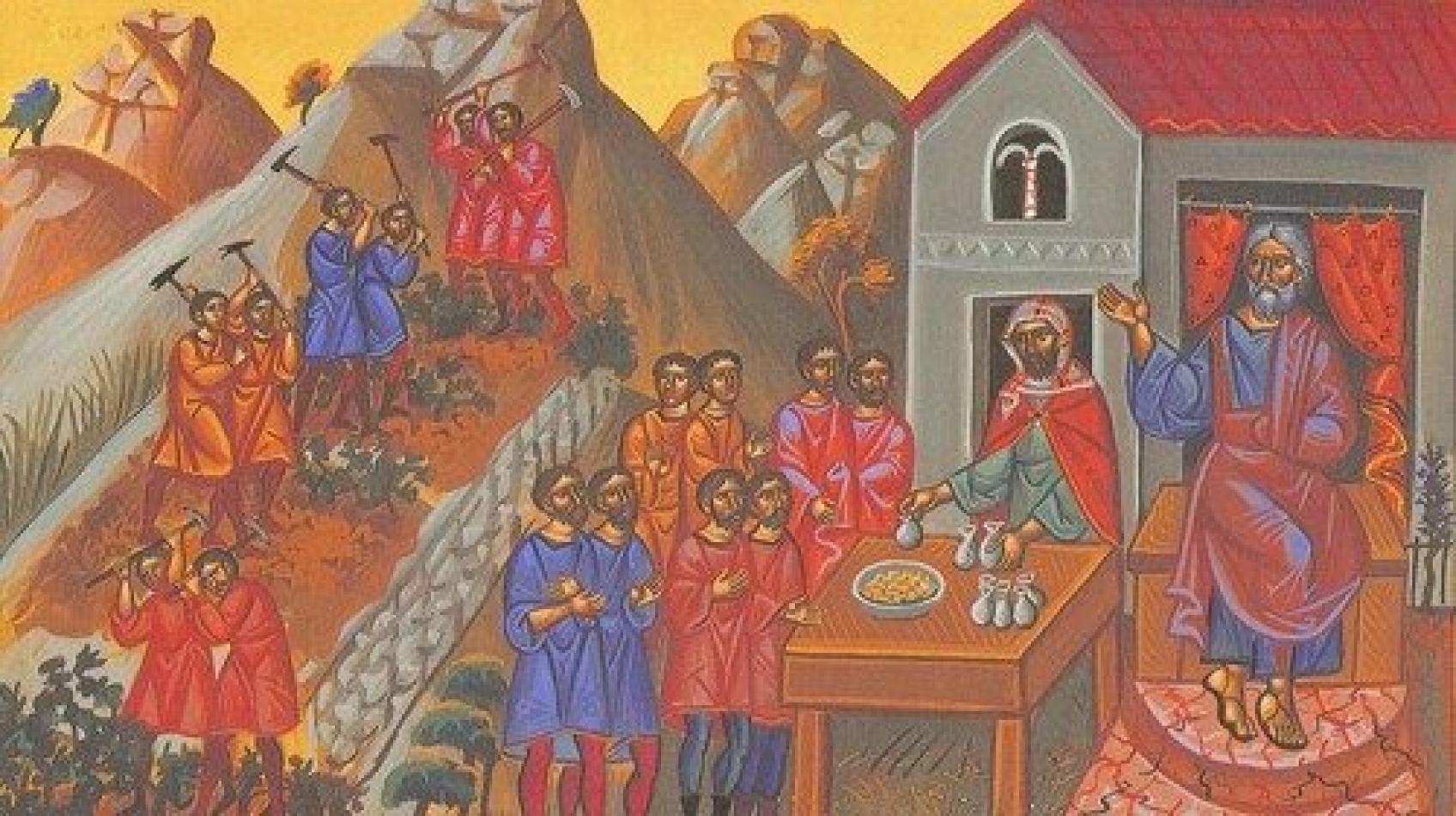


Today we begin a cycle of three parables of Jesus about the vineyard: the parable of the labourers hired by the day to work in the vineyard, this Sunday; that of the two sons sent to work in the vineyard, next Sunday; and finally, the parable of the murderous tenants, the following Sunday.
A scandalous generosity
“You too go into the vineyard”
Matthew 20:1-16
The vineyard has a profound meaning in the Bible. One detail in today’s parable immediately draws our attention. Although we are told that the vineyard belongs to a landowner, he never says “my vineyard”, but “the vineyard”: “You too go into the vineyard”!
What is this vineyard? It is the vineyard of the Kingdom, God’s vineyard. But it is also the vineyard of Israel, the people with whom God established his Covenant (Isaiah 5:1–7; Jeremiah 2:21; Ezekiel 15:4). So this “going into the vineyard” is not so much an invitation to work in the vineyard as it is to enter into the Covenant, to share in God’s love.
A scandalous generosity
The parable draws our attention, first of all, to the unusual behaviour of the owner of the vineyard, who goes to the marketplace five times to hire workers: at 6 in the morning, at 9, at noon, at 3 in the afternoon and, astonishingly, at 5, just one hour before the end of the working day. The heart of the story lies precisely in the contrast between the workers hired at dawn and those of the eleventh hour, whom the owner pays in exactly the same way: one denarius each, the wage agreed with the first workers.
But what becomes irritating and provocative in the owner’s behaviour is the fact that he makes the first workers wait so that they can witness his generosity towards the last. At first, this decision raises the expectations of the first workers, who consider him a good and generous master, only then to provoke their protest when they end up judging him unfair. And Jesus’ conclusion is even more provocative: “Thus the last will be first, and the first, last.” What a strange parable!
A challenge to meritocracy
This parable, which we find only in Matthew’s Gospel, was probably aimed at a number of first-hour believers from Judaism who regarded themselves as superior and entitled to greater rights than those of the last hour, the newly converted pagans. This situation in Matthew’s community is far from alien to our own time. Even today there are such “super-Christians”. And woe betide us priests if, by chance, we get on the wrong side of them, because they may be precisely among the most willing and committed members of the community, the “good ones”! Indeed, it could be us ourselves, you and me. Let me explain.
We have often been taught to think of Christian life according to an almost meritocratic logic: multiplying good works in order to accumulate merits in heaven, before God, so as to receive a fine reward in paradise. But is salvation really obtained in this way? The first reading already warns us: “My thoughts are not your thoughts, your ways are not my ways.” Salvation will always be a gift. It is not an acquired right for having “borne the burden of the day and the heat” (v. 12); it is not a wage owed to those who perform certain works. And so the so-called “good thief” is the first to enter the Kingdom, while the elder son in the parable of the “prodigal son” protests — “quite rightly”, from his point of view! — at what he considers an insult from the Father after having served him for so many years.
But if, before God, we cannot claim acquired rights, why make such an effort? Why should I have entered the seminary at the age of ten and become a missionary? Would it not have been better to marry and lead a “normal” life, like everyone else? This is how those who see the Gospel as a burden, an effort, hard work, sacrifice and servitude reason, rather than seeing it as a stroke of good fortune that has enabled us to find the treasure hidden in the field of our lives.
I am reminded of the priest in a story by the Indian Jesuit Anthony de Mello (in The Song of the Bird), who, seeing God grant the same “reward” to his brother, who had led an ordinary life, rejoiced enormously and said to God: “Lord, you are so good that for your sake I would be ready to sacrifice my life all over again!”
Christian life lived as slaves, servants or children
Christian life can be lived with three different attitudes and behaviours: that of the slave, who is afraid of punishment and for whom God is a judge; that of the servant, who works for a wage and for whom God is a master; and that of the child, who works selflessly, out of love, and for whom God is a Father.
In reality, however — and this is the strange thing! — the Gospel seems to address these three ways of relating to God according to their expectations. Jesus says: “Whoever says [to his brother], ‘You fool’, will be liable to the fire of Gehenna” (5:22). To Peter, who asks him: “Look, we have left everything and followed you; what then will we have?”, Jesus replies: “You will sit [with me] on twelve thrones, judging the twelve tribes of Israel.” And to those who leave everything to follow him he promises a “hundredfold”, concluding by saying: “Many who are first will be last, and many who are last will be first”, which, as it happens, forms the framework for today’s Gospel! (Matthew 19:27–30).
Why does Jesus use deliberately powerful images such as the punishment of “Gehenna” (seven times in Matthew)? Why does Jesus place so much emphasis on “reward” (about a dozen times in Matthew)? Certainly, for Jesus, God is the “Father” (mentioned around forty times in Matthew’s Gospel, including 16 times as “my Father” and 14 times as “your Father”). The Father does not want us to live as wage-earners or slaves: he wants children! And the purpose of Jesus’ mission is to make us like the Father: “so that you may be children of your Father in heaven” (Matthew 5:45). God wants us to be children who seek him out of love.
Unfortunately, many times it is fear or self-interest that moves us. And who knows whether even these imperfect motivations may serve a purpose at certain moments in life! Perhaps God knows how to make use even of these imperfect motivations, because he does not want to lose any of his children.
Surprisingly, this conviction that God should be served out of love, and not out of self-interest or fear, also appears in other religious contexts. A famous account from the Sufi tradition attributed to the eighth-century Muslim mystic Rabia of Basra is particularly eloquent: “I would like to set paradise on fire and extinguish hell, so that these two veils may disappear and his servants may worship Him without hoping for rewards and without fearing punishments.”
For personal reflection
-
Which motivation prevails in my relationship with God: fear, self-interest or love?
-
How would you respond to this provocation from someone: “If Paradise did not exist, would you still believe in God?”
-
Meditate on Saint Paul’s beautiful testimony in today’s second reading: “For to me, to live is Christ.”
Fr Manuel João Pereira Correia, MCCJ
Gospel Reflection
There’s something unfair and irritating in the behavior of the owner referred to in the parable. He acts generously but does not take into account the merits. Nobody forbade him to do charity with his money. However, rewarding those who had appeared at the seventeenth hour and who until then, had remained dormant and, perhaps, had done nothing but loiter, is very illogical. Who deserved a recompense, if ever, were those who had struggled most, the workers of the first hour. We stipulate contracts based on certain principles and these are not observed in the parable.
It is exactly in the provocative act of the master that the main teaching of the story is dealt with. Let’s find out.
It’s harvest time. The mature grapes are collected and crushed, paying attention to the time and the right moon. For owners of large vineyards, these are tense days. They need workers and laborers who do not have a steady job and who know how to take advantage of the kindness of the tenants to snatch a favorable contract. The more willing place themselves well before dawn at strategic points. They expect that someone may pass to hire them. It is at this point that our parable begins.
Even before sunrise, behold, the tenant arrives breathless. He is on his feet for more than two hours. He has scheduled the day’s work, placed the tubs, baskets, and barrels.
He baked the bread and prepared the olives to be distributed to the workers at midday. His face is tense and from his looks, snappy, almost nervous gestures, he shows all his concerns and haste. A few words to agree on the pay and behold the first group, the early risers, are already in the vineyard.
The eagerness of the master to conclude the work as soon as possible is really great. In fact, he comes out four more times searching for workers: at mid-morning, midday, at three in the afternoon and when he calls the last group it was already the seventeenth hour, an hour before the end of the workday. So far nothing strange, everything is normal and logical.
We begin to identify the characters: the master is God or Christ; the workers are the disciples who, at different times of their lives, respond to the call; the vineyard is the Christian community, where work is not lacking and must be done with extreme urgency. The haste is the same that we find in the disposition given by Jesus to his envoys; “Do not stop at the homes of those you know” (Lk 1:4) because there is no time to lose. The day is the image of everyone’s life and the evening is the time of the righteous judgment of God.
We thus come to the crux of the parable. The law states: “Do not exploit the lowly and the poor daily-wage earner, whether he be one of your brothers or a foreigner whom you find in your land and in any of your cities. Pay him daily before the sun goes down because he is poor and he depends on his earnings. Then he will not cry to Yahweh against you, and you will have no sin” (Dt 24:14-15) and, in fact, the master ordered to put workers in line and to hand to all a silver coin … beginning from the last.
Here is the impropriety!
If he had rounded the pay of those who had worked only one hour, secretly, without attracting attention, for compassion there would be nothing to object. However, provoking the rage of those who, after twelve hours of work had sunburned faces and haggard with fatigue, it seems downright cruel. The workers of the first hour, who cannot even hold up for fatigue, are forced to witness an irritating scene. They unbelievingly observe the colleagues, with shameless and relaxed audacity of idlers, receiving an undeserved pay.
It is in this surprising and disconcerting behavior of the master that the message of the parable is perceived.
With the workers of the first hour, he had agreed on a silver coin, with others what will be just, with the last he had not agreed on anything.
The lack of understanding comes from the lack of clarity about what the boss meant by just. The workers have understood him according to their criteria of judgment. They were convinced that he would take account of the merits. The owner instead follows his own justice and distributes his goods in a completely free and open way. He did not wrong anyone; he just decided not to consider the merits. He gave everyone according to their needs and, of course, the first to be benefited were the last, the poorest (v. 16). That’s the surprise of God; that is his strange way of conceiving and practicing justice.
The parable is the clearest and provocative denouncement that can be imagined of the religion of merits taught by the spiritual guides of Israel (and supported by many even today).
The people—catechized by the priestly caste—forgot the good God, father, husband and faithful friend, preached by the prophets. They were convinced that the Lord was a legislator and a judge, so the relationship with him could only be one of the servants before the master. The rabbis taught: “He who fulfills a precept acquires for himself a lawyer, who commits a transgression acquires for himself a prosecutor. All God’s judgments are based on measure for measure.” They completed their catechesis talking about books kept in heaven, on which the meritorious deeds and transgressions were carefully noted.
According to this logic, God could not give anything for free. To get his blessing one had to earn it. To the objection: “The Bible says that Abraham, while still a pagan, was called by God. He was not just, therefore, his vocation was completely a free gift.” The rabbis replied, “Even if it is not explicitly stated, Abraham certainly had done good works; he had earned his vocation!”
With his parable, Jesus destroyed, forever, this self-righteous way of relating to God. The love of the Lord is never bought, conquered or assessed based on good works. It is received freely and in proportion to the need. “God has filled the hungry with good things, but he sent the rich away empty” (Lk 1:53).
He never gets tired of going out to meet the person, even when he misses all the appointments. God does not pay according to merits. No one can feel in credit with him (Lk 18:9-14).
Before God, we are all children: we turn our eyes to the Father and expect from him all the best.
The religion of merits stems from the conviction that getting into the vineyard of the Lord—that is, the Kingdom of God—is tantamount to bearing an immense effort that of observing the commandments and precepts that do not always seem justified. So we ask: how is it possible that one who scrupulously practices the law of God be benefited as one who has neglected it? Why is one who was called by God only at the last hour, who is saved in the nick of time, must have part of the heavenly inheritance like the servants who remained faithful throughout their life?
Many “just ones” feel an unacknowledged envy against one who, being converted at the last moment, had the good fortune to “work less,” to enjoy life more. Here is the error: to think that joy consists in being far from God and that faithfulness to his word deserves a prize.
An example may help to grasp the ambiguity present in this way of thinking.
One starts to study music at an early age and practices for many hours a day. Another, at seventy, decides, when he lost all interest, to get his hands on a piano and does so with little enthusiasm. Which “reward” awaits the two? Nothing more than this: the joy of relishing the music. Their enjoyment will be different: the one who started early had more time to savor the pleasure of performing and listening to music;his joy is more intense and deeper.
Blessed are the servants who came first in the “vineyard of the Lord.” They surely have also struggled. They have enjoyed “since morning” the presence of the Lord. The workers of the first hour are those who have spent every day of their lives in the intimacy with God and in listening to His Word. The others who presented themselves late at the appointment, who did not let themselves be found when the Lord came to call them, have lost many opportunities that were offered to them.
Those who defers the entrance into the Kingdom of God does not make God angry. He does not punish for this. He complains, yes, because he wants to involve people earlier in his love and make them happy. These indecisions, perplexities, hesitations in abandoning themselves to him are also moments of lost joy. Every moment the bride spends without the groom is a moment of missed loved.
With this parable, the evangelist who was addressing Christians imbued with the self-righteous mentality also wanted to put the disciples on guard of the danger of competition within the community. No one can think of oneself being superior to others because no one can consider oneself a veteran because he got converted first, because he practices the Gospel more faithfully. No one is master of the “vineyard”; are all workers, all are brothers.
The parable is not ended. After the words of the master, how did those who murmur react? Have they accepted? Have they continued to grumble? Have they responded with insults? Have they thrown the money at the face of the winemaker? Have they vowed to never come back to work for him?
The reaction that we attribute to the workers in the parable reflects our reaction to the goodness and generosity of God. In his vineyard one commits oneself freely. One does not do good to the brother to get a prize. It would be the worst of selfishness: to make use of the poor and needy to accumulate merits.
READ: This parable is not a popular one. Notice that it has several endings, as if the author did not know how to deal with this teaching of Jesus. Pay attention to all the characters and their reactions.
REFLECT: Why is it difficult to rejoice in the great fortune of another? People get jealous when they think someone has something that belongs to them—or even when they simply want what another has. What is your reaction to this parable?
PRAY: You can always find someone who has more than you and others who have less. In your prayer, ask to avoid envy. Jealousy destroys relationships. Pray to avoid it at all costs; and remember that life can be unfair. Pray for a heart that delights in the well-being of the other.
ACT: When something good happens to another, join in the celebration and try to move beyond self-centeredness. Make an act of genuine appreciation and delight in the blessings received by someone in your circle of friends.
Fernando Armellini
Italian missionary and biblical scholar