Daniel Comboni
Comboni Missionaries
Institutional area
Other links
Newsletter
Solemnity of All Saints (A-B-C) The Eight Gates of Paradise
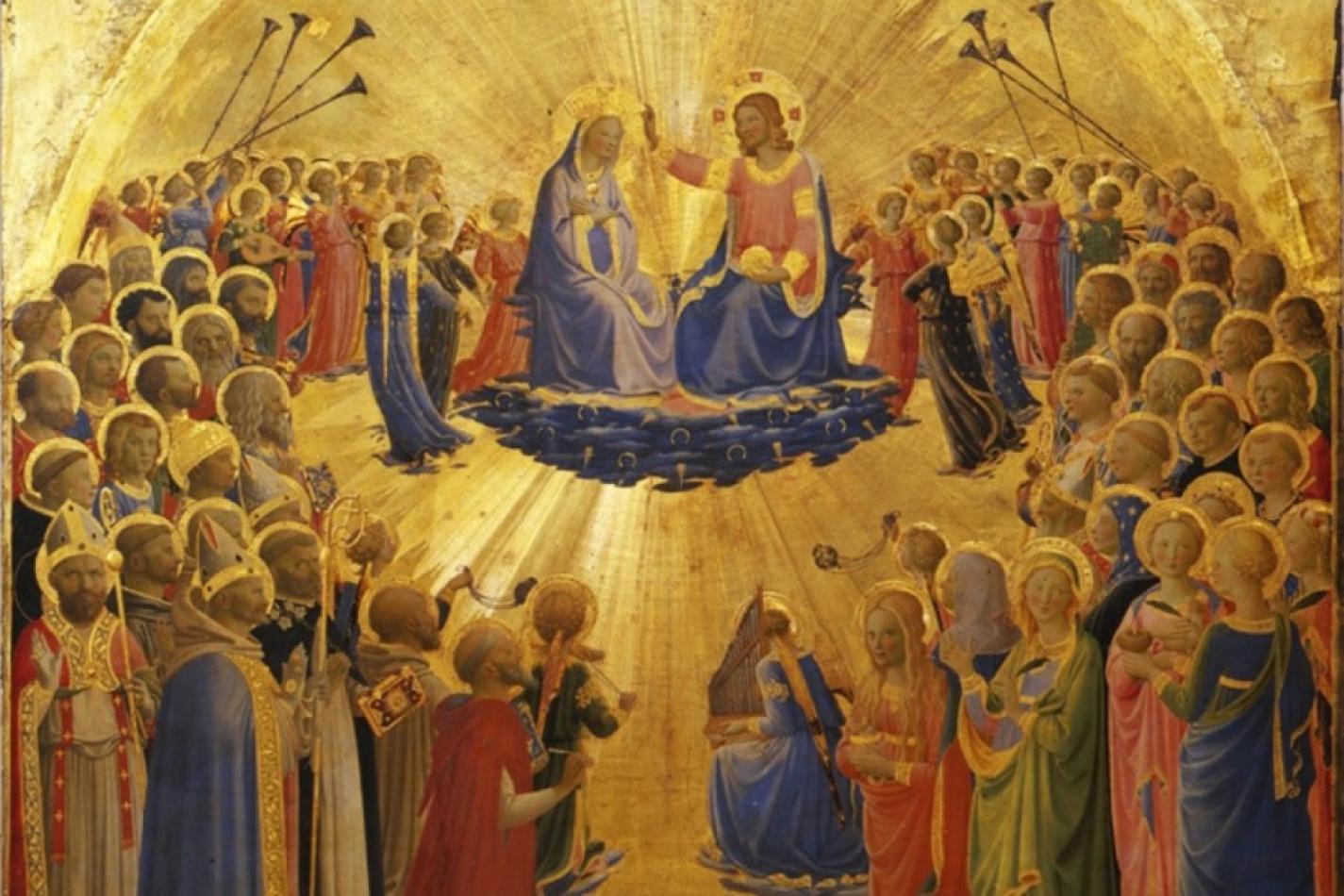
The solemnity of All Saints celebrates the countless saints who are not included in the Church’s official calendar. We are therefore invited to rejoice with this multitude of men, women, children, adults and elderly people who live in the joy and glory of paradise. In remembering them, we first of all celebrate the merciful love of God who welcomes them; and then it is a feast of hope for us in the pilgrim and suffering Church.
The Eight Gates of Paradise
“Jesus went up the mountain; he sat down, and his disciples came to him.”
Matthew 5:1-12
On 1 November, the Church celebrates the Solemnity of All Saints, a feast of very ancient origin. Already by the end of the second century, we find evidence of genuine veneration of the saints. The solemnity originated in the East in the fourth century and gradually spread to other regions, though with different dates: in Rome it was celebrated on 13 May, while in England and Ireland, beginning in the eighth century, it was held on 1 November. This latter date was later adopted in Rome from the ninth century onwards.
Who are the saints we celebrate today? They are not (only) those officially recognised by the Church, who have worked miracles, but the great multitude seen by St John in the Book of Revelation: “a great multitude which no one could count, from every nation, tribe, people and language” (Rev 7). Many of them have lived alongside us and cared for us; others we have encountered during our lives. And many, even unknown to us, have been like angels in our midst.
The Beatitudes: Eight Words, Eight Paths, Eight Gates
The liturgy presents us with the Gospel of the Beatitudes according to Matthew (Mt 5:1–12). They form the prologue to Jesus’ first discourse in Matthew and the summary of the entire Gospel. It is a well-known text, but precisely for that reason we risk skimming over it and missing its richness, depth, and complexity. Gandhi once said that these were “the highest words of human thought”, the quintessence of Christianity.
It should be noted that the evangelist Matthew has a fondness for mountains. In his Gospel, the word “mountain” appears fourteen times. Seven particular mountains mark the public life of Jesus, from the temptations (cf. Mt 4:8) to the apostolic mandate on the mountain of Mission (cf. Mt 28:16). These mountains carry symbolic and theological meaning: the mountain signifies closeness to God. In fact, Luke places this discourse of Jesus on a plain. The Christian life unfolds in a twofold movement: the ascent to the mountain and the descent to the plain.
“Seeing the crowds, Jesus went up the mountain; he sat down, and his disciples came to him.” This “going up the mountain” and “sitting down” (a solemn act, as of a teacher taking his seat) clearly recalls Moses on Mount Sinai. This mountain is therefore the new Sinai, from which the new Moses proclaims the new Law. Whereas the Law of Moses, with its prohibitions, set the limits not to be crossed in order to remain within God’s Covenant, the new “Law” opens up new horizons. It is a new plan for life.
Jesus’ discourse begins with the eight Beatitudes (the ninth, addressed to the disciples, is an expansion of the eighth). To the ten “words” of the Decalogue now correspond the eight “words” of the Beatitudes. They are the new paths of the Kingdom and the eight gates of Paradise!
What the Beatitudes ARE NOT
-
The Beatitudes are NOT a praise of poverty, suffering, endurance, or passivity… Quite the opposite: they are a revolutionary discourse! That is why they provoke the violent opposition of those who feel threatened in their power, wealth, or social standing.
-
The Beatitudes are NOT an opiate for the poor, the suffering, the oppressed, or the weak… for they would lull to sleep the conscience of injustice of which they are victims, leading them to resignation. Even though, at times in the past, they have been used in this way. On the contrary, they are an adrenaline that energises the Christian to engage in the struggle to eliminate the causes and roots of injustice!
-
The Beatitudes are NOT a postponement of happiness—which lies at the heart of every person—to the future life, in the hereafter. They are already a source of happiness in this life. Indeed, the first and the eighth, which frame the other six, use the verb in the present tense: “for theirs is the Kingdom of Heaven.” The other six use the future tense, but it is a promise that already makes happiness present today, even while moving towards its fulfilment. A promise that guarantees that evil and injustice do not have the final word. The world does not, and will not, belong to the rich and the powerful!
-
The Beatitudes are NOT (only) personal. It is the Christian community, the Church, that must be poor, merciful, mourning with those who mourn, hungry and thirsty for justice… in order to bear witness to the Gospel!
What the Beatitudes ARE
-
The Beatitudes ARE a cry, a proclamation of happiness, a Gospel addressed to all. “Blessed” (makarios in Greek) can also be translated as “happy”, “congratulations!”, “well done!”, “how fortunate you are!”. The Beatitudes apply to all situations and at every level. But we must realise that this message we profess and proclaim stands in complete contradiction to the mindset of the world in which we live. So we should not be surprised if many draw back from it.
-
The Beatitudes ARE… one single reality! The eight are variations of one and the same truth, and each sheds light on the others. Commentators generally consider the first to be fundamental: “Blessed are the poor in spirit, for theirs is the Kingdom of Heaven.” All the others are, in some way, different forms of poverty. Whenever, in the Bible, the Covenant is renewed, it always begins by re-establishing the rights of the poor and the excluded. Without this, the Covenant cannot be renewed! One might wonder why there is no Beatitude about love. In reality, all of them are concrete expressions of love!
-
The Beatitudes ARE the mirror, the self-portrait of Christ. To understand them and grasp their nuances, we must look to Jesus and see how each one was fulfilled in his person.
-
The Beatitudes ARE the key to entry into the Kingdom of God—for everyone: Christians and non-Christians, believers and non-believers. In this sense, the Beatitudes are not “Christian” in an exclusive way. They define who can truly enter the Kingdom. All are called to the Beatitudes! This is also what Matthew 25 tells us about the final judgement.
Conclusion
The Beatitudes are not the expression of a dream of an ideal, unattainable world—a utopia for dreamers. For the Christian, they are the criterion of life: either we accept them, or we shall not enter the Kingdom!
The Beatitudes correspond to eight categories of people and to eight gates of entry into the Kingdom. There are no other entrances! To enter Paradise, one must identify with at least one of these eight attitudes and embody an aspect of the life of Christ.
Which Beatitude is mine—the one to which I feel particularly drawn? The one I sense to be my vocation, by nature and by grace?
Fr Manuel João Pereira Correia, mccj
The Four Surprises of Paradise
These celebrations offer us a window through which we can glimpse broader horizons, or a skylight from which to admire the starry sky. Better still, a DOOR opens: “After this I looked, and behold, a door standing open in heaven! And the first voice, which I had heard speaking to me like a trumpet, said, ‘Come up here, and I will show you what must take place after this’” (Revelation 4:1). Let us enter through that door. Paradise opens its doors and allows a visit! An opportunity not to be missed! Allow me to share my "visit" with you!
ALL THE SAME OR ALL DIFFERENT?
First surprise: Heaven is a marvellous and immense mosaic of diversity
“After this I looked, and behold, a great multitude that no one could number, from every nation, tribe, people and language” (Revelation 7:9). There are no different “heavens” capable of separating and avoiding the “different” ... in an eternal and monotonous uniformity! Rather, there is a single heaven able to host and integrate diversity. All differences, whether geographical, temporal, racial, cultural or religious, coexist happily, grateful for the varied panorama, which offers continual and perpetual newness.
A further surprise: the richness of temperaments and sensibilities! All of them respected. All of them purified. “A drop of the divine is in every human being. We are the dissimilar leaves of a single tree” (Cardinal Martini).
At last, “The wolf shall dwell with the lamb, and the leopard shall lie down with the young goat; the calf and the lion cub and the fattened animal together, and a little child shall lead them” (Isaiah 11:6).
ETERNAL REST?
A second surprise: in heaven, people work!...
Heaven is not a place of idleness! Everyone works! The Father is the first to set the example: “My Father is working until now, and I am working,” says Jesus (John 5:17). And it is not a “divine” work done “from above”; on the contrary, it is very human, humble service, done on one’s knees: “Whoever has seen me has seen the Father,” says Jesus, after washing his disciples’ feet.
Let us, then, abandon the conviction of those who think that “eternal rest” is a justification for idleness. And let those who cannot bear to be idle relax! The way the world is going, how could we carry on without the help of Heaven?
FULL JOY?
A third surprise: The joy of heaven is not a relaxed happiness!
And how could it be, if it is the place of perfect charity? How could our brothers and sisters detach themselves from our suffering and our sorrows? And God above all, how could he do so?! The solidarity of Christ, his compassion, his tears (John 11:42) are emblematic. Scripture does not avoid speaking of the profound sadness of God (Genesis 6:6). And Saint Paul asks us “not to grieve the Holy Spirit of God” (Ephesians 4:30). It is no wonder, then, that some visionaries have heard Our Lady speak of the “sadness” of God and of her Son, and have seen her "weep"! ...
A PRIZE EARNED BY OUR MERITS?
Fourth surprise: Heaven is not exclusively for the “righteous”!
Heaven is not the “wage” granted only to upright people who would have earned it with their good works. We may well be astonished to meet “certain” people there, and embarrassed to find ourselves embracing some of our “enemies”! Because God is the One who eats and drinks with sinners and sits at table with them (Mark 2:15-16). “Infinite goodness has such wide arms that it takes whatever turns to it” (Dante). Therefore, to go to Paradise, “it is enough to ask for it,” says Saint Thomas.
There we will fully understand Jesus’ disconcerting parable of the workers invited to labour in the Vineyard who all receive the full wage. This parable found an eloquent application in the case of the “good thief,” “hired” at the last moment...
Into heaven one enters only through love. Thus the Muslim Sufi mystic Rabia of Basra († 801) said that, if she could, she would put out hell and burn paradise so that everyone would love God selflessly, not out of fear of hell or hope of heaven!
CONCLUSION?
Forgive my boldness. This “interpretation” of mine is certainly distorted by my myopic and clouded eye. A wretched, darkened shadow distorts reality, since Heaven is the Great Surprise that God holds in store for us!
Fr. Manuel João Pereira Correia, MCCJ
A family celebration
Today’s first reading, from the Book of Revelation, speaks to us about heaven and sets before us “a great multitude”, innumerable, “from every nation, from all tribes and peoples and tongues” (Rev 7:9). They are the saints. What do they do up there in heaven? They sing together, they joyfully praise God. It would be beautiful to hear their song…. But we can imagine it: do you know when? During Mass, when we sing “Holy, Holy, Holy Lord God of hosts…”. It is a hymn, the Bible says, which comes from heaven, which is sung there (cf. Is 6:3; Rev 4:8), a hymn of praise. Thus, by singing the Sanctus, not only do we think of the saints, but we do as they do: at that moment, in the Mass, we are united with them more than ever.
And we are united with all the saints: not only the most well known, from the calendar, but also those “next door”, our family members and acquaintances who are now part of that great multitude. Therefore, today is a family celebration. The saints are close to us, indeed they are our truest brothers and sisters. They understand us, love us, know what is truly good for us, help us and await us. They are happy and want us to be happy with them in paradise.
Thus they invite us on the path of happiness, indicated by today’s beautiful and well-known Gospel passage: “Blessed are the poor in spirit…. Blessed are the meek…. Blessed are the pure in heart…” (cf. Mt 5:3-8). But how? The Gospel says blessed are the poor, while the world says blessed are the rich. The Gospel says blessed are the meek, while the world says blessed are the overbearing. The Gospel says blessed are the pure, while the world says blessed are the cunning and the pleasure-seekers. This way of the Beatitudes, of holiness, seems to always lead to defeat. Yet — the first reading also reminds us — the Saints hold “palm branches in their hands” (Rev 7:9), which is a symbol of victory. They have prevailed, not the world. And they exhort us to choose their side, that of God who is Holy.
Let us ask ourselves which side we are on: that of heaven or that of earth? Do we live for the Lord or for ourselves, for eternal happiness or for some immediate gratification? Let us ask ourselves: do we truly want holiness? Or are we content with being Christians without infamy and without praise, who believe in God and esteem their neighbour, but without overemphasizing. “The Lord asks everything of us, and in return he offers us true life, the happiness for which we were created” (Apostolic Exhortation Gaudete et Exsultate, 1). Thus, either holiness or nothing! It is good for us to let ourselves be spurred by the saints, who did not use half-measures here, and are ‘cheering us on’ from there, so that we may choose God, humility, meekness, mercy, purity, so that we may be impassioned by heaven rather than earth.
Today our brothers and sisters do not ask us to listen to another fine Gospel passage, but to put it into practice, to set out on the way of the Beatitudes. It is not a matter of doing extraordinary things, but of following, each day, this way that leads us to heaven, leads us to family, leads us home. Thus today we glimpse our future and we celebrate what we were born for: we were born so as to die no more; we were born to enjoy God’s happiness! The Lord encourages us and says to those setting out on the path of the Beatitudes: “Rejoice and be glad, for your reward is great in heaven” (Mt 5:12). May the Holy Mother of God, Queen of Saints, help us to decisively follow the road to holiness; may she, who is the Gate of Heaven, introduce our departed loved ones into the heavenly family.
Pope Francis
The way of holiness
In the Gospel we listened to Jesus who was teaching his disciples and the crowd that had gathered on the mountain near the lake of Galilee (cf. Mt 5:1-12). The Word of the risen and living Lord also shows us, today, the way to reach the true beatitude, the way that leads to Heaven. It is difficult to understand the path because it goes against the current, but the Lord tells us that those who go on this path are happy, sooner or later they become happy.
“Blessed are the poor in spirit, for theirs is the kingdom of heaven”. We might ask ourselves how a person poor of heart can be happy, one whose only treasure is the Kingdom of Heaven. The reason is exactly this: that having the heart stripped and free of so many worldly things, this person is “awaited” in the Kingdom of Heaven.
“Blessed are those who mourn, for they shall be comforted”. How can those who weep be happy? Yet, those who in life have never felt sadness, angst, sorrow, will never know the power of comfort. Instead, happy are those with the capacity to be moved, the capacity to feel in their heart the sorrow that exists in their life and in the lives of others. They will be happy! Because the tender hand of God the Father will comfort them and will caress them.
“Blessed are the meek”. How often are we, on the contrary, impatient, irritable, always ready to complain! We have many demands regarding others, but when our turn comes, we react by raising our voice, as if we were masters of the world, when in reality we are all children of God. Let us think instead of those mothers and fathers who are so patient with their children who “drive them mad”. This is the way of the Lord: the way of meekness and of patience. Jesus traveled this path: as a child he endured persecution and exile; and then, as an adult, slander, snares, false accusations in court; and he endured it all with meekness. Out of love for us he endured even the cross.
“Blessed are those who hunger and thirst for righteousness, for they shall be satisfied”. Yes, those who have a strong sense of justice, and not only toward others, but first of all toward themselves, they will be satisfied, because they are ready to receive the greatest justice, that which only God can give.
Then, “blessed are the merciful, for they shall obtain mercy”. Happy are those who know how to forgive, who have mercy on others, who do not judge every thing and every one, but try to put themselves in the place of others. Forgiveness is the thing we all need, without exception. This is why at the beginning of the Mass we recognize ourselves for what we are, namely, sinners. It isn’t an expression or a formality: it is an act of truth. “Lord, here I am, have mercy on me”. If we are able to give others the forgiveness we ask for ourselves, we are blessed. As we say in the “Our Father”: “Forgive us our trespasses as we forgive those who trespass against us”.
“Blessed are the peacemakers, for they shall be called sons of God”. Let us look at the faces of those who go around sowing discord: are they happy? Those who are always seeking occasions to mislead, to take advantage of others, are they happy? No, they cannot be happy. Instead, those who patiently try to sow peace each day, are who artisans of peace, of reconciliation, yes, they are blessed, because they are true children of our Heavenly Father, who sows always and only peace, to the point that he sent his Son into the world as the seed of peace for humanity.
Dear brothers and sisters, this is the way of holiness, and it is the very way of happiness. It is the way that Jesus travelled. Indeed, He himself is the Way: those who walk with Him and proceed through Him enter into life, into eternal life. Let us ask the Lord for the grace to be simple and humble people, the grace to be able to weep, the grace to be meek, the grace to work for justice and peace, and above all the grace to let ourselves be forgiven by God so as to become instruments of his mercy.
This is what the Saints did, those who have preceded us to our heavenly home. They accompany us on our earthly pilgrimage, they encourage us to go forward.
Pope Francis