
Daniel Comboni
Comboni Missionaries
Institutional area
Other links
Newsletter
4th Sunday of Lent – Year A: Sunday of the Man Born Blind

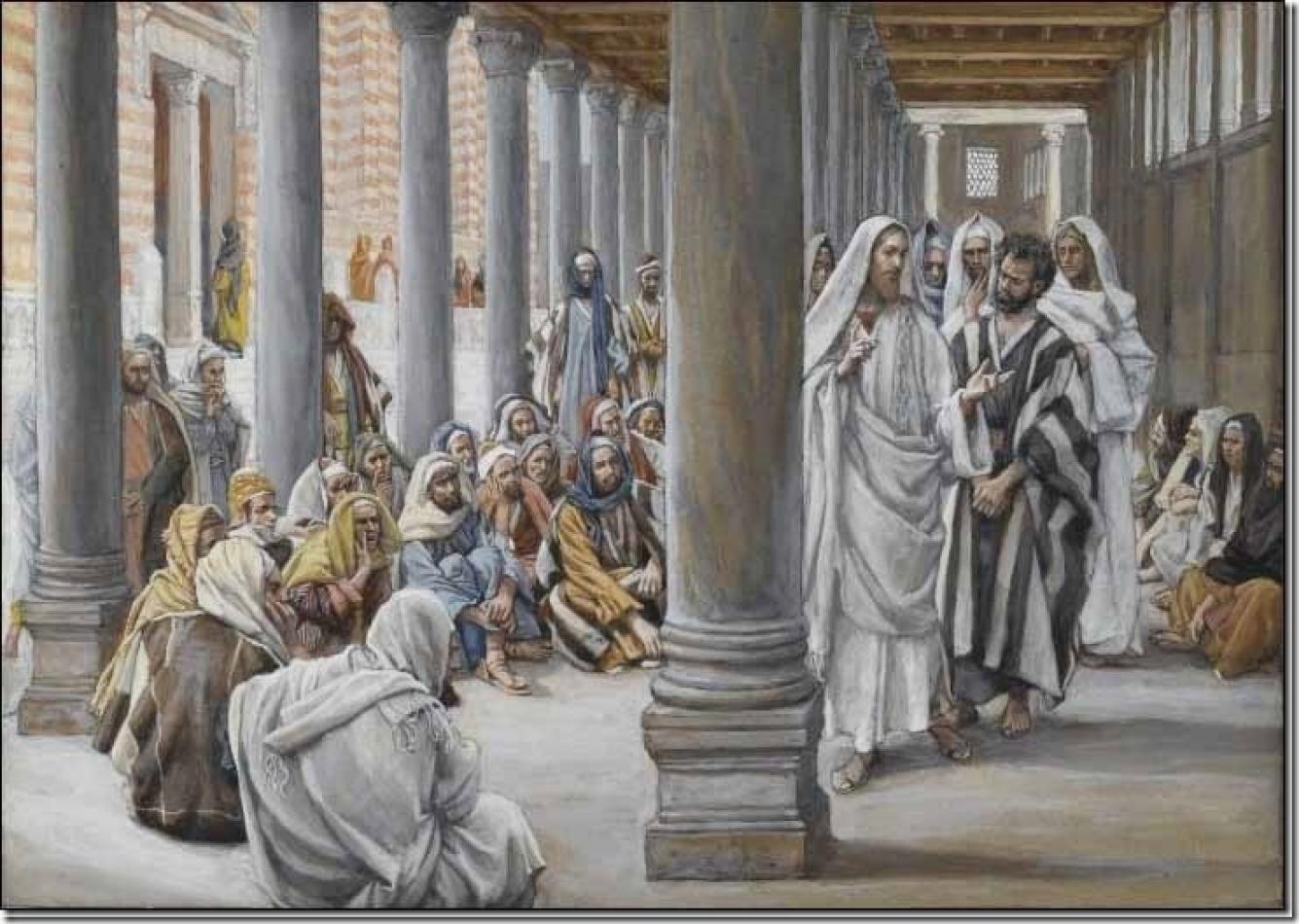
The fourth Sunday of Lent is a second baptismal catechesis on LIGHT, following last Sunday’s one on water. The protagonist is the man born blind whom Jesus heals, presented by John in chapter 9 of his Gospel. It is a beautiful text which has always been read as an illustration of baptism. The man born blind represents each one of us, whom Jesus reshapes (Genesis 2:7) and sends to the pool of Siloam, a symbol of baptism. (...)
Sunday of the Man Born Blind
Questions and gazes: a journey towards the light
“Are we blind too?”
John 9:1–41
The fourth Sunday of Lent is a second baptismal catechesis on LIGHT, following last Sunday’s one on water. The protagonist is the man born blind whom Jesus heals, presented by John in chapter 9 of his Gospel. It is a beautiful text which has always been read as an illustration of baptism. The man born blind represents each one of us, whom Jesus reshapes (Genesis 2:7) and sends to the pool of Siloam, a symbol of baptism.
Life is born blind; humanisation is a process of illumination
Life on earth arose in a state of blindness and remained so for millions of years. Even a newborn becomes able to see only gradually. In fact, one could say that humanisation is a slow and demanding process of illumination. The same is true of the life of faith, which is grafted onto this process and brings it to its full fulfilment. From the vision of natural reality, faith leads us towards the contemplation of the invisible, until we enter the full Light which is God himself. Without the openness of faith, vision remains incomplete and risks falling back into the darkness of meaninglessness. “In you is the fountain of life; in your light we see light” (Psalm 36:9–10).
Questions and gazes
The account of the healing of the man born blind is woven around a long series of questions (sixteen). I will try to summarise them in seven. Questions and answers place before us different attitudes and ways of seeing. This Gospel also invites us to ask ourselves questions so as to become aware of the quality of our gaze and to see how far we have progressed in our journey of baptismal illumination.
The passage begins by saying that “Jesus, as he passed by, saw…”. Jesus is the one who passes and sees. Like the Samaritan in the parable: “as he passed by, he saw him and had compassion” (Luke 10). And he continues to pass by and look at us with compassion. Yet we are blind and often do not even realise it, accustomed to passing by without seeing, or to looking — or being looked at — with indifference or pity.
1. “Rabbi, who sinned, this man or his parents, that he was born blind?”
“Jesus, as he passed by, saw a man blind from birth.” The apostles also see him and ask a question: “Who sinned…?”. This is the gaze of prejudice, which blames even before trying to understand another person’s situation.
2. “Isn’t this the man who used to sit and beg?”
His neighbours and acquaintances ask themselves: could it really be him? “Yes, it is I!” And how is it that you can now see? “It was the man called Jesus!” And where is he? “I do not know.” And everything ends there. This is the gaze of superficial curiosity. It does not seek to go deeper into what it sees, even when it is something unprecedented such as a miracle.
3. “How can a sinner perform signs like these?”
Then appears the inquisitorial gaze of the Pharisees, who want to investigate whether the law has been respected. A glimmer of light seems to emerge: “How can a sinner perform signs like these?”, but it is immediately stifled. They are not concerned that a blind man has been healed, because they do not have the good of the person at heart. What matters to them is not the greatness of the sign, but only that the Sabbath law has not been broken.
The witness is questioned. His gaze has entered a process of illumination. When he is asked, “What do you say about him, since he opened your eyes?”, Jesus is no longer merely “the man called Jesus”, but “a prophet”.
4. “Is this your son, whom you say was born blind? How then does he now see?”
The guardians of the law do not want to admit reality because it does not fit into their mental framework. For them, life is not autonomous. Even reality must submit to the law. They question his parents who, out of fear, distance themselves from their son: “We do not know!”. The gaze of fear is not supportive; it abandons the other to his fate, even if that person is one’s own child.
5. “You were born entirely in sin, and are you trying to teach us?”
The healed blind man is questioned again, in an attempt to intimidate him and catch him in error, so as to safeguard the law and their own position as holders of power. The Pharisees display all their knowledge: “Give glory to God! We know that this man is a sinner.”
“We know… we know.” They know everything.
The witness, for his part, says: “One thing I do know: I was blind and now I see!” They insist: “What did he do to you? How did he open your eyes?” The newly sighted man, increasingly confident, becomes bold: “Why do you want to hear it again? Do you also want to become his disciples?” At this point the fury of the gaze of falsehood erupts, unable to accept being challenged or questioned:
“You were born entirely in sin, and are you trying to teach us?” And they cast him out. The darkness grows thicker and closes itself to the light:
“The light shines in the darkness, and the darkness has not overcome it” (John 1:5).
6. “Do you believe in the Son of Man?”
Then Jesus looks for him and, finding him, asks him:
“Do you believe in the Son of Man?”
He replied, “And who is he, Sir, that I may believe in him?”
Jesus said to him, “You have seen him; it is he who is speaking with you.”
He said, “Lord, I believe!”
And he worshipped him.
This is the gaze of faith. The blind man is fully flooded with Light.
7. “Are we blind too?”
The account ends with a troubling statement from Jesus: “I came into this world for judgement, so that those who do not see may see, and those who see may become blind.”
Then comes a worrying question that all of us should ask: “Are we blind too?”
“If you were blind, you would not have sin; but now that you say, ‘We see’, your sin remains.”
The first illumination is to recognise that we are blind!
There is a “good” sin — a saving one — that opens us to God’s mercy. And there is a “bad” sin of the person who feels righteous and self-sufficient, which closes us to grace.
In conclusion…
I invite you to reread the text of the second reading: “Brothers and sisters, once you were darkness, but now you are light in the Lord. Live then as children of light” (Ephesians 5:8–14).
The risk of falling back into darkness is a daily one. Becoming aware of our blindness (Revelation 3:17–18) and caring for the brightness of our eyes (Matthew 6:23) are Lenten tasks.
Let us also cry out to the Lord, like the blind man of Jericho:
Lord, let me see again!
Fr Manuel João Pereira Correia, mccj
Opening the Eyes of Faith
The healing of the man blind from birth hits close to home, because in a certain sense all of us are blind from birth. The very world was born blind. According to what science tells us today, during millions of years there was life on earth, but it was life in a blind state. The eye for seeing did not exist yet, sight itself did not exist. The eye, in its complexity and perfection, is one of the functions formed more slowly.
This situation is reproduced in part in the life of every man. A child is born, though not precisely blind, at least incapable of distinguishing things clearly. Only after weeks he begins to focus. If the child could express what he experiences when he begins to see clearly the face of his mother, of people, of things, of colors — how many “oh’s” of awe would be heard! What a hymn to light and sight.
To see is a miracle, only we don’t pay attention to it because we are too accustomed to it and we take it for granted. It is here that God sometimes acts in a sudden and extraordinary way, aiming to take us out of drowsiness and make us alert. That is what he did with the healing of the man blind from birth and of other blind people in the Gospel.
But is this the only reason that Jesus healed the man blind from birth? There is another sense in which we were born blind. There are other eyes — besides the physical ones — that should open themselves to the world: the eyes of faith! They allow a glimpse of another world beyond that which we see with the eyes of the body: the world of God, of eternal life, the world of the Gospel, the world that does not end — not even with the end of the world.
This is what Jesus wanted to remind us of with the healing of the man blind from birth. Before anything else, he sent the young blind man to the pool of Siloam. With this, Jesus wanted to signify that these different eyes, those of faith, begin to open up in baptism, precisely when we receive the gift of faith. That’s why in ancient times baptism was also called “illumination,” and being baptized meant “having been illuminated.”
In our case, it’s not about believing generically in God, but believing in Christ. The Evangelist avails of the episode to show us how to arrive to a full and mature faith in the Son of God. The blind man’s recovery of his sight happens, in fact, at the same time that he discovers who Jesus is. In the beginning, for the blind man, Jesus is no more than a man. “The man called Jesus made clay …”
Later, he was asked, “What do you have to say about him, since he opened your eyes?” He responded, “He is a prophet.” He has taken a step forward; he has understood that Jesus is sent form God, which he speaks and acts in his name.
Finally, finding Jesus again, he exclaims, “I do believe Lord,” and he bows before him to worship him, thus openly recognizing him as his Lord and God.
In describing all of this with so much detail, it is as if John the Evangelist very discreetly invites us to ask ourselves the question: “And me? In what point am I on this path? Who is Jesus of Nazareth for me?”
That Jesus is a man, no one denies. That he is a prophet, one sent from God, is also admitted almost universally. Many stay at that point. But it is not enough. A Muslim, if he is coherent with what is found written in the Koran, also recognizes that Jesus is a prophet. But not for that is one considered a Christian.
The leap by which one passes to be a Christian in the true sense is when he proclaims, like the man blind from birth, that Jesus is “Lord” and adores him as God. Christian faith is not primarily to believe in something — that God exists, that there is something beyond — but to believe in someone. Jesus in the Gospel does not give us a list of things to believe; he says, “Believe in God; believe also in me” (John 14:1).
For Christians, to believe is to believe in Jesus Christ.
Fr. Raniero Cantalamessa
[Translation by Joseph G. Trabbic]
New eyes
The story of the blind man of Siloam is structured around a strong contrast. The Pharisees believe that they know everything. They have no doubts. They impose their truth. They even end up expelling a poor blind man from the synagogue. «We know that God spoke to Moses». «We know that that man who has healed you doesn’t keep the Sabbath». «We know that he is a sinner».
On the other hand, the beggar who is healed by Jesus knows nothing. He only tells of his experience to whoever would want to listen to him: «I only know that I was blind and now I see». «That man did something to my eyes, and I began to see». The story concludes with this last warning from Jesus: «I have come into this world, so that those without sight may see and those with sight may become blind».
Jesus fears a religion defended by secure arrogant scribes, who authoritatively manage God’s Word in order to impose it, utilize it as a weapon, and even excommunicate those who think differently. He fears doctors of the law who are more worried about «keeping the Sabbath» than about «healing» sick beggars. For Jesus it seems to be a tragedy to have a religion of «blind guides» and he says it openly: «If a blind man leads another blind man, they both fall into the pit».
Theologians, preachers, catechists, and teachers, who pretend to «guide» others without perhaps having allowed themselves to be enlightened by Jesus: don’t we need to hear his questioning? Are we going to keep repeating endlessly our doctrines without living a personal experience of encounter with Jesus that opens our eyes and our hearts?
Our Church today doesn’t need preachers who fill the Churches with words, but witnesses who spread, albeit in a humble manner, their small experience of the Gospel. We don’t need fanatics who defend «truths» in an authoritative manner and with empty language, woven together of clichés and stock phrases. We need believers of the truth, attentive to life and sensitive to the problems people have, seekers of God who are capable of listening and accompanying respectfully the great number of men and women who are suffering, who seek and don’t find a way to live that is more human and more believing.
José Antonio Pagola
Translator: Fr. Jay VonHandorf