
Daniel Comboni
Comboni Missionaries
Institutional area
Other links
Newsletter
The Fight Against Corruption in Africa – An Ethical, Moral, and Christian Imperative



Monday, July 13, 2026
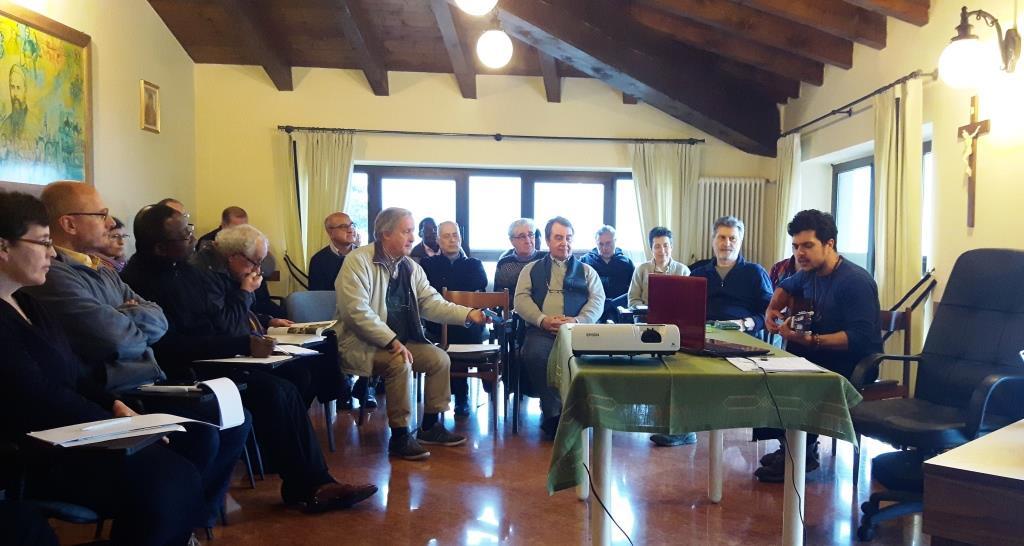
In Africa, corruption exacerbates poverty, reinforces inequality, and limits the population’s access to essential goods and services, preventing the improvement of living conditions for the majority. This issue must be understood as a structural, ethical, and spiritual crisis that demands a profound transformation of individuals, institutions, and social culture. The author, Father Endjegandeyo-Yepoussa Fugain Dreyfus [centered in the photo], a Comboni missionary from the Central African Republic, summarizes his master’s thesis in Moral Theology on this topic, which he defended at Loyola University of Granada, in Spain.
THE FIGHT AGAINST CORRUPTION IN AFRICA
AN ETHICAL, MORAL, AND CHRISTIAN IMPERATIVE

Corruption constitutes one of the main obstacles to human, social, political, and institutional development in Africa. It is not merely a legal or administrative problem, but a structural reality that directly affects the daily lives of millions of people. Its effects are seen in the deterioration of public services, in the inequality of access to education, healthcare, justice, and employment, as well as in the increase in poverty and social exclusion. Furthermore, it weakens trust in institutions and erodes the cohesion of collective life.
The gravity of the phenomenon also lies in its normalization. In many African contexts, corruption has ceased to be perceived as an exceptional deviation and has come to be considered a habitual, and even useful, practice for solving everyday problems. This social acceptance is particularly worrying because it reduces moral sensitivity to injustice and empties the ideal of the common good of its content. When corruption becomes embedded in customs and informal mechanisms of interaction, it ceases to be seen as a threat and begins to reproduce itself as part of the ordinary functioning of society.
From this perspective, corruption cannot be understood merely as the sum of individual acts. It manifests as a complex and multidimensional phenomenon. In the political sphere, it appears when those in power use it to favour private interests, manipulate democratic processes, or consolidate clientelism networks. On the economic and administrative level, it is expressed through the embezzlement of funds, bribery, the sale of offices, and the misuse of public resources. In social life, it takes on more everyday forms, such as informal payments or favours demanded to access basic rights. Added to this is a moral and spiritual dimension, visible when values such as honesty, justice, and responsibility are weakened, and even when these practices infiltrate institutions called to promote integrity.
The causes of this situation are diverse and deeply intertwined. Poverty is a significant factor, as in contexts of extreme need, some people resort to corrupt practices as a survival strategy. This is compounded by the weakness of judicial and political institutions, a lack of transparency, insufficient control mechanisms, and the persistence of particularist forms of loyalty that place the interests of the clan, family, or group above the demands of justice. However, one of the most decisive elements is the moral banalization of corruption. When a society stops perceiving it as an evil, it becomes much more difficult to combat it effectively.
The consequences derived from this phenomenon are profound. On the social and economic level, corruption exacerbates poverty, strengthens inequality, and limits the population’s access to essential goods and services. Resources that should be allocated to collective well-being are illegitimately appropriated, preventing the improvement of living conditions for the majority. This situation particularly affects the most vulnerable sectors and perpetuates a logic of exclusion that is passed down from generation to generation. In some cases, it also favours the unjust appropriation of land and natural resources, causing social conflicts and population displacement.
In the political and institutional sphere, corruption produces a crisis of legitimacy. Citizens lose trust in the state, in justice, and in democratic procedures, perceiving that institutions do not act in the service of the general interest. In this way, networks of impunity are consolidated, authoritarian practices are reinforced, and citizen participation is weakened. When people consider that reporting wrongdoing is useless or that voting changes nothing, democracy is progressively emptied of meaning. Corruption not only alters institutional functioning but also disfigures the very idea of politics as service.
On the moral and cultural level, the effects are equally grave. The constant repetition of corrupt practices ends up altering society’s scale of values. Honesty can be perceived as naivety, while deceit or personal gain come to be seen as signs of cleverness. This moral inversion erodes trust between people, weakens solidarity, and breaks the sense of community. Corruption then ceases to be merely a problem of rules and sanctions, becoming a profound crisis of conscience.
Faced with this reality, the response cannot be limited to legal reforms or external oversight mechanisms. Although these measures are necessary, they are insufficient if not accompanied by an ethical and spiritual transformation. The fight against corruption demands the recovery of the values of justice, the common good, responsibility, and human dignity. In this sense, the renewal of structures must go hand in hand with the renewal of consciences. Without a solid moral formation, laws may exist, but their effectiveness will always be fragile and limited.
Biblical and theological reflection offers an important foundation for this renewal. Corruption appears as a grave offence against justice and against the dignity of persons, especially the poorest. The prophetic tradition strongly denounces every form of manipulation of the law and exploitation of the weak. Likewise, the message of Jesus rejects hypocrisy, religious abuse, and the instrumentalization of power. Faith cannot be separated from the demand for justice. From this perspective, corruption is not just an administrative fault, but also a social sin that wounds the entire community and compromises the collective future.
In this framework, the Church is called to play a prophetic and pedagogical role. Its mission consists not only in publicly denouncing injustices, but also in forming responsible consciences, promoting a culture of integrity, and collaborating with civil society in the defence of the common good. However, this task demands internal coherence. The promotion of transparency, honesty, and responsibility must begin within the Church’s own structures, so that the testimony is credible and effective.
Overcoming corruption therefore requires joint and sustained action. It is fundamental to educate children from an early age in ethical values, strengthen the moral formation of political and religious leaders, consolidate transparent institutions, and foster an active citizenship that does not resign itself to injustice. Only through this convergence of education, moral commitment, institutional reform, and social responsibility will it be possible to build societies that are more just, more solidary, and more respectful of human dignity.
In conclusion, corruption in Africa must be understood as a structural, ethical, and spiritual crisis that cannot be resolved exclusively through external controls or legal reforms. Its eradication demands a profound transformation of individuals, institutions, and social culture. The recovery of the sense of justice, the common good, and collective responsibility thus appears as an indispensable condition for opening a horizon of authentic development, democratic coexistence, and hope for the African continent.
Father Endjegandeyo-Yepoussa Fugain Dreyfus, MCCJ