
Daniel Comboni
Comboni Missionaries
Institutional area
Other links
Newsletter
17th Sunday in Ordinary Time – Year A: Where is your treasure?


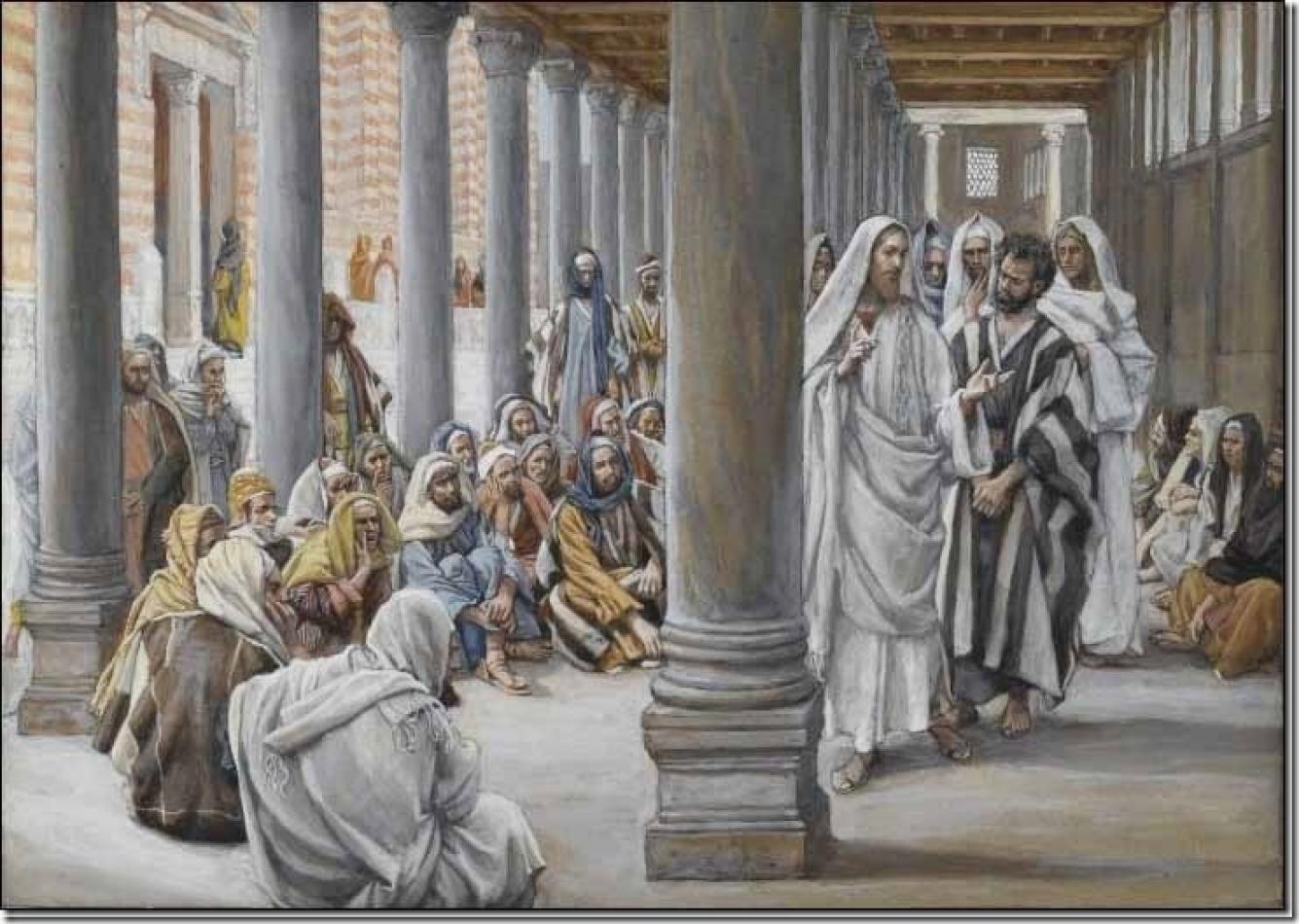
This Sunday we conclude our reading of chapter 13 of Matthew’s Gospel, which contains Jesus’ third great discourse, in which the Kingdom of God is presented through seven parables. Today we hear the final three, addressed to the apostles: the hidden treasure, the merchant in search of pearls, and the net that catches fish of every kind. (...)
Where is your treasure?
“The kingdom of heaven is like treasure hidden in a field.”
Matthew 13:44–52
This Sunday we conclude our reading of chapter 13 of Matthew’s Gospel, which contains Jesus’ third great discourse, in which the Kingdom of God is presented through seven parables. Today we hear the final three, addressed to the apostles: the hidden treasure, the merchant in search of pearls, and the net that catches fish of every kind.
The first two are similar and speak to us of the joy experienced by those who have discovered the Kingdom. The third, by contrast, recalls the parable of the wheat and the weeds, which we heard last Sunday, and concerns the coexistence of good and evil.
The parable of the net, like that of the wheat and the weeds, evokes the ‘end of the world’, that is, the conclusion of our life, as the supreme moment when its authenticity will be tested and the falsehood of those who ‘call evil good and good evil, who put darkness for light and light for darkness, who put bitter for sweet and sweet for bitter’ will be exposed (Isaiah 5:20).
Let us reflect on the two short parables of the treasure and the pearl.
1. WHO are the seekers of treasures and pearls?
‘The kingdom of heaven is like treasure hidden in a field; a man finds it and hides it again; then, filled with joy, he goes, sells everything he owns and buys that field.’
Stories about treasure are always fascinating, today as they were in the time of Jesus. In a land that was often the scene of wars, when an enemy approached, it was common for people to hide their wealth by burying it in a field or beneath the floor of their house before fleeing, in the hope of recovering it later. This, however, did not always happen.
The poor farm labourer in the parable is one of the fortunate people who, quite unexpectedly, finds the great opportunity of his life and does not let it slip away: filled with joy, he sells all his possessions and buys that field!
‘Again, the kingdom of heaven is like a merchant in search of fine pearls; on finding one pearl of great value, he goes, sells everything he owns and buys it.’
In the East, pearls were considered among the most precious of all things, just as diamonds are to us. They were a symbol of beauty, so much so that ‘Peninnah’, meaning ‘Pearl’, was also a name given to girls (cf. 1 Samuel 1:2). The merchant in the parable was searching for these pearls and, when he finds one of great value, he too does not hesitate to sell everything he owns in order to buy it.
Both the poor farmer and the wealthy merchant act in the same way: they find the treasure or the pearl, go away, sell everything and buy it. Yet while the farmer finds the treasure unexpectedly, the merchant finds the pearl after searching for it for a long time.
We are those seekers of treasures and pearls, of wealth and beauty, of perfection and infinity. Our life is a field scattered with treasures hidden beneath our feet, but the ‘mud’ prevents us from seeing them. Our life is a bazaar filled with pearls, often too covered in dust for us to perceive their splendour. Yet it sometimes happens that we sacrifice everything, our life and our soul, dazzled by something false, only to end up empty-handed.
2. WHAT are the treasure and the pearl?
What do that treasure and that pearl represent? For Solomon, they are Wisdom (cf. the first reading); for the psalmist, they are the Law, the Torah (cf. Responsorial Psalm 118); for Saint Paul, they are our vocation and God’s plan for our life (cf. the second reading). For Jesus, however, they are the Kingdom. We can nevertheless reflect on the two parables by broadening their perspective still further.
First and foremost, the treasure is Christ. For his sake, the apostles left everything behind, and many others after them have done the same. Paul regarded everything as rubbish compared with the surpassing worth of knowing Christ (cf. Philippians 3:8). Many Christians are prepared to give even their own lives rather than lose him.
There are, however, also those who have not discovered this treasure in Jesus: like the rich young man, who went away sorrowful; like Judas, who sold him for thirty silver coins; and like so many Christians who, having never truly encountered him, have exchanged him for a few worthless trinkets.
Yet we too are that treasure and that pearl which Christ found in the field or in the marketplace of the world. This is why he redeemed us ‘not with perishable things like silver or gold, […] but with the precious blood of Christ’ (1 Peter 1:18–19).
The people beside us are pearls too, often hidden behind their faults, their surliness and their shells.
3. WHERE can the treasure be found?
Where and how can we find the treasure or the pearl? Allow me to explain through a Hasidic tale — Hasidism is a Jewish spiritual movement — the story of Rabbi Eisik, son of Rabbi Jekel, of Kraków, as told by the Jewish philosopher Martin Buber.
‘After many years of severe poverty, which nevertheless had not shaken his trust in God, Rabbi Eisik received an instruction in a dream to go to Prague and search for a treasure beneath the bridge leading to the royal palace. When the dream was repeated for the third time, Eisik set out and reached Prague on foot.
The bridge, however, was guarded day and night by sentries, and he did not have the courage to dig in the place indicated. Nevertheless, he returned to the bridge every morning and wandered around it until evening. Eventually, the captain of the guards, who had noticed his comings and goings, approached him and kindly asked whether he had lost something or was waiting for someone. Eisik told him about the dream that had brought him there from his distant homeland.
The captain burst out laughing: “And you, poor fellow, have come all this way on foot because you believed a dream? Ha, ha, ha! You will have a hard time of it if you put your trust in dreams! In that case, I too should have set out in obedience to a dream and travelled all the way to Kraków, to the house of a Jew named Eisik, son of Jekel, to search for treasure beneath the stove! Eisik, son of Jekel… are you joking? I can just see myself going in and turning upside down every house in a city where half the Jews are called Eisik and the other half Jekel!” And he laughed again. Eisik bade him farewell, returned home and dug up the treasure.’
Martin Buber concludes: ‘There is something you cannot find anywhere else in the world; and yet there is a place where you can find it: where you are, in the innermost depths of your own being!’ (The Way of Man).
Fr Manuel João Pereira Correia, MCCJ
GOSPEL REFLECTION
Matthew 13:44-52
It often happens that archeologists discover, under the floors of houses, boxes or pots containing coins.They were probably placed there by the owners before turning to a hasty escape. In the imminence of war orof an enemy’s invasion, everyone tried to hide hurriedly whatever valuables they had and whatever they could not take with them. They hoped to recover it one day, as soon as the danger had passed. The real ownersmany times did not come back, and the house was occupied by others who had no suspicion of the wealth thatlay beneath their feet.
At the time of Jesus, treasures discovered by accident were fantasized. It was said of the poor laborers who, intending to plow another’s field, accidentally struck an obstacle. They bent to check and found a box full of jewelry, gems, and precious stones. The popular imagination loved to lull with these dreams of unexpectedstrokes of luck.
The first parable in today’s Gospel (v. 44) takes one of these stories: by pure accident a man discovers a treasure in the field he is working. He hides it again; goes to sell everything he has and buys that field.
Many stopped to quibble the moral behavior of this man and the legality of the financial transaction carried out by him. However, this is not the point in question. The commentators were intrigued by the fact that the discovered treasure was hidden again. It apparently seemed illogical and superfluous. This detail is instead precious. There is reason to believe that the poor farmer, attracted by the unmistakable sparkle of a golden object that has emerged from the ground, immediately intuited that, under the clouds, an immense wealthcould be hidden. He did not want to lose even a crumb, so he decided to buy the whole field.
We are thus introduced in the parable: the treasure which Jesus speaks about is the kingdom of heaven, the new condition where one who welcomes the proposals of the Beatitudes enters. It has an incalculable value and is only gradually discovered by one who decided to wager his own life on it.
The fact that this treasure is found by chance indicates its gratuity. God offers it freely to people. It is not a prize for their good works.
There is but a behavior to assume in front of this gift. Whoever finds it out should not hesitate, be perplexed or doubt. If one hesitates, he loses precious time, a favorable opportunity may escape and not return. The decision must be taken urgently; the choice cannot be delayed. One cannot miss the appointment with the Lord.
Then one has to bet everything. One is not asked to give up something, but to move all his thoughts, attention, interests, and efforts to the new target.
As it will also happen with the pearl, he treasure is not purchased in order to be sold and to repossess the goods found, but to keep it in lieu of what, until then, had given meaning to life. The discovery of the Kingdom of God involves a radical change. This is the meaning of the decision to “sell everything one has to buy the field.
This is what happened to Paul, the Jew and blameless fanatic, convinced that the Torah was the treasure that would give him salvation. One day, on his way to Damascus, he met Christ. All those things that he might have considered as profit, he reckoned as loss. “But once I found Christ, I have let everything fall away and I now consider all as garbage, if instead, I may gain Christ” (Phil 3:7-8).
Such a change causes surprise, wonder, and amazement. Who has not found the same treasure cannot comprehend, cannot find an explanation that justifies the novelty of life of one who has entered the Kingdom of God.
Whoever has seen the farmer selling everything to buy the field must have thought he was crazy: the barren and rocky land of Palestine does not justify such sacrifices. He alone was conscious of his choice: he was concluding the deal of his life.
Those who knew Paul—the scrupulous law observing rabbi—and suddenly saw him abandon his security to wager all for a condemned man must have considered him a fool: “Paul, you are mad; your great learning has deranged your mind” (Acts 26:24). Instead, Paul had found the most valuable asset, “Christ crucified! For the Jews a great scandal. And for the Greeks, what nonsense” (1 Cor 1:23).
By his joy, all—the farmer’s neighbors and Paul’s co-religionists—should have realized that he was acting with lucidity and for good reason. One who knew of possessing an unexpected and not hoped-for treasurecannot but be filled with joy: “My joy overflows” (2 Cor 7:4)—ensures the apostle—”I rejoice in the Lord” (Phil 4:10); “The Kingdom of God is ‘joy’ (Rom 14:17).
In short, whoever observes the radiant face of someone who has found the Kingdom of God would guess that he had glimpsed on, like the archaeologist Carter, “wonderful things.”
The second parable (vv. 15-16) is called the twin of the previous one and contains the same message. Itdiffers in some significant details: first of all, the protagonist is not a poor laborer, but a wealthy merchant who travels the orld with a very specific goal: to find pearls.
In ancient times, pearls were as valuable as diamonds are now. They were harvested from the Red Sea, the Persian Gulf, and the Indian Ocean. In the imperial era, they were considered the most valuable thing, so as to become proverbial. Aphrodite, the goddess of love and beauty, was worshiped as the goddess of pearls.A much-loved child was called “pearl”; a wise man is said to have a mouth from which pearls came out. The twelve gates of heaven—writes the seer of the Apocalypse—”were twelve pearls; each port is made of a single colossal and wonderful pearl” (Rev 21:21). Being considered of great value, Jesus chose them as an image of the inestimable treasure that he offered: The Kingdom of God.
Unlike the farmer who accidentally stumbles into a treasure, the merchant finds the pearl after an exhausting search. The two discoveries are results, one of a good fortune, the other of one’s commitment.
The behavior of the merchant is the image of the man who passionately seeks what gives meaning to his life and fills his days with joy.
The two parables are complementary: The Kingdom of God, on the one hand, is a free gift of God, and on the other is also a fruit of human diligence.
The third parable (vv. 47-50) takes up the theme introduced last Sunday in the parable of the wheat and the tares. The image is taken from fishing on the Sea of Galilee where nets and trawls caught good fish and also inedible or unclean ones were employed (Lev 11:10-11). On the beach, the fishermen proceeded to the separation. Thus—Jesus says—it happens in the kingdom of heaven.
According to the view of the ancients, the sea was the kingdom of the evil forces, enemies of life. The mission to “fish for people,” removing them from the power of evil was given to the disciples. Uncontrollable passions, egoism, greed envelop them like raging waves, which, like a vortex, drag them into the abyss. The kingdom of heaven is a net that pulls them out, makes them breathe, and leads them toward the light, toward salvation.
In this net, not only the good and the capable are welcomed, but everyone, without distinction. The Kingdom of God does not present itself today in a pure state. Within the Christian community, the presence of evil and of sin is serenely accepted beside the good. No one, though impure, must feel left out or be marginalized. This is a time of mercy and the patience of God who “does not want anyone to perish, but that all may come to conversion” (2 P 3:9).
Of course, the time of separation will come and Matthew, as he usually does, talks about it using the dramatic language of the preachers of his time. He employs images with which the Bible described the destruction of the enemies of the people of Israel (Ez 30:38-39): the righteous shall enter in peace and the wicked will be punished in a fiery prison.
In rabbinic literature, this judgment of God is often talked about. It is not to threaten eternal punishment for sinners, but to highlight the importance of the present time and the urgency of the decisions to take today. Every moment wasted is definitively lost; and mistakes done in this world will have eternal consequences. The possibility of dissipating or squandering one’s own existence by focusing it on wrong treasures is anything but remote. However, in the end, the separation will not be between good and bad, but between good and evil. Only the good will enter heaven, all the negativity will be annihilated first by the fire of God’s love.
The discourse of Jesus concludes with the question: “Have you understood” and with the call to the workof the scribe (vv. 51-52). The question is addressed to the disciples, to those who have found the treasure andthe pearl of great price. The kingdom of heaven they now possess has been prepared through the Old Testament (old things) and realized in Christ (the new stuff). Christians are encouraged to become aware, be well-informed, through the study of the sacred Scriptures, of the immense gift they have received from God.
READ: Those whom God predestined he called, and those whom he called he makes righteous, and to those whom he makes righteous he will give his glory.
REFLECT: God gives us a precious gift—his wisdom and knowledge—to do great things for His greater honor and glory!
PRAY: Let us be convinced that our calling and consecration are not privileges but a challenge to do our ultimate purpose in life.
ACT: St. Augustine said that who we are is God’s gift to us, what we make of ourselves is our gift to God. What kind of gift are we making of ourselves?
Fernando Armellini
Italian missionary and biblical scholar