
Daniel Comboni
Comboni Missionaries
Institutional area
Other links
Newsletter
Rome: Appeal to stop the conflict in Sudan
Thursday, July 30, 2026
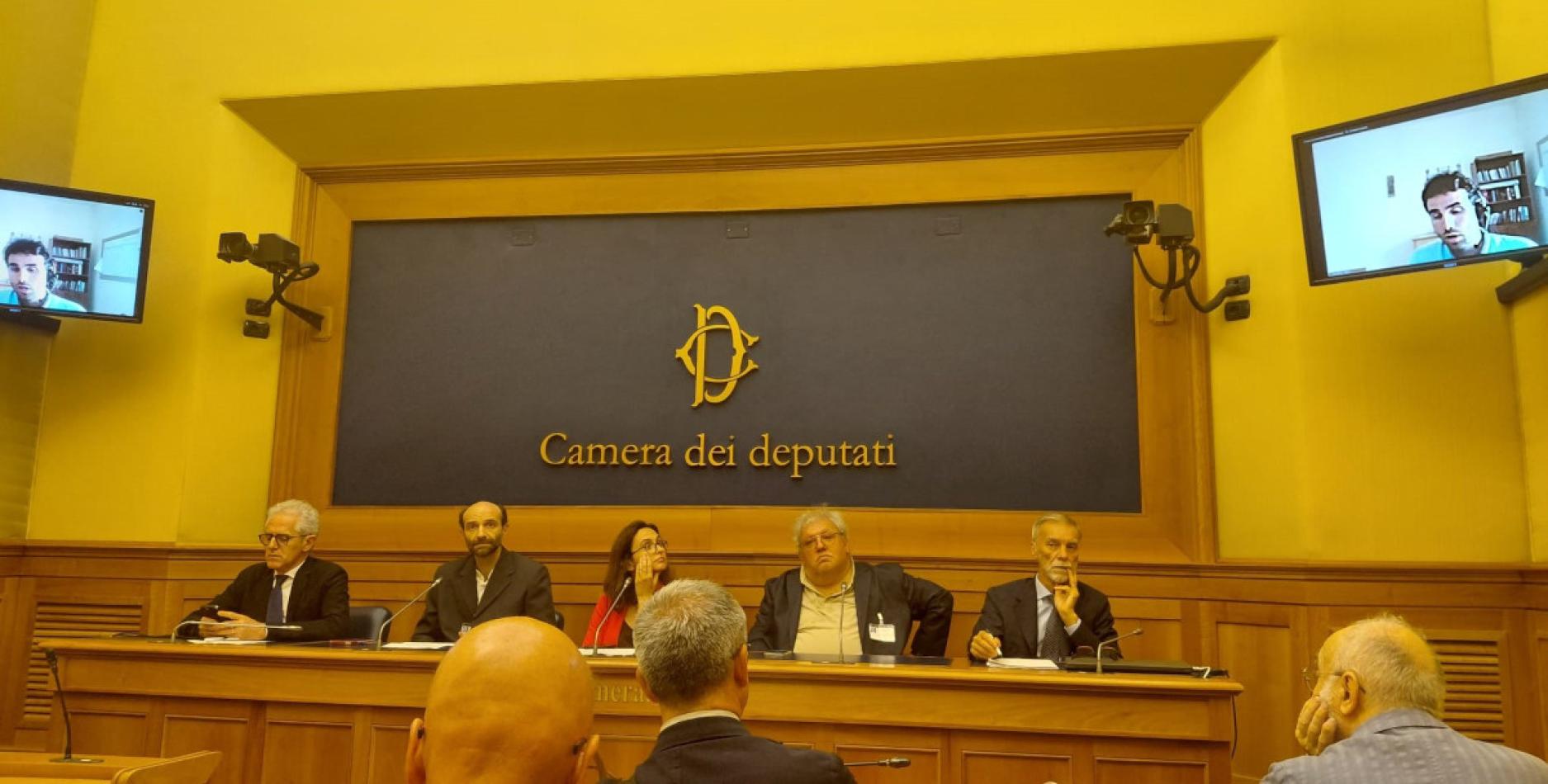
More than 1,200 days have passed since the beginning of the war in Sudan, but the silence surrounding this conflict continues to be deafening. To bring attention back to what is today one of the most severe humanitarian emergencies of our time, a press conference was held on July 28 at the Chamber of Deputies in Rome. It was promoted by MPs Lia Quartapelle and Paolo Ciani, Senator Graziano Delrio, and the Nigrizia Foundation ETS, alongside a day of symbolic fasting. [From left in the photo: Paolo Ciani, Dario Bossi, Lia Quartapelle, Antonio Soffientini, Graziano Del Rio]
The press conference had a dual objective: to denounce the dramatic worsening of the humanitarian situation in Sudan, particularly in the besieged city of El Obeid, and to present new international research documenting the link between the illicit gold trade and the financing of the war.
The Alarm for El Obeid
At the center of the conference was the situation in the city of El Obeid, in Kordofan, where thousands of civilians risk living through a new humanitarian tragedy, following what has already occurred in El Fasher. The Holy See, intervening at the United Nations Human Rights Council, also expressed strong concern over the imminence of a new catastrophe.
A particularly touching testimony came, via a video link, from Natalina Yacoub, originally from Kordofan and Secretary General of the Supreme Council for Social Peace. She spoke of families forced to leave their homes, children without schools, hospitals at breaking point, scarcity of food and medicine, and a population that lives every day in uncertainty about its survival.
Natalina called upon the Italian Parliament, the Government, the European Union, and the international community to strengthen diplomatic efforts and humanitarian support, reminding us that it is not enough to send aid if, at the same time, weapons continue to reach those who fuel the conflict.
The Gold That Finances the War
The conference also presented investigations conducted by Swissaid and The Sentry, which show how the clandestine gold trade represents one of the main sources of financing for both the regular Sudanese army and the Rapid Support Forces.
According to the research, between 50 and 70 tons of gold illegally leave Sudan every year, generating estimated profits of between USD 4.5 and USD 8 billion. Much of the metal transits through the United Arab Emirates, where its origin is often concealed before reaching international markets, including Europe. A portion of these flows also involves Switzerland, a major global center for gold refining.
For this reason, the Nigrizia Foundation drew attention to the need to strengthen controls along the entire gold supply chain and to verify with greater transparency the flows that also reach the Italian market.
A Commitment That Continues
For over two years, the Comboni Missionaries and the Nigrizia Foundation have been working to keep attention high on the war in Sudan, intervening with the Italian Parliament, the European Parliament, and numerous national and international institutions.
This work is carried out together with a network of about twenty Italian and Sudanese organizations, including ACLI, Amnesty International Italy, ANPI, AOI, ARCI, Baobab Experience, Caritas Italiana, CIPAX, International Committee for Peace in Sudan, Community of Sant’Egidio, Sudanese Community in Italy, Economia Disarmata – Movimento dei Focolari Italia, Emergency, FOCSIV, Doctors Without Borders (Medici Senza Frontiere), Comboni Missionaries in Italy, Nigrizia Foundation ETS, Italian Network for Peace and Disarmament (Rete Italiana Pace e Disarmo), and Un Ponte Per.
The Next Steps
Several concrete initiatives emerged from the press conference.
The promoting parliamentarians will present a parliamentary question to the Italian Government to ask what information is available regarding gold flows potentially traceable to Sudan that, passing through the United Arab Emirates, Switzerland, or other third countries, reach the Italian and European markets, and what measures Italy intends to adopt to prevent such imports from contributing, even indirectly, to the financing of the war.
In parallel, the Nigrizia Foundation and the network of civil society organizations are contributing to the revision of European regulations on minerals from conflict zones and due diligence legislation. Among the proposals presented are the obligation to monitor the entire gold supply chain, not just the last supplier, to prevent the “laundering” of the metal’s origin, and the extension of the definition of “high-risk countries” to include states that support armed groups or trade resources that finance their activities.
Breaking the silence on Sudan means it is necessary to give a voice to the victims and also to intervene in the economic mechanisms that allow the war to continue, seeking to limit or interrupt the financial flows that fuel the conflict.
To follow the press conference, click here.
Father Dario Bossi, MCCJ