
Daniel Comboni
Comboni Missionaries
Institutional area
Other links
Newsletter
Solemnity of Our Lord Jesus Christ, King of the Universe
Today, the last Sunday of the liturgical year, we celebrate the Solemnity of Our Lord Jesus Christ, King of the Universe. This feast was introduced by Pope Pius XI in 1925, in a historical period marked by the difficulties and turmoil of the immediate post-war years. The Gospel text for today is taken from Saint Luke, who has accompanied us throughout this liturgical year, cycle C.
The King, crucified with us wrongdoers
“Today you will be with me in Paradise.”
Luke 23:35–43
Today, the last Sunday of the liturgical year, we celebrate the Solemnity of Our Lord Jesus Christ, King of the Universe. This feast was introduced by Pope Pius XI in 1925, in a historical period marked by the difficulties and turmoil of the immediate post-war years. Pius XI was convinced that only the proclamation of Christ’s kingship over all peoples and nations could guarantee peace. With the liturgical reform following the Second Vatican Council, the feast was placed at the end of the liturgical year, as its natural conclusion. The Gospel text for today is taken from Saint Luke, who has accompanied us throughout this liturgical year, cycle C.
The Mother of the King and her long travail
Luke opens his Gospel with the account of a double heavenly visitation: one to Zechariah in the Temple of Jerusalem, and the other to Mary in Nazareth of Galilee. To Mary, the angel Gabriel makes a solemn and striking announcement and promise: “You will conceive and bear a son, and you shall name him Jesus. He will be great and will be called Son of the Most High; the Lord God will give him the throne of David his father, and he will reign forever over the house of Jacob, and his kingdom will have no end” (Lk 1:31–33). Son of the Most High and King! His kingship is emphasised three times, and twice it is stated that it will be eternal.
The entire Gospel of Luke unfolds around this promise, carried forward at a pace painfully slow for our expectations and in ways paradoxical according to our criteria.
-
A king at the mercy of the emperor of Rome. Mary is forced to go to Bethlehem to give birth. The Word comes to her aid: David his father was born in Bethlehem!
-
A king who is born in a stable. Yet the Word reminds her that God chose David his servant “and took him from the sheepfolds” (Ps 78:70).
-
A king who must flee from Herod’s murderous fury. The Word of God supports her once more: David too became a fugitive to escape King Saul.
-
A king who goes to live on the outskirts of the kingdom, in a remote Galilean village called Nazareth. And again the Word comes to Mary’s aid: “He shall be called a Nazarene” (Mt 2:23). The Hebrew name “Nazareth” shares the same verbal root naszar, meaning “shoot”, the shoot of David (Is 11:1).
But then follow thirty long years in which the King works as a carpenter, putting Mary’s faith to the test!
The King who came from afar to claim his Kingdomà
All of Luke’s Gospel is woven around this twofold revelation: Jesus, Son of God and King Messiah.
In the first part, Jesus is proclaimed Son of God by the Father, at his baptism and on Mount Tabor, but only Satan and the possessed recognise him as such.
In the second part of Luke’s Gospel, the Kingdom of God becomes the central theme of his preaching. At a certain point, Jesus sets out on the road to Jerusalem (Lk 9:51) to claim his title as King. As he himself recounts in a parable while ascending from Jericho to the Holy City: “A man of noble birth went to a distant country to receive kingly power and then return” (Lk 19:12). He receives it on the occasion of his “second baptism” (cf. Lk 12:50), the baptism of blood, on the throne of the Cross: “This is the King of the Jews”.
Along the journey from Galilee to Jerusalem, however, Jesus gradually alienates his followers, who were expecting quite a different kind of king. There is one last enthusiastic attempt by his fellow Galileans to proclaim him king—his triumphal entry into Jerusalem—but it fails immediately. The religious and political leaders soon regain control. And the crowd of his supporters, intimidated and disappointed, simply watch, waiting to see what will happen next. His disciples do the same.
Thus, a king without a kingdom, without subjects, without an army or lieutenants. The king will find himself alone!
A king targeted by temptation
His title of Son of God had been tested three times by Satan: “If you are the Son of God…”. Now the “appointed time” arrives for the return of the Adversary (cf. Lk 4:13). Indeed, the devil renews his attack three more times, through three protagonists of the crucifixion: the religious leaders, the soldiers, and one of the wrongdoers: “If you are the Christ, the King of the Jews, save yourself.”
If, in the first series of temptations, Jesus drove the devil away with the Word, now he does so with Silence. Yes, he speaks three times: but the first and the third are addressed to the Father (Lk 23:34.46), and the second is spoken in response to the plea of the second wrongdoer.
A king with only one subject
“Jesus, remember me when you come into your kingdom. He replied, Truly I tell you, today you will be with me in Paradise.” Astonishing! This wrongdoer is the only one to recognise Christ’s kingship and becomes the first citizen of his Kingdom.
According to certain authors, the dialogue between Jesus and the second wrongdoer is not a mere detail added by the evangelist, but the climax and central point of Luke’s account of the crucifixion (J.A. Fitzmyer and W. Trilling). In this sense, it becomes the synthesis and pinnacle of Jesus’s mission according to Luke’s Gospel: “For the Son of Man came to seek out and save what was lost” (Lk 19:10).
Apocryphal tradition (the Gospel of Nicodemus, a 4th-century apocryphon) gives the so-called good thief the name Dismas, placing him on the right of Jesus, while the other, who insulted him, would be called Gestas. And Dismas becomes… Saint Dismas, very popular in the Middle Ages. The Church celebrates him on… 25 March, a date linked by tradition to the death of Jesus! “A saint at once!”, by direct decree, is the first act of the King: “Truly I tell you: today you will be with me in Paradise”! Not even John Paul II achieved such a feat, despite popular acclamation!
“Today you will be with me in Paradise!” Saint Luke is the evangelist of “today”, semeron (ten times, eight of them on Jesus’s lips). This is the last occurrence of that temporal adverb. On Jesus’s lips, it becomes his supreme word. It is the today of mercy which introduces us into the eternal TODAY. A word therefore full of hope and consolation, for Dismas and for us, since this “today” still continues (Heb 3:13). Indeed, “God again sets a certain day—today” (Heb 4:7) for each one of us. How could we fail to make use of it?
Gestas or Dismas?
The name Gestas, in a somewhat imaginative interpretation, could mean, from the Latin gesta (heroic deeds). Dismas, on the other hand, would mean “sunset”, from the Greek. Gestas and Dismas could reflect our humanity, two opposing ways of conducting one’s life.
We are all “wrong-doers” and, sooner or later, we find ourselves in some way on the cross. And then we have only two alternatives: to place our trust in the works of our own hands, or to entrust our life into the hands of God. We can be like Gestas and look back on the “deeds” of our past: at times proud of our achievements, but more often disappointed and embittered. Or we can act like Dismas: look towards the cross of the King and implore with trust: Jesus, remember me! Jesus, remember me! Only he can fill our sunset with serene light!
Fr Manuel João Pereira Correia, mccj
REMEMBER ME
Luke 23:35-43
According to Luke’s account, Jesus has suffered agony in the midst of mockery and scorn from those around him. No one seems to have understood his life. No one seems to have caught on to his self-giving for those who suffer, or his forgiveness of those who are guilty. No one has seen in his face the compassionate gaze of God. No one today seems to sense much mystery in such a death.
The religious authorities make fun of him with contemptuous gestures: he has tried to save others; let him save himself now. If he is the Messiah of God, God’s «Chosen One», God will come right to his defense.
Even the soldiers join with taunts. They don’t believe in anyone Sent by God. They laugh at the sign that Pilate commanded be placed on the cross: «This is the king of the Jews». It’s absurd that someone can reign without power. Let him show his strength by saving himself.
Jesus keeps quiet, but doesn’t come down from the cross. What would we have done if the one sent by God sought his own salvation by escaping from that cross that unites him forever with all who have been crucified throughout history? How could we believe in a God who abandons us and leaves us on our own forever?
Right then, in the midst of so much mockery and scorn, there’s a surprising statement: «Jesus, remember me when you come into your kingdom». It isn’t a disciple or one of Jesus’ followers. It’s one of the two delinquents crucified next to him. Luke puts him forth as an admirable example of faith in the Crucified.
This man, at the point of dying as a condemned man, knows that Jesus is innocent, that he hasn’t done anything but good to everyone. He senses in Jesus’ life a mystery that has eluded him, but he’s now convinced that Jesus isn’t going to be defeated by death. From his heart is born a plea. He only asks Jesus to not forget him: Jesus will be able to do something for him.
Jesus answers right away: «Today you will be with me in paradise». For now these two are united in pain and powerlessness, but Jesus welcomes him as an inseparable companion. They will die crucified, but will go together into God’s mystery.
Immersed in today’s unbelieving society, many go about confused. They don’t know if they believe or not. Almost without knowing it, they carry in their hearts a small and fragile faith. Sometimes, without knowing why or how, when they are exhausted by life’s heaviness, they call out to Jesus in their own way. «Jesus, remember me» and Jesus hears them: «You will be with me always». God has a way to meet up with each person and these ways don’t always pass through ways we think of. What’s decisive is to have a heart that opens us to the mystery of God incarnate in Jesus.
José Antonio Pagola
Translator: Fr. Jay VonHandorf
https://www.feadulta.com
GOSPEL REFLECTION
A Cross for a Throne
The Israelites were expecting a great king. They dreamed of him wrapped in precious vestments, strong, sitting on a golden throne. They wanted to see him rule over all peoples and humiliate the enemy, forcing them to fall prostrate at his feet and lick the dust (Ps 72:9-11). They harbored the hope that his kingdom would be eternal and universal.
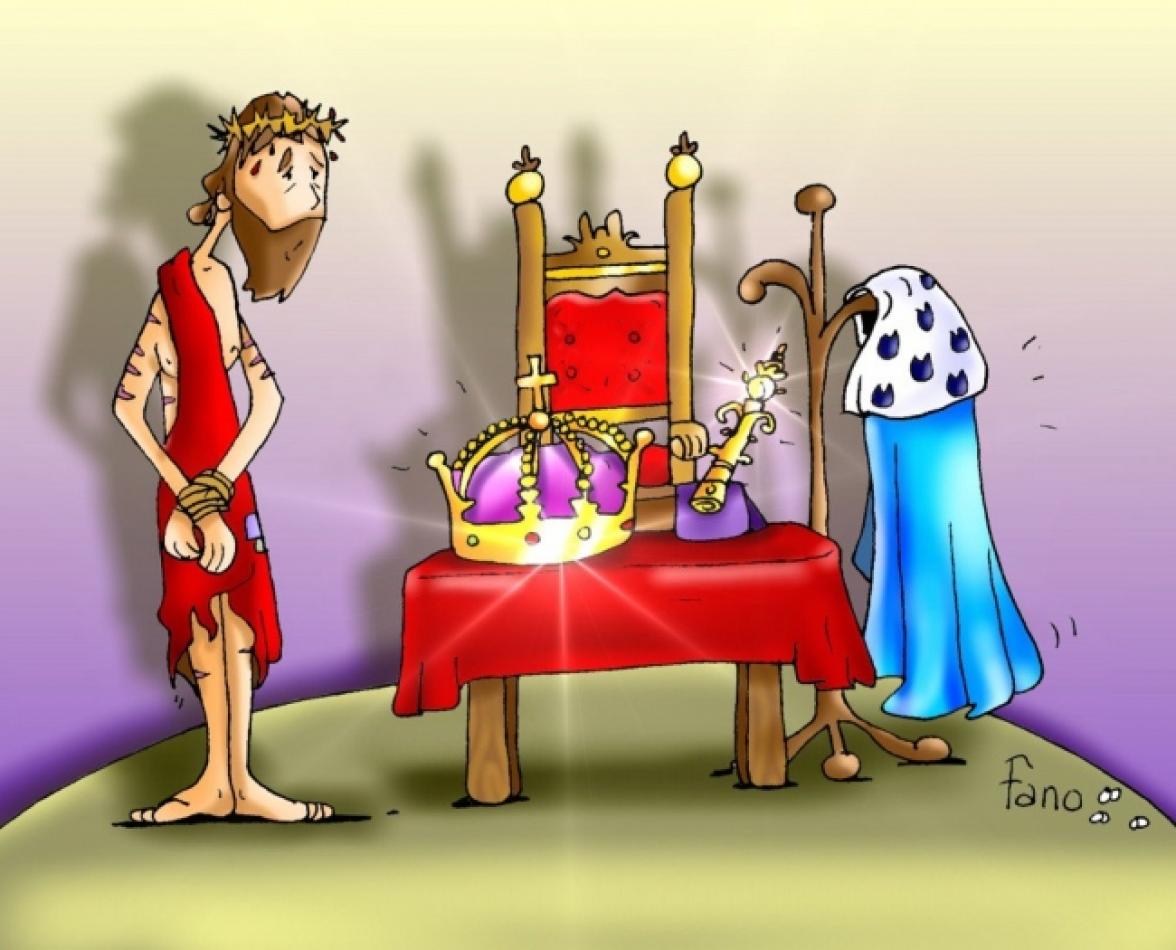
In the Gospel passage God’s response is presented to these expectations. We are on Calvary, and Jesus is crucified, two bandits at his side, and above him an inscription was written: This is the king of the Jews (v. 38). Would he be the expected son of David? No, it is not possible: he is just an unfortunate one. Where are the signs of kingship?
He does not rule from a golden throne; he is nailed to a cross. He is not surrounded by servants who pay him homage and stoop at his feet. There are no soldiers ready to take his every order. He stands in front of people who insult him and laugh at him. He is not wearing luxurious trappings and is completely naked.
He does not threaten anyone and uses words of love and forgiveness for all. He does not force his enemies to lick the dust. It is he himself who drinks vinegar. He has no ministers, army generals at his side but two criminals.
One day, James and John would ask him: “Grant us to sit, one at your right hand and one at your left” (Mk 10:37). Had they known what they were asking for….
What a strange kingship Jesus has! It is the opposite of what people are accustomed to imagine. Unfortunately, many Christians have not grown hopes different from that of the Jews. They identified the kingdom of Christ with victories and triumphs and with the respect the church leaders instill in the great people of this world.
The inscription on the cross proclaims the king of the Jews a defeated person, unable to defend himself and devoid of any power. This kind of king destroys all our projects. Then the question insistently comes back: how is it possible that he is the promised messiah? Let us look closely at the three scenes that are described in today’s Gospel.
In the first scene (vv. 35-37), three groups of people at the foot of the cross, at the foot of the “king”, are introduced.
First of all, the people present: How do they behave? They do nothing, neither good nor bad; they are observing (v. 35). They are amazed; they seem not to realize what is happening. They do not understand how a man who dies without reacting may be the long-awaited king. He is a righteous person, but then why does not God intervene to save him?
We noticed several times during this liturgical year that Luke has great sympathy for the poor, the last and the simple people. This evangelist presents to us the silent and perplexed people at the foot of the cross. He wants to tell us that they are not responsible for the death of Jesus. A few verses later he notes: “All people who had gathered to watch the spectacle, as soon as they saw what had happened, went home beating their breast” (Lk 23:48).
The amazed people represent all those well-disposed people who would like to understand the plan of God but they cannot because the one who would enlighten them, in turn, is blind.
Besides the people, there are the leaders at the foot of the cross. They are the real culprits! They, like the elders of Israel who have anointed David king at Hebron, should recognize in Jesus the promised Messiah. Instead, they laugh at him: he is not the king that they like; he is a loser, unable to save himself and does not come down from the cross (v. 35).
Why does Jesus not give the proof that they ask for? Why does he not descend from the cross? Why does not he accomplish the miracle? If he did he would convince all and would avoid a huge crime. If he came down from the cross, everyone would believe. But in what would they believe? In a strong and mighty God, in a God who defeats and humbles the enemies, who answers tit for tat to the provocations of the wicked, who inspires awe and respect, and does not joke… This is not the God of Jesus.
If he came down from the cross he would betray his mission: he would be supporting the false idea of God that the spiritual leaders of the people have in mind. He would be confirming that the true God is that which the powerful of this world have always adored because he is similar to them: strong, arrogant, oppressive, vindictive and armed.
This mighty God is incompatible with the one revealed to us by Jesus on the cross: the God who loves everyone, even those who fight him, always forgives, saves and lets himself be defeated for love.
God is not all-powerful because with his immense power he can do what he wants, but because he loves so immensely, he puts himself without limits and conditions to the service of persons. His is not the omnipotent of domination but of service. We have seen it in Jesus who stoops to wash the disciples’ feet: that is the authentic face of the omnipotent God, the King of the universe.
The third group at the foot of the cross is composed of the soldiers. These are poor men, snatched from their families and sent, for little money, to commit violence against a people of different language, custom and religion. They are far from their wives, children, friends, and have lost all human feelings and unleash themselves against those weaker than them. They are not perpetrators but victims of the folly of others superior to them.
They only know how to follow orders. They cannot express their opinion; they repeat the words they have heard uttered by their leaders: “If you are the king of the Jews, save yourself ” (v. 36).
For fear, for very little money, out of ignorance they sold themselves and their conscience. They collaborate in injustice, abuse and violence against the most vulnerable. They have been brought up to believe in the strength and power of weapons, to respect the winner and mock the loser. Now Jesus is on the side of the losers.
The second scene (v. 38) occupies the center of the passage. It presents the inscription placed above the head of Jesus.
Luke seems to address an invitation to the Christians of his and our communities: contemplate the king nailed to the cross. In front of him, every lust for glory, will to rule and desire to reach the top, is ridiculous. From the cross Jesus points out to all, who is the king chosen by God: he is the one who accepts humiliation, who knows that the only way to give glory to God is to choose the last place to serve the poor.
We have contemplated the two scenes of what happens at the foot of the cross and then the inscription posted above.
The third scene (vv. 39-43) takes place at the sides of Jesus, where two criminals are crucified. Like the people, the leaders, the soldiers, one of the two does not understand anything. The only thing he expected from the Messiah is freedom from torture he was subjected to. Jesus does not help him; he shows himself unable to meet his request.
The second thief is the only one who recognizes in Jesus the expected king: “Jesus, remember me when you enter into your kingdom.” He calls him by name. He understood that he can confidently call him this way. He considers him as a friend the friend of someone who has had a devastated life. He does not consider him a “gentleman” but a traveling companion, some one who agreed to undergo, despite being right, the fate of the wicked.
He does not expect a miraculous deliverance from Jesus. He asks only to accomplish with him the last steps of life and the life that has been a succession of mistakes and crimes.
Jesus promises him: Today you will be with me in paradise.
The history of this criminal is that of every person; who has not acted like him? Who has not panned sometimes the life of a brother with hatred, slander, and injustice? Who has not provoked small or big disasters in society, in families, in the Christian community?
At heart, many continue to think that, on the cross, the kingship of Jesus is not well celebrated. That was just only an unfortunate moment. The real manifestation will take place later, at the end of the world, at the moment of reckoning. Then the glory of Christ will shine: he will come with his army of angels and will show to all, especially to those who crucified him his power.
Before he died, Jesus gave a judgment of acquittal to his executioners. Will it also be valid at the end or is it a provisional statement, susceptible to revision? Is it true that those who condemned and killed him did not know what they were doing (Lk 23:34)? Maybe someone believes that Jesus on Calvary was not in the ideal conditions to objectively assess the responsibilities of those who were crucifying Him, still less, to manifest all his glory.
Well, if we still cultivate such thoughts, we have not captured the face of God that Jesus has revealed to us.
The trial against those who killed Jesus—let it be clear—will not be reopened: there will be no revision of the judgment. Jesus gave his final judgment: he absolved his executioners, saved them in the most glorious moment of his life when, on the cross, he showed the utmost of his love. For us a king triumphs when he wins, defeats, humiliates. We try in every way to conform the image of Christ the King to that of the kings of this world. We do not want to believe that he wins in the moment in which he loses, in the moment he gives his life. This ruler who reigns from a cross disturbs us because he requires a radical change of the choices in our lives. He requires, for example, that we offer an unconditional forgiveness to all those who do us harm.
In this perspective, the final judgment should not be feared, but expected with joy because … it will occur with roles reversed. In the end it will not be God who judges us, but we to judge him.
Stripped of miseries, meanness and pettiness that have burdened our minds and hardened our hearts, cured of spiritual blindness that prevented us to understand the Scriptures (Lk 24:25), “they will see his face” (Rev 22:4), “see him as he is” (1 Jn 3:2). Then we will be able to deliver an objective judgment on him. Amazed, we will be forced to admit: God is bigger than our hearts (1 Jn 3:20).
Fernando Armellini
Italian missionary and biblical scholar