
Daniel Comboni
Comboni Missionaries
Institutional area
Other links
Newsletter
2nd Sunday of Lent – Year A: The Gaze of Beauty
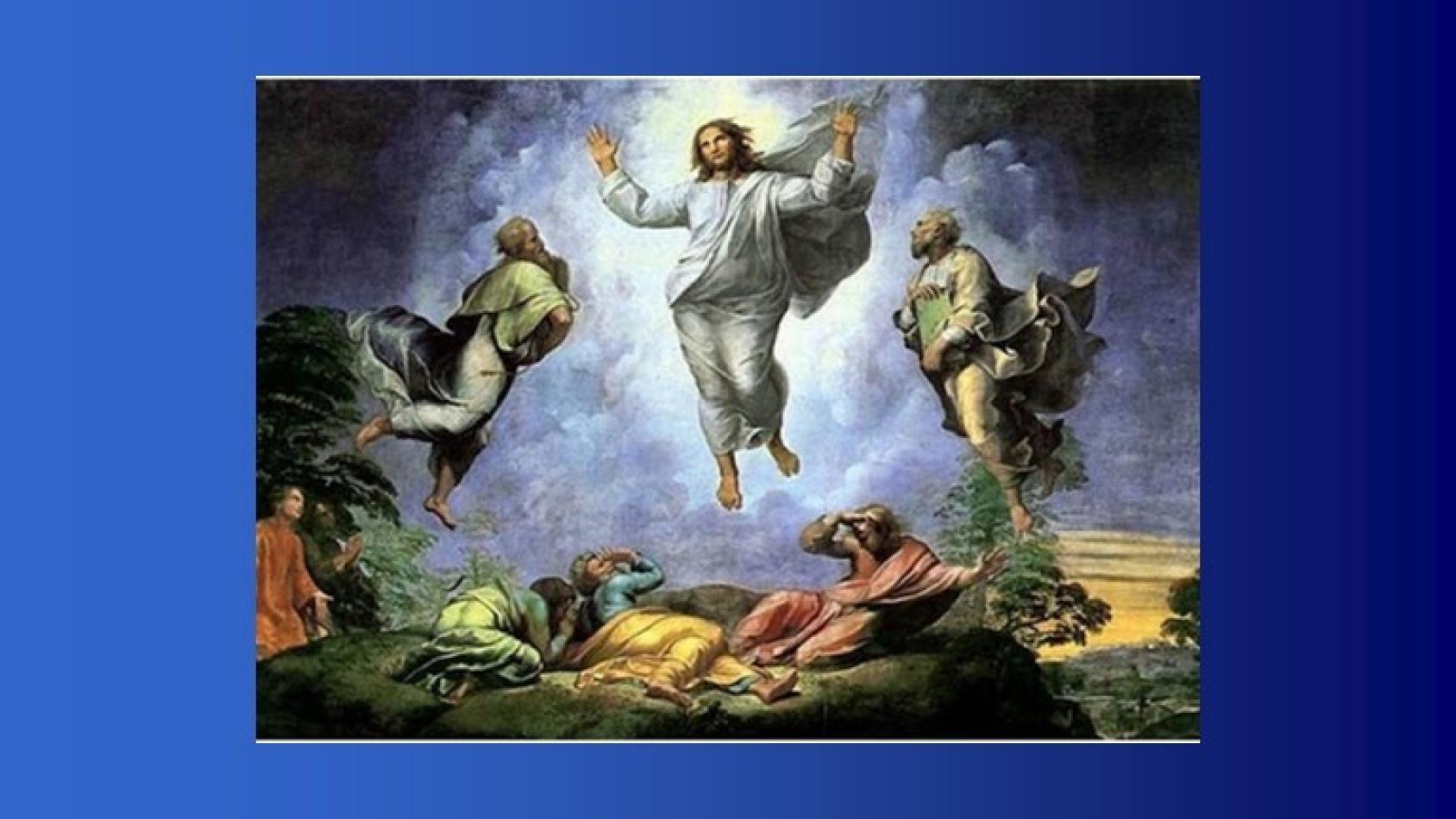

Each year, on the First Sunday of Lent, the Church presents the passage of the Temptations, and on the Second Sunday, that of the Transfiguration. They are therefore two Gospel texts typical of the Lenten journey. It is as if we are being told that there can be no Christian life without temptation, but neither can there be one without moments of light, of transfiguration.
“Lord, it is good for us to be here!”
Matthew 17:1–9
Each year, on the First Sunday of Lent, the Church presents the passage of the Temptations, and on the Second Sunday, that of the Transfiguration. They are therefore two Gospel texts typical of the Lenten journey. It is as if we are being told that there can be no Christian life without temptation, but neither can there be one without moments of light, of transfiguration.
1. First Reading: setting out again like Abraham
In the first readings of the Sundays of Lent, the liturgy sets before us, in broad outline, the history of salvation. Lent is a catechumenal journey, during which catechumens preparing for Baptism at Easter retrace the principal stages of biblical history. Together with them, we do the same, in order to renew our baptismal promises at Easter.
Last Sunday we encountered our first parents in their disobedience. Today we meet Abraham, the father of all believers, in his act of obedience to God’s call, which opens a new history, a history of grace: “Go from your country, your people and your father’s household to the land I will show you…”. So Abram went, as the Lord had told him. Abraham was eighty years old. For most people, it would have been time to rest, to enjoy what had been achieved and to come to terms with the disappointments of dreams shattered by life’s vicissitudes. But God did not think so: “Go!”, and he launches him into a new adventure.
God unsettles the plans of Abraham and of every believer. He always wants us on the move. Perhaps we too, in one way or another, are being called to change direction. “It’s no longer for me. The game is over!”, we might say, with a mixture of disappointment and resignation. And yet God invites us to stake our lives once more. Not by calculating human possibilities, but by investing everything in faith in God.
“Go!”. Yes, this is the time for all of us to change land. Perhaps we have lived in the “land of our projects”. Today, however, God invites us to move into the “land of his promise”. Those who live by projects “project” their lives out in front of themselves as protagonists, making their own calculations. Those who live by promises, on the other hand, welcome the “promise” that God places before them and entrust themselves with confidence.
The protagonists of this Sunday’s readings are all men who invested their lives in God’s “promise”: Abraham, Moses, Elijah, Peter, James, John, Paul, Timothy… They belong to a long and unbroken line of women and men who believed in God’s promise. Their lives were troubled. They knew joy and enthusiasm, but also trial and discouragement; light and inspiration, but also doubt and confusion; consolation and success, but also defeat and desolation. Yet they never ceased to follow the star of God’s promise.
2. Gospel: towards light and beauty
The ascent: from mountain to mountain
From the “very high mountain” of the supreme temptation, today we are led by Jesus apart to a “high mountain”: “Jesus took with him Peter, James and John his brother and led them up a high mountain by themselves. There he was transfigured before them.” This “high mountain” may be an allusion to Sinai, where Moses and Elijah encountered God (Exodus 24:29–34; 1 Kings 19). These mountains have no name, not only because they are symbolic, but also because it is for us to give them a name.
The Transfiguration is a mystery of light. Three times its brightness is emphasised: the face of Jesus, his garments, and the luminous cloud. According to iconographic tradition, the icon of the Transfiguration is the test of maturity for every apprentice iconographer. All icons must be illuminated by the light of Tabor (the mountain on which the Transfiguration is traditionally said to have taken place). So it is for the Christian: maturity comes when the light of Tabor illuminates and transfigures the whole reality of the believer’s life.
The metamorphosis: from glory to glory
The Transfiguration is not only the mystery of Jesus’ metamorphosis, but also of our own transformation, and of the reality that surrounds us. Whatever is touched by its rays responds by revealing its inner beauty and deep harmony. The verb used here for transfiguration or metamorphosis (metamorphein) is very rare in the New Testament. We find it only here, in the Gospel account of the Transfiguration (Matt 17:2; Mark 9:2), and twice in Saint Paul (Romans 12:1–2; 2 Corinthians 3:18), always in the passive form.
Particularly striking is the apostle Paul’s statement in 2 Corinthians 3:18: “And we all, who with unveiled faces contemplate the Lord’s glory as in a mirror, are being transformed into his image with ever-increasing glory, which comes from the Lord, who is the Spirit.” It is a beautiful text, one to be kept in the memory of the heart. Here it is the face of the Christian that is bathed in the light of Christ’s face and reflects his glory, like a mirror. This light is not a passing event; it works within us a metamorphosis. We become the images we contemplate. If we feed our gaze, our imagination and our soul with images of apparent and fleeting beauty, we find ourselves naked and even disfigured. If, on the contrary, we nourish our hearts with true beauty, we truly become beautiful. This genuine and lasting beauty can also be seen in the luminous gaze of certain elderly faces, despite the wrinkles of age and the furrows left by life’s trials.
The meaning of our life is to be transfigured into the image of the Son. This transfiguration is not instantaneous; it is a long process. It requires constant contemplation of Christ’s face in prayer and faithful familiarity with the Word, in which that face is reflected. Thus the Voice of the Father, enveloped in the luminous Cloud of the Spirit, invites us to listen to the Son: “Listen to him” — listen to him, him alone!, in the literal translation.
The descent: towards wounded beauty
The mountain of the Transfiguration has two slopes: that of the ascent (luminous experiences of prayer) and that of the descent into the valley, into our daily life with its greyness and ugliness. They are the two faces of life, to be reconciled. The face of Christ, “the fairest of the sons of men” (Psalm 45), is that of the Transfiguration and of the Risen One. But it is also that of the Servant of the Lord who “had no beauty or majesty to attract us to him, nothing in his appearance that we should desire him” (Isaiah 53:2). It is easy, at certain moments, to say like Peter: “Lord, it is good for us to be here!” Harder is it to reach the point of saying, like the British Catholic writer Gilbert K. Chesterton (1874–1936), standing beside a dying friend and contemplating his deathly pale face: “It was good for me to be there!”
3. Conversion of the gaze
Lent is the time to convert our gaze to true beauty, because “Beauty will save the world”, affirms Fyodor Dostoevsky (in The Idiot). In meditating on the Gospel of the Transfiguration, we cannot forget the faces disfigured by suffering, injustice and war. For — as Pope Francis said — “The face of God is reflected in the faces of the poor.” And “the glory of God is that the poor should live”, proclaimed, in both word and life, Oscar Romero. “Every small act of love is a transfiguration”, reminds us Madeleine Delbrêl, French mystic and activist (1904–1964).
Nor can we ignore that the beauty of creation is disfigured by predatory greed: the conversion of our gaze is also an ecological conversion. Lent invites us to become apostles of what is beautiful and courageous prophets against the ugliness wrought by those who practise injustice.
Fr Manuel João Pereira Correia, mccj
Ascent and descent
Genesis 12:1-4a; 2 Timothy 1:8b-10; Matthew 17:1-9
Today the Gospel presents the Transfiguration. It is the second stage of the Lenten journey: the first was the temptation in the desert, last Sunday; the second, the Transfiguration. Jesus “took with him Peter and James and John his brother, and led them up a high mountain apart” (Mt 17:1). The mountain in the Bible represents a place close to God and an intimate encounter with Him, a place of prayer where one stands in the presence of the Lord. There up on the mount, Jesus is revealed to the three disciples as transfigured, luminescent and most beautiful. And then Moses and Elijah appear and converse with Him. His face is so resplendent and his robes so white that Peter, awe-struck, wishes to stay there, as if to stop time. Suddenly from on high the voice of the Father resounds proclaiming Jesus to be his most beloved Son, saying “listen to him” (v. 5). This word is important! Our Father said this to these Apostles, and says it to us as well: “listen to Jesus, because he is my beloved Son”. This week let us keep this word in our minds and in our hearts: “listen to Jesus!”. And the Pope is not saying this, God the Father says it to everyone: to me, to you, to everyone, all people! It is like an aid for going forward on the path of Lent. “Listen to Jesus!”. Don’t forget.
This invitation from the Father is very important. We, the disciples of Jesus, are called to be people who listen to his voice and take his words seriously. To listen to Jesus, we must be close to him, to follow him, like the crowd in the Gospel who chase him through the streets of Palestine. Jesus did not have a teaching post or a fixed pulpit, he was an itinerant teacher, who proposed his teachings, teachings given to him by the Father, along the streets, covering distances that were not always predictable or easy. Follow Jesus in order to listen to him. But also let us listen to Jesus in his written Word, in the Gospel. I pose a question to you: do you read a passage of the Gospel everyday? Yes, no… yes, no… half of the time … some yes, some no. It is important! Do you read the Gospel? It is so good; it is a good thing to have a small book of the Gospel, a little one, and to carry in our pocket or in our purse and read a little passage in whatever moment presents itself during the day. In any given moment of the day I take the Gospel from my pocket and I read something, a short passage. Jesus is there and he speaks to us in the Gospel! Ponder this. It’s not difficult, nor is it necessary to have all four books: one of the Gospels, a small one, with us. Let the Gospel be with us always, because it is the Word of Jesus in order for us to be able to listen to him.
From the event of the Transfiguration I would like to take two significant elements that can be summed up in two words: ascent and descent. We all need to go apart, to ascend the mountain in a space of silence, to find ourselves and better perceive the voice of the Lord. This we do in prayer. But we cannot stay there! Encounter with God in prayer inspires us anew to “descend the mountain” and return to the plain where we meet many brothers weighed down by fatigue, sickness, injustice, ignorance, poverty both material and spiritual. To these brothers in difficulty, we are called to bear the fruit of that experience with God, by sharing the grace we have received. And this is curious. When we hear the Word of Jesus, when we listen to the Word of Jesus and carry it in our heart, this Word grows. Do you know how it grows? By giving it to the other! The Word of Christ grows in us when we proclaim it, when we give it to others! And this is what Christian life is. It is a mission for the whole Church, for all the baptized, for us all: listen to Jesus and offer him to others. Do not forget: this week listen to Jesus! And think about the matter of the Gospel: will you? Will you do this? Then next Sunday you tell me if you have done this: that you have a little book of the Gospel in your pocket or in your purse to read in little stages throughout the day.
And now let us turn to our Mother Mary, and entrust ourselves to her guidance in pursuing with faith and generosity this path of Lent, learning a little more how to “ascend” with prayer and listen to Jesus and to “descend” with brotherly love, proclaiming Jesus.
Pope Francis
Lent 2014
Falling in Love With Christ
Why are faith and religious practice in decline and why do they not seem to constitute, at least not for most people, the point of reference in life?
Why the boredom, the weariness, the struggle for believers in performing their duties? Why do young people not feel attracted to the faith? In sum, why this dullness and this lack of joy among the believers in Christ? The event of Christ’s transfiguration helps us to answer these questions.
What did the transfiguration mean for the three disciples who were present? Up until now they knew Jesus only in his external appearance: He was not a man different from others; they knew where he came from, his habits, the timber of his voice. Now they know another Jesus, the true Jesus, the one who cannot be seen with the eyes of ordinary life, in the normal light of the sun; what they now know of him is the fruit of a sudden revelation, of a change, of a gift.
Because things change for us too, as they changed for the three disciples on Tabor; something needs to happen in our lives similar to what happens when a young man and woman fall in love. In falling in love with someone, the beloved, who before was one of many, or perhaps unknown, suddenly becomes the only one, the sole person in the world who interests us. Everything else is left behind and becomes a kind of neutral background. One is not able to think of anything else. A very real transfiguration takes place. The person loved comes to be seen as a luminous aura. Everything about her is beautiful, even the defects. One feels unworthy of her. True love generates humility.
Something concrete also changes in one’s own habits. I have known young people whose parents could not get them out of bed in the morning to go to school; or they neglected their studies and did no graduate. Then, once they fall in love with someone and enter a serious relationship, they jump out of bed in the morning, they are impatient to finish school, if they have a job, they hold onto it. What has happened? Nothing, it is just that what they were forced to do before they now do because of an attraction. And attraction allows one to do things that force cannot make one do; it puts wings on one’s feet. “Everyone,” the poet Ovid said, “is attracted by the object of his pleasure.”
Something of the kind must happen once in our lives for us to be true, convinced Christians, and overjoyed to be so. Some say, “But the young man or young woman is seen and touched!”
I answer: We see and touch Jesus too, but with different eyes and different hands — those of the heart, of faith. He is risen and is alive. He is a concrete being, not an abstraction, for those who experience and know him.
Indeed, with Jesus things go even better. In human love we deceive ourselves, we attribute gifts to the beloved that she does not have and with time we are often forced to change our mind about her. In the case of Jesus, the more one knows him and is together with him, the more one discovers new reasons to be in love with him and is confirmed in one’s choice.
This does not mean that with Christ too we must wait for the classic “lightning bolt” of love. If a young man or woman stayed at home all the time without seeing anyone, nothing would ever happen in his or her life. To fall in love you have to spend time with people!
If one is convinced, or simply begins to think that it is good and worthwhile to know Jesus Christ in this other, transfigured, way, then one must spend time with him, to read his writings. The Gospel is his love letter! It is there that he reveals himself, where he “transfigures” himself. His house is the Church: It is there that one meets him.
[Translation by Joseph G. Trabbic]