
Daniel Comboni
Comboni Missionaries
Institutional area
Other links
Newsletter
Ascension of the Lord – Year A: On mission, as eleven!
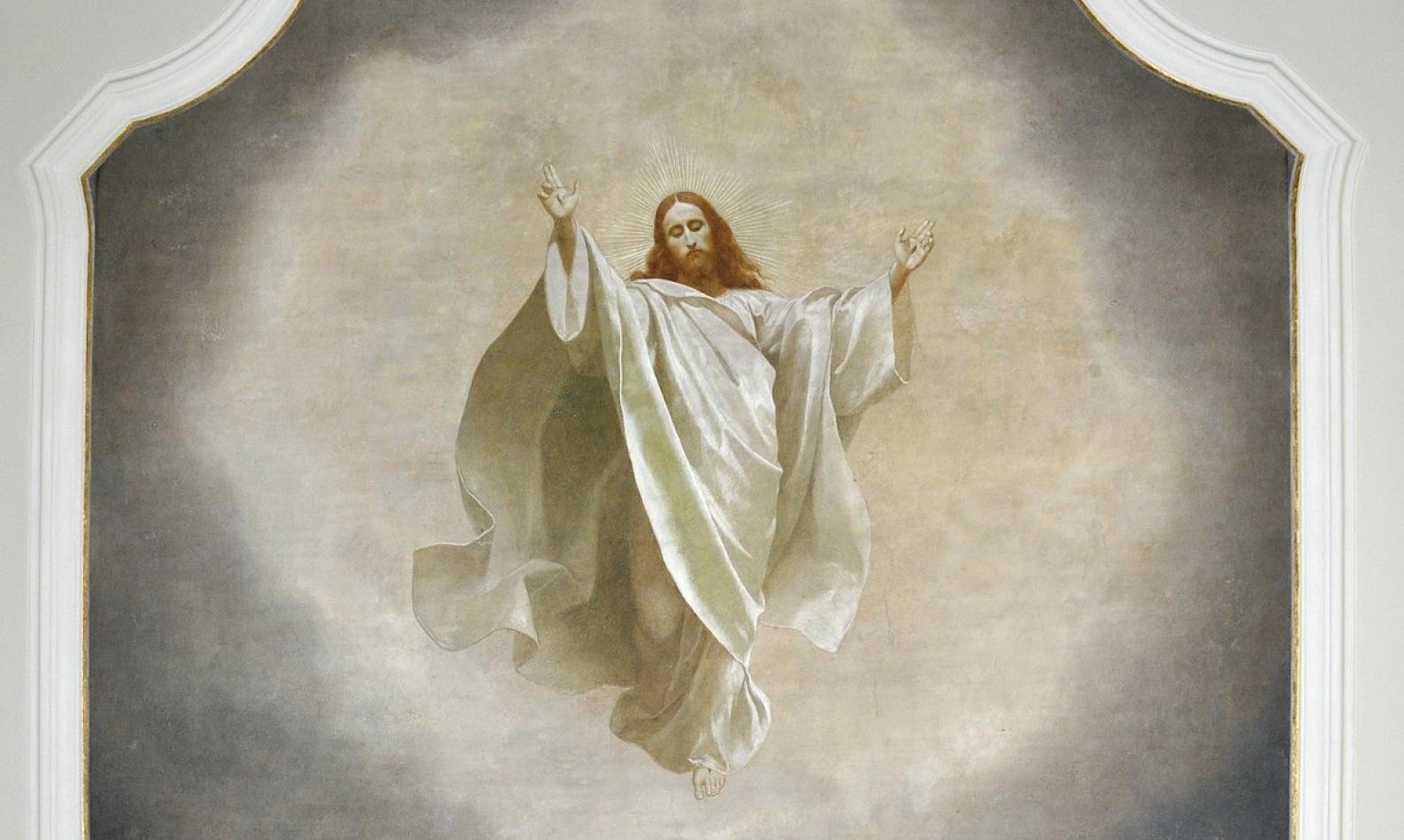

We have arrived at the feast of the Ascension of the Lord, which the book of the Acts of the Apostles symbolically places forty days after Easter (cf. first reading: Acts 1:1-11). It is particularly significant to note that this is the only appearance of Jesus to his disciples narrated in the Gospel of Saint Matthew. [...]
“Go therefore and make disciples of all nations.”
Matthew 28:16-20
We have arrived at the feast of the Ascension of the Lord, which the book of the Acts of the Apostles symbolically places forty days after Easter (cf. first reading: Acts 1:1-11). It is particularly significant to note that this is the only appearance of Jesus to his disciples narrated in the Gospel of Saint Matthew. Before this, in fact, he had appeared only to the two Marys who had gone to the tomb, entrusting to them the task of telling the disciples to go to Galilee: “Go and tell my brothers to go to Galilee; there they will see me” (Matthew 28:10).
This is not a historical inconsistency between the Gospels. The main events of Jesus’ life, handed down by the apostles, had by then become the common heritage of the Christian communities. When the evangelists wrote the Gospel, they gathered together certain accounts and gave them a literary structure, with a particular theological and catechetical orientation, bearing in mind the needs of their communities.
I share with you a few reflections, keeping before our eyes today’s Gospel — a text of just five verses — and seeking to interiorise its message. It is the conclusion of Matthew’s Gospel and therefore its summit, as well as the key to rereading the whole Gospel. It would be difficult to overestimate its significance.
1. Galilee, the place of the appointment
“The eleven disciples went to Galilee, to the mountain to which Jesus had directed them.”
Jesus appoints a meeting with the apostles far from the religious and political centre of Jerusalem: in Galilee, a place of periphery and frontier, where everything had begun. From there they set out again, no longer towards the centre, but towards the ends of the world, towards all peoples. It is the beginning of the great adventure of the Church, which will last “until the end of the world”. Jesus, who had set out from Galilee to bring his journey to completion in Jerusalem, now seems to leave behind the holy city and its temple: they are now realities whose time has passed!
Galilee is the place of ordinary life, where Jesus had met and called his disciples. It is the symbol of daily life. After Eastertide, the Risen Lord sends us back to our everyday life. It is there that we shall see him.
The appointment is on the mountain. This is the seventh and final mountain in Matthew’s Gospel: the mountain of mission. It corresponds to the first, the mountain of temptation, where the devil had tried to divert Jesus from God’s plan by offering him the power and glory of the world (Matthew 4:8).
2. The eleven disciples, the protagonists
They are eleven, only eleven, and no longer twelve. That absence will be heavy, embarrassing, full of questions, a cause of sadness and dismay. For this reason Peter will propose filling that empty place by choosing Matthias (Acts 1:26). But Matthias could represent each one of us.
It is with these eleven — a number that speaks of incompleteness and imperfection — that we too are summoned for the great mission. Given the immensity of the task, we would be tempted to take a census of the forces on which we can rely, as King David did, provoking God’s anger (cf. 2 Samuel 24:9). Are not many of our statistics, deep down, just this?
God seems almost to mock our calculations and continually reduces our forces, as he did with Gideon’s troops marching against the Midianites: from thirty-two thousand to three hundred men, so that “Israel might boast against me, saying, ‘My own hand has saved me’” (Judges 7:2). And now it will be with eleven men that Jesus will cause the world to ferment!
3. The doubt that makes faith true
“When they saw him, they worshipped him; but they doubted.”
They saw him, they worshipped him, yet they doubted! The women at the tomb, when they saw Jesus, “came to him, took hold of his feet, and worshipped him” (Matthew 28:9). Here, however, there is doubt, and it is Jesus who has to draw near to the eleven.
The evangelists make no allowances for the apostles! They highlight their limits, their weaknesses, their misunderstandings, their slowness: in a word, their inadequacy. They are men like us. Thinking of them, no one will ever again be able to say: “But how can you want to choose me, of all people?” We must not be ashamed of our doubts. Doubt takes seriously the greatness of faith.
4. All power to the… “cursed one” on the cross!
“Jesus came near and said to them: All authority in heaven and on earth has been given to me.”
He who had been judged by the religious authorities to be a blasphemer and accursed by God receives from the Father “all authority in heaven and on earth”! What irony! It gives us pause for thought, especially those of us who exercise “power” in the name of God!
Everything is now in his hands (John 13:3): in the hands of Love. Nothing and no one can snatch us from those hands (Romans 8:35; John 10:28). It is a consoling and liberating certainty, capable of untying the paralysing bonds of our fears.
5. The missionary mandate of the Church
“Go therefore and make disciples of all nations, baptising them in the name of the Father and of the Son and of the Holy Spirit, teaching them to observe all that I have commanded you.”
Go is the first command. To take up again the path of mission, the mission of Jesus. It is striking to see how, from the very beginning, the Church — a tiny and insignificant reality — had such a strong awareness of being sent to the whole world!
To make disciples: his, not ours. Baptising them in the name of the Father and of the Son and of the Holy Spirit, that is, immersing them — this is the meaning of the Greek verb “to baptise” — in the Love of the Trinity. Teaching them not as masters, but as disciples and witnesses of the one Master (Matthew 23:10).
6. The Ascension, the fullness of the Incarnation
“And behold, I am with you always, to the end of the age.”
This is the final word of Jesus, Emmanuel (Matthew 1:23). It is his incarnation in each one of us. Presence is something difficult to define. One can be present in body and absent in mind and heart.
The Ascension is not a departure, but a new and deeper mode of presence: Christ is “more inward to us than we are to ourselves”, to put it with Saint Augustine. For this reason Saint Paul could say: “It is no longer I who live, but Christ who lives in me” (Galatians 2:20).
7. A suggestion
When it seems to you that Christ is the great absent one in your life or in our society; when it seems to you that the “prince of this world” has taken power back into his hands… take up this Gospel again and listen to this word that will never pass away: “All authority in heaven and on earth has been given to me.”
And remember the final and definitive promise of Jesus: “And behold, I am with you always, to the end of the age.”
Fr Manuel João Pereira Correia, MCCJ
GOSPEL REFLECTION
Matthew 28:16-20
Matthew does not describe the Ascension of Jesus as the Acts of the Apostles do but, using different images, he suggests the same message. Unlike Luke and John, he places the encounter with the Risen not in Jerusalem but in Galilee. This geographical setting has a theological value: the evangelist wants to say that the mission of the apostles begins where their Master had begun.
Galilee was a despised region. Due to the frequent invasions from the north and east, it was inhabited by a diverse population, derived from a mixture of races. Isaiah designates it as “the land of the Gentiles,” that is, of the pagans (Is 9:1). The Orthodox Jews looked at it with suspicion and distrust. To Nicodemus, who shyly tried to defend Jesus, the Pharisees of Jerusalem objected: “Look it up and see for yourself that no prophet is to come from Galilee” (Jn 7:52). It is exactly to these semi-pagans—Matthew wants to say—that now the Gospel is destined. Jerusalem, the city that rejected the Messiah of God, lost her privilege to be the spiritual center of Israel.
The Risen One meets the disciples on the mountain (v. 16). Commenting on the Gospel of the Second Sunday of Lent, we have clarified the meaning of the mountain. It was the site of the manifestations of God; he was manifested to Moses and Elijah at the top of the mountain. Matthew often uses this image: he places Jesus on the mount every time he teaches or performs some particularly important acts. If one keeps this fact in mind, one can understand the meaning of the scene narrated in today’s passage: the sending of the disciples in the world is a decisive event. Not only that, but one who had the experience of the Risen Lord and has assimilated his message on the mountain is empowered to fulfill this mission.
The remark that “although some apostles doubted” (v. 17) is amazing. How could they still have doubts if they had already met the Risen Lord in Jerusalem on Easter Sunday?
From the point of view of catechesis, this particular remark is indicative. For Matthew, the Christian community is not made up of perfect people, but of people in whom good and evil, light and darkness continue to be present. We encounter this situation among the first disciples: they have faith, but they still have doubts and uncertainties. It is possible to believe in Christ and have doubts. The contrary is impossible: faith cannot exist together with the evidence. One cannot “believe” that the sun exists; there is the certainty, one can see it. The effects of its light and its heat are scientifically verifiable. In the field of faith, this evidence is impossible. Like the apostles, we, too, have a deep conviction of the truth of the resurrection of Christ, but it cannot be proven.
In the second part of the passage (vv. 18-20), there is the sending of the apostles to evangelize the whole world. During his public life, Jesus had sent them to announce the kingdom of heaven with these instructions: “Do not visit pagan territory, and do not enter a Samaritan town. Go instead to the lost sheep of the people of Israel” (Mt 10:5-6). After Easter, their mission expands; it becomes universal.
The light was enkindled in Galilee when Jesus, having left Nazareth, settled in Capernaum. “The people who lived in darkness have seen a great light; on those who live in the land of the shadow of death a light has shone” (Mt 4:16). Now its light must shine in the whole world. As the prophets have announced, Israel becomes “light of the nations” (Is 42:6). The time is decisive, and Jesus refers to his authority: he was sent by the Father to bring the message of salvation; now he entrusts this task to the community of the disciples, giving them his own powers.
The Church is called to make Christ present in the world. Through Baptism, she generates new children that are inserted in the communion of the Trinity, the Father, the Son and the Spirit. It is a sublime but difficult mission; it inspires awe and trepidation in those who are called to carry it out. Every vocation is always accompanied by human fear and by God’s promise that assures: “Fear not, I am with you.” God guarantees to Jacob on his journey to an unknown land: “I am with you and I will keep you safe wherever you go. I will not leave you” (Gen 28:15). To Israel deported to Babylon, God says: “Since you are precious in my sight, and important—for I have loved you. Fear not, for I am with you” (Is 43:4-5). To Moses who objects: “Who am I that I should go to Pharaoh and bring the people of Israel out of Egypt?” He replies: “I will be with you” (Ex 3:11-12). To Paul in Corinth, who is tempted to be discouraged, the Lord says: “Do not be afraid, for I am with you, so no one will harm you” (Acts 18:9-10).
The promise of the Risen Lord to his disciples, who are about to take their first tentative steps, cannot be different: “Behold, I am with you always, until the end of the world” (v. 20). The Gospel of Matthew closes as it had begun, with the appeal to the Emmanuel, the God-with-us, the name by which the Messiah was foretold by the prophets (Mt 1:22-23).
READ: The Gospel ends on a glorious and triumphant note. The eleven joyfully join Jesus on the mountaintop. Jesus has power over all, and he sends out his disciples to continue his ministry in all nations.
REFLECT: What a wonderful ending for the Gospel! So different from the other Gospels! The Church begins with Jesus commissioning the eleven. All are welcome to join!
PRAY: Pray for the evangelization of all people. Pray that the Gospel be preached from one end of the earth to the other.
ACT: Proclaim the Gospel by how you live. Let your actions flow from your beliefs. Jesus is risen! Alleluia!
Fernando Armellini
Italian missionary and biblical scholar