
Daniel Comboni
Comboni Missionaries
Institutional area
Other links
Newsletter
Pentecost Sunday – Year A: The four Pentecosts
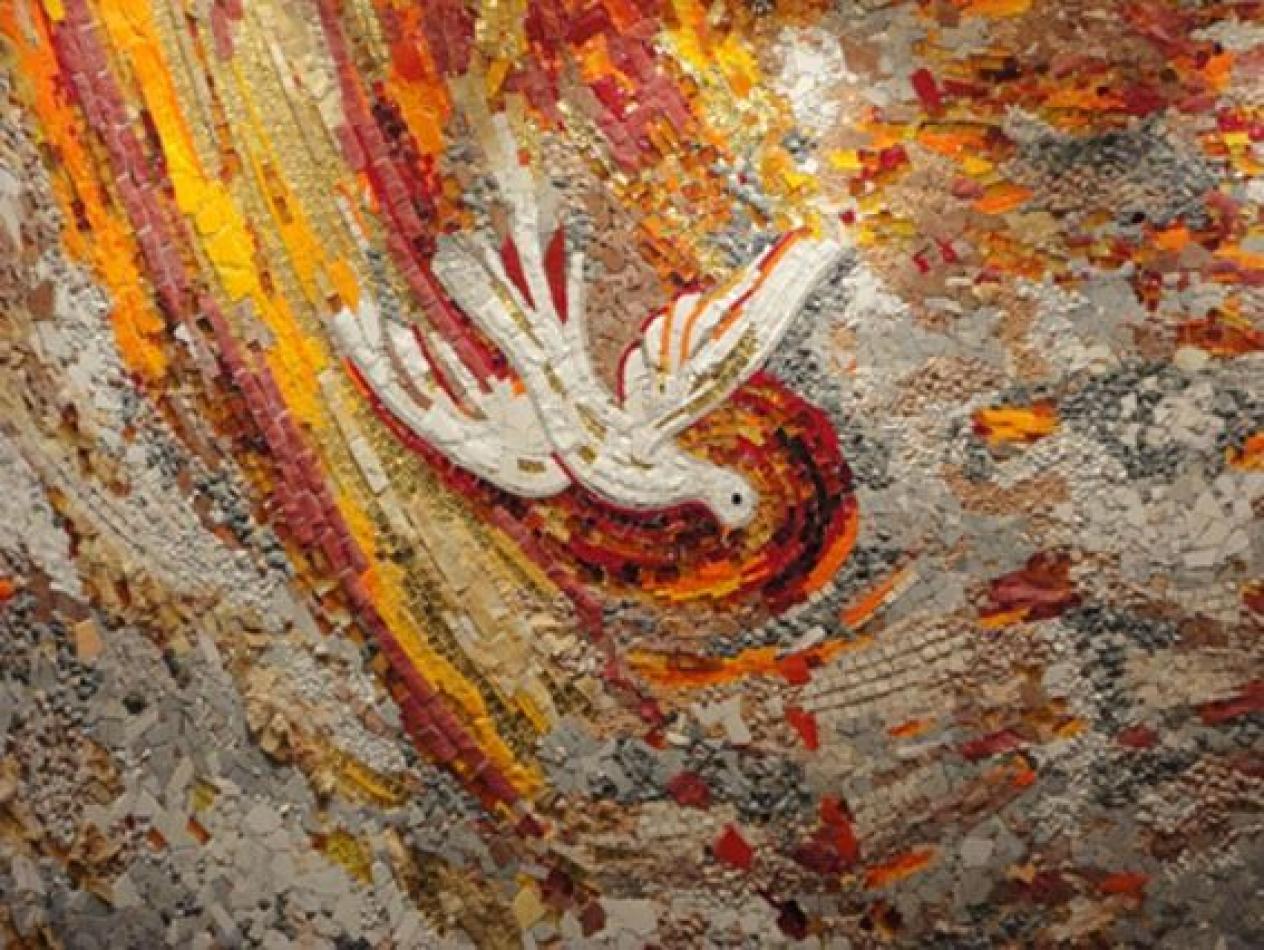
Today the Church celebrates the great solemnity of Pentecost, the feast of the descent of the Holy Spirit, fifty days after Easter, according to the account in the Acts of the Apostles (see first reading). [...]
“Receive the Holy Spirit.”
John 20:19-23
Today the Church celebrates the great solemnity of Pentecost, the feast of the descent of the Holy Spirit, fifty days after Easter, according to the account in the Acts of the Apostles, proposed in the first reading.
The word Pentecost means “fiftieth day” and comes from Greek. Originally it was a Jewish feast, one of the three great pilgrimage feasts to the Temple in Jerusalem: Passover, Pentecost and the Feast of Tabernacles, the autumn harvest festival. It was an agricultural feast, the feast of the harvest and of the first fruits, celebrated on the fiftieth day after the Jewish Passover. It was also called the “Feast of Weeks”, because it occurred seven weeks after Passover. Later, this agricultural feast became associated with the remembrance of the gift of the Law, the Torah, received by Moses on Mount Sinai.
The Christian Pentecost is the fulfilment and conclusion of the Easter season. It is our Passover: the passage to a new condition, no longer under the regime of the Law, but under that of the Spirit. It is the feast of the birth of the Church and the beginning of the mission.
The readings of the feast, in fact, present us with four comings of the Holy Spirit, or four different yet complementary ways of his presence. We could say that they are four “Pentecosts”. Today there is a theological sensitivity that speaks of “deep incarnation”. The incarnation of Christ would not be directed solely towards humanity, but towards the whole of creation. The same can be said of his resurrection. And, by analogy, we can say the same of Pentecost.
1. Pentecost upon the Church
The first reading, taken from the Acts of the Apostles, presents us with a coming of the Spirit that is overwhelming, impetuous, irresistible and fiery:
“Suddenly from heaven there came a sound like the rush of a violent wind, and it filled the entire house where they were sitting. There appeared to them tongues as of fire, which divided and came to rest on each one of them, and they were all filled with the Holy Spirit.”
It is a coming that arouses astonishment and wonder, enthusiasm and euphoria, consolation and courage. It is absolutely gratuitous, unpredictable and never something that can be programmed. These are exceptional events. We find some of them in the book of Acts, but there have also been such moments in the history of the Church: not always so striking and forceful, but always of great fruitfulness.
Indeed, such a Pentecost is always followed by an ecclesial springtime. God knows how much we need it, in the ecclesial winter we are going through in the West! Only unceasing prayer in the upper room of the Church, the humble patience of the sower and docility to the Spirit can obtain such a grace.
2. Pentecost upon the world
The outpouring of the Spirit extends to the whole of creation. It is he “who gives life and sanctifies the universe” — as Eucharistic Prayer III proclaims. It is he who “carries the pollen of spring into the heart of history and of all things”, to use an expression of Ermes Ronchi.
For this reason, with the psalmist, we have invoked Pentecost upon the whole earth:
“Send forth your Spirit, O Lord, and renew the face of the earth” — Psalm 103
This should be a typical prayer of the Christian: to invoke Pentecost upon the world, upon the dynamics that govern our social life, upon the events of history. Everyone complains about “how badly the world is going”, about the “evil spirits” that animate it; but how many of us truly make the “epiclesis”, that is, the invocation of the Spirit, so that he may descend upon the people, situations and events of our daily lives?
3. The Pentecost of charisms or service
The apostle Paul, in the second reading, taken from the First Letter to the Corinthians, draws our attention to another epiphany of the Spirit: the charisms.
“There are different kinds of charisms, but the same Spirit… To each one is given a particular manifestation of the Spirit for the common good… For we were all baptised by one Spirit into one body…”
Today we speak a great deal about charisms and the sharing of ecclesial services, but we are also witnessing a growing and troubling disengagement among the younger generations. The sacrament of Confirmation, the “personal Pentecost”, which should mark the passage to full participation in the life of the Church, unfortunately becomes, for many, the moment of desertion. It is a clear sign that we have failed in the aim of Christian initiation.
What is to be done? The Church will have to become one great ear and strengthen its antennae, in order to perceive the voice of the Spirit at this particular moment in history. I would dare to say that the gravest problem is the spiritual mediocrity of our communities. Concerned with safeguarding orthodoxy and the good order of the liturgy, we have lost sight of what is essential: the experience of faith.
4. The Sunday Pentecost
The liturgy presents to us once again the Gospel of the appearance of the risen Jesus on Easter evening. It is a passage filled throughout with Easter resonances:
“On the evening of that day, the first day of the week, when the doors of the place where the disciples were staying were locked for fear of the Jews, Jesus came and stood among them and said: ‘Peace be with you!’ Having said this, he showed them his hands and his side. Then the disciples rejoiced when they saw the Lord. Jesus said to them again: ‘Peace be with you! As the Father has sent me, so I send you.’ Having said this, he breathed on them and said: ‘Receive the Holy Spirit. Those whose sins you forgive are forgiven; those whose sins you retain are retained.’”
This passage is called “the little Pentecost” of John’s Gospel, because here Easter and Pentecost coincide. The Risen One gives the Spirit on the very evening of Easter. The whole context suggests the Sunday gathering and the Eucharist. It is there that the Spirit hovers over the waters of fear and death, bringing the peace and joy of life.
We must rediscover the pre-eminent role of the Spirit. This is his time. Without him we cannot proclaim that “Jesus is Lord” — 1 Corinthians 12:3 — nor can we cry out: “Abba! Father!” — Galatians 4:6. There is no Eucharist without the intervention of the Spirit. Therefore, let us enter the Eucharist with the plea in our hearts: Come, come, Holy Spirit!
In conclusion: how do you navigate the sea of life, with oars or with sails?
We breathe the Holy Spirit. The Spirit is our oxygen. Without him, Christian life becomes law and duty: a constant rowing, with effort and fatigue. With him, however, it is the joy of living and loving; it is the lightness of sailing with full sails.
Now that, after the Easter season, we return to Ordinary Time, with the routine of daily life, how are you preparing to navigate: by the strength of the oars, or by allowing yourself to be carried by the Wind of the Spirit that blows upon the unfurled sail of your heart?
Fr Manuel João Pereira Correia, MCCJ
GOSPEL REFLECTION
John 20:19-23
For the first Christians, the first day of the week is important because it is the day of the Lord (Rev 1:10). It is that day in which the community usually reunites to break the Eucharistic bread (Acts 20:7; 1 Cor 16:2). It is evening. The temporal indication with which the evangelical passage starts is precious. Perhaps it indicates the late hour in which the early Christians were used to gather for their celebration.
The doors are locked for fear of the Jews (v. 19). Jesus certainly did not announce triumphs and easy life to his disciples. “You will have trouble in the world,” he said (Jn 16:33). However, the main reason for insisting on closed doors (Jn 20:26) is theological. John wants to make it clear that the Risen One is the same Jesus that the apostles have seen, known, heard, touched, but is in a different condition. He is not back to his previous life (as Lazarus did). He enters into a completely new existence. The body is no longer made of material atoms. It is imperceptible to the verification of the senses.
The resurrection of the flesh is not equivalent to the resuscitation of a corpse. It is the mysterious blossoming of a new life from a finite being. Paul explains this fact through the image of the seed. He says that “the body is sown in decomposition; it will be raised never more to die. It is sown in humiliation, but it will be raised for glory. It is buried in weakness, but the resurrection shall be with power. When buried it is a natural body, but it will be raised as a spiritual body” (1 Cor 15:42-44).
When Jesus shows his hands and his side, the disciples rejoice. A surprising reaction: they should be sad seeing the signs of his Passion and Death. Instead, they rejoice, not because they find themselves in front of the Jesus whom they accompanied along the roads of Palestine, but because they see the Lord (v. 20). They realize that the Risen One, who is revealing himself to them, is the same Jesus who gave up his own life.
John places the manifestations of the Risen One in the context of the first day of the week. He wants to tell the Christians of his community that they too can meet the Lord. They will not encounter Jesus of Nazareth with the material body he had in this world, but the Risen One, every time they come together “in the Lord’s day.” After having twice addressed them the greeting: Peace be with you! (vv. 19:21) Jesus gives His Spirit to the disciples and confers them the power to forgive sins (vv. 21-23).
The disciples are sent to fulfill a mission: “As the Father has sent me, so I send you.”
When he was in the world, Jesus made the face and the love of the Father present (Jn 12:45). Now, having left this world, he continues his work through the disciples on whom he confers his Spirit. Welcoming him was welcoming the Father who sent him, now welcoming his envoys are welcoming him (Jn 13:20). To understand the mission entrusted to the apostles, the forgiveness of sins through the outpouring of the Spirit, we must refer to the religious conceptions of the people of Israel and to the words of the prophets.
At the time of Jesus, it was widely thought that the people were acting badly. They defiled themselves with their idols. They were unclean because they were moved by an evil spirit. We wondered when God would intervene to rescue them and to instill in them a good spirit.
In the Letter to the Romans, Paul makes a dramatic description of the miserable condition of the person who is at the mercy of the evil spirit: “I cannot explain what is happening to me because I do not do what I want, but on the contrary, the very things I hate. I know that what is right does not abide in me, I mean in my flesh. I can want to do what is right, but I am unable to do it. In fact, I do not do the good I want, but the evil I hate” (Rom 7:15-19).
Through the mouth of the prophets God promised the gift of a new spirit, of His Spirit: “Then I shall pour pure water over you and you shall be made clean—cleansed from the defilement of all your idols. I shall give you a new heart and put a new spirit within you. I shall remove your heart of stone and give you a heart of flesh. I shall put my spirit within you and move you to follow my decrees and keep my laws” (Ezk 36:25-27).
This outpouring of the Lord’s Spirit would renew the world. He will flood it—said the prophet Ezekiel—like a rushing torrent of water which, when it enters the desert, makes it fruitful and turns it into a garden. “Near the river on both banks there will be all kinds of fruit trees will foliage that will not wither and fruit that will never fail; each month they will bear a fresh crop because the water comes from the temple. The fruit will be good to eat and the leaves will be used for healing” (Ezk 47:12). They are delightful images that admirably describe the life-giving work of the Spirit.
On Easter day these prophecies are fulfilled. In a symbolic gesture—Jesus breathed on them—the Spirit is consigned. This breath recalls the moment of creation, when “the Lord God formed man, dust drawnfrom the clay, and breathed into his nostrils a breath of life” (Gen 2:7). The breath of Jesus creates the new person, one who is no longer a victim of the forces that lead to evil but is animated by a new energy that drives him to do good.
Where the Spirit goes, evil is overcome, sin is forgiven—cancelled, destroyed—and the new being, modelled on the person of Christ, is born. The mission that the Risen One entrusts to his disciples is to forgive sins, thus continuing his work as the “Lamb of God, who came to take away the sins of the world” (Jn 1:29).
What does it mean to forgive sins? These words have been interpreted—in the right way but limited—as the conferment on the apostles the power to absolve from sins. It’s not the only way to forgive, that is, to neutralize in order to overcome sin. The rights conferred by Jesus is much more extensive and involves all the disciples who are animated by his Spirit; it is that of cleansing the world of every form of evil. The powers are not two, but one—to forgive or to retain—at the discretion of the confessor that evaluates each case.
The power is only one, that of annihilating sin, in all ways. But this can also be not forgiven, if the disciple is not committed to creating the conditions that all may open their hearts to the action of the Spirit, the sin is not remitted.
Of this failure of the mission, the disciple is responsible.
READ: Jesus breathes the Holy Spirit onto the disciples. On the day of the Pentecost, the Spirit descends on them as tongues of fire. In baptism, we have all received the same Spirit who unites us into one body of Christ.
PRAY: Pray for an increase in the power of your faith. Pray that the Spirit will rekindle the passion to live with God and for God. Pray for the gifts and the fruits of the Holy Spirit.
REFLECT: The Holy Spirit is the life of the Church and every Christian. He animates us and gifts us with the charisms for the good of the society. He helps us relate to one another as sisters and brothers of Christ, thus uniting us into one body of Christ. The Holy Spirit is the union and understanding among peoples.
ACT: Take a leisurely, solitary walk and feel your kinship with the entire creation, giving thanks to the Spirit.
Fernando Armellini
Italian missionary and biblical scholar