
Daniel Comboni
Comboni Missionaries
Institutional area
Other links
Newsletter
19th Sunday in Ordinary Time – Year A: “Command me to come towards you!”
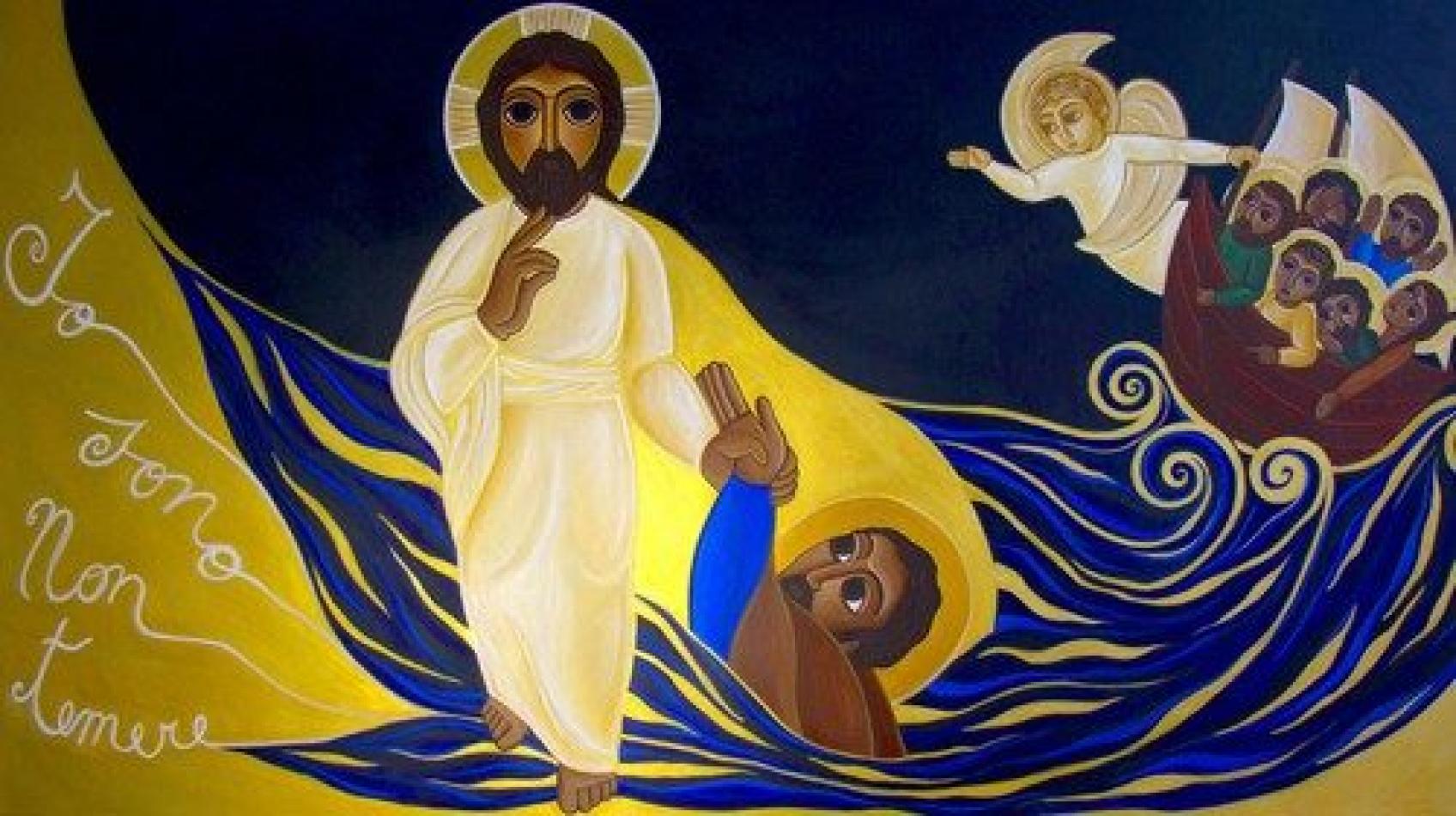


Last Sunday’s Gospel told us about the miracle of the multiplication of the loaves for a great crowd in a deserted place, which ended with the gathering of twelve baskets full of leftovers. That event is followed by today’s well-known episode, in which Jesus walks on the sea. [...]
“Command me to come towards you!”
“Lord, if it is you, command me to come towards you on the water”
Matthew 14:22-33
Last Sunday’s Gospel told us about the miracle of the multiplication of the loaves for a great crowd in a deserted place, which ended with the gathering of twelve baskets full of leftovers. That event is followed by today’s well-known episode, in which Jesus walks on the sea.
These two miracles — the multiplication of the five loaves and two fish, and Jesus’ walking on the water — are a further manifestation of Jesus’ identity. He reveals himself as the Messiah — who, according to one tradition, would renew the miracle of the manna — and as the Son of God: walking on the water was, in fact, considered a divine prerogative.
Between the two episodes, the Gospel presents Jesus praying alone on the mountain during the night.
1. “Go out and stand on the mountain” (Elijah, first reading)
Faced with this epiphany, let us ask the Lord for the grace to come out of the caves in which we have taken refuge, like the prophet Elijah, so that we may welcome the newness of God’s passage through our lives.
Perhaps God will no longer reveal himself as “a strong and mighty wind” — as in our youth — nor as the earthquake or fire of our first years of Christian commitment, but as “the whisper of a gentle breeze”, perceptible only in the silence of the heart.
2. “Command me to come towards you” (Peter, in the Gospel)
a) Urged towards the other shore
“After the crowd had eaten, Jesus immediately made the disciples get into the boat and go on ahead of him to the other shore.”
It is significant that, in this episode, Jesus “makes” the disciples leave. We can imagine him having them load the twelve baskets full of leftovers and urging them to get into the boat, despite the protests of the Twelve: it is too late, the wind is against us, it is unwise to head towards the other shore of the lake, towards a predominantly pagan and foreign territory! And why leave Jesus alone?
The apostles would have preferred to remain there and enjoy that moment of euphoria with the crowd. But there is no alternative: they reluctantly set off towards the other shore, as if to show that the bread must be carried there as well.
The same happens to us, the Church whom Christ continually urges towards “the other shore”!
b) At the mercy of the sea and ghosts
“Towards the end of the night, he came towards them, walking on the sea.”
To the threatening elements of the sea, the night and the wind, a ghost is now added! Overcome with terror, the Twelve cry out in fear. “But immediately Jesus spoke to them, saying: Take courage, it is I; do not be afraid!”
Fear is our habitual companion; God’s invitation not to be afraid is its daily antidote. “Do not be afraid”, because “it is I”; or rather, “I Am”, an expression that evokes the very Name of God.
c) Command me!
Peter takes the initiative and says to Jesus: “Lord, if it is you, command me to come towards you on the water.” “If it is you…” Is this a doubt and a request for proof? The effect of an uncontrolled emotion after his fear? A childish and enthusiastic reaction? Or an impulse of trust in the Lord? Perhaps even Peter himself does not know exactly, as so often happens to us!
What is striking, however, is the way Peter phrases his request: “Command me to come towards you on the water.” Command me! He does not say: “Enable me to come…” or “Allow me to come…” No, he asks to do so by virtue of Jesus’ command. And Jesus agrees.
“Command me to come towards you on the water!” This can become our request too. Our life is hardly ever a peaceful cruise. It often resembles sailing in a fragile little boat at the mercy of the waves. At times, it even seems that this precarious security is disappearing from beneath our feet. Then nothing remains but naked faith, capable of walking on water: not because of our courage or initiative, but because of our trust in the Lord’s command.
Command me, and I will walk upon the stormy sea of illness or bereavement.
Command me, and I will face the threatening waters of a marital crisis.
Command me, and I will brave the storm of a difficult relationship with a son or daughter.
Command me, and I will make my way through the tempest that has turned my life upside down.
d) Save me!
Faith is something tremendously serious: precious and fragile like life itself. The true believer knows and experiences this. It is enough to take one’s eyes off Christ for a single moment to feel oneself sinking.
Poor Peter, and poor us! Why does Peter doubt right in the middle of the miracle? Perhaps he expected the waves to subside so that he could walk in complete tranquillity. But that does not happen. The external circumstances do not change. Faith does not exempt us from risks.
Then nothing remains but to cry out: “Lord, save me!” And the fisherman… is fished out!
Today, it seems more difficult to cry out: “Save me!”, partly because Christ is not always perceived as the Saviour. Save us from what?
What happened to a priest presiding over a First Holy Communion Mass is very telling. After inviting the children to offer spontaneous prayers, he was surprised when a little girl said: “Thank you, Jesus, because you saved me… although I can’t remember what from!” The whole congregation laughed heartily. But how many of those present would have been able to go beyond the stock answer learnt in catechism?
3. “The great sorrow” (Paul, second reading)
Those who have experienced the saving hand cannot remain indifferent towards those who seem to be lost. This is the suffering that Saint Paul confesses in the second reading: “I have great sorrow and unceasing anguish in my heart” because of “my own people, my kindred according to the flesh” (Romans 9:1–5).
For a believer, seeing one’s fellow citizens, family and friends far from Christ is a thorn in the flesh. Praying for them is not simply a “good deed”, but a responsibility, an answer to God’s question: “Where is your brother?”
Matta El-Meskeen, an Egyptian Christian monk († 2006), states: “Through prayer, a person becomes a priest, in the sense that he becomes responsible for the salvation of others […]. By taking their sin upon himself, groaning from the depths of his heart beneath its weight and doing penance, he becomes capable, by making himself a sinner in their place, of asking forgiveness and obtaining it for them.”
For reflection
-
How do I behave in times of trial: with anger or patience? With fear or trust? With discouragement or hope?
-
Amid the storms of life, do I too cry out: “Command me! Save me, Lord”?
-
Am I ready to reach out my hand and grasp those who are sinking?
Fr Manuel João Pereira Correia, MCCJ
Matthew 14:22-33
GOSPEL REFLECTION
“Get up and eat, for the journey is too long for you,” the angel of the Lord said to Elijah fleeing into the wilderness. “The prophet stood up, ate and drank and on the force of that food, he traveled forty days and forty nights to Horeb, the mount of God” (1K 19:7-8).
To this famous story of the gift of bread and water by the angel to Elijah, the revelation of the Lord narrated in the First Reading followed.
In the Gospel passage, the scene is repeated. The disciples, nourished with the bread offered by Jesus (Mt 14:13-20), now receive the order to get moving, to get into the boat to the other side. Like Elijah, a revelation of the Lord awaits them.
There are several strange details in this episode. It’s not easy to find a reason for the order given by Jesus. Why does he let them go by themselves? Where must they go at this hour? Why doesn’t he go with them?Why does it take them too long to cross the lake? I do not think it’s because of the bad weather that he calmly goes up the mountain to pray and stay there until towards morning (v. 25). The claim of Peter to walk on the water is especially striking and—in the case of a proven swimmer—his fear of drowning (Jn 21:7).
These unique details make the exegete suspicious. They are an invitation to approach the passage with caution because it is not the story of a miracle, but a page of theology written with biblical images.
Some of these images are well known. The darkness of the night, first of all, is present, with its charge of negative meanings, in a number of Old Testament texts. Recall, for example, the psalmist who, on the night of his pain cries out to God without finding rest (Ps 22:3). It is with this darkness that the disciples are to confront themselves. When evening came, Jesus “forces them” (this is the verb used in the original text) to get into the boat and head to the “other side.” One gets the impression that they are reluctant and that they would like to stay next to the Master. However he, after having fed them with his bread, wants them to leave, to undertake the dangerous journey alone. The food he gave them is his Word and his own person present in the sacrament of the Eucharist. Nourished by this dual bread, they have the necessary strength to accomplish the difficult crossing.
If Jesus was visibly present on the boat, the darkness would disappear; instead, the darkness is thick.
When evening came (v. 13) indicates, in the symbolic language of the evangelist, the conclusion of Jesus’ day. It is the end of his life. It is the moment in which he “climbs the mountain” alone, moves away from the crowds and definitely enters the world of God. This is why the disciples find themselves in the dark. Darkness is the image of disorientation, doubt that captures even the most convinced believer. At times, even one who is driven by a strong faith feels alone. He undergoes the harrowing experience of God’s silence and wonders if his choices, his sacrifices, his commitment to the good have a sense.
Then there is the headwind. The Israelites have had the experience of the “mighty wind unleashed over the desert” that strikes and brings down the house (Job 1:19). They know the “east wind that shatters the ships”(Ps 48:8) and the “tempestuous wind” which whips up the waves, shakes ships plunging them to the depths, reeling like drunkards, in spite of all their seamanship (Ps 107:26-27).
The author of the Letter to the Ephesians employs this image to describe the senseless reasoning of people, the mentality of this world opposite to that of Christ. To the Christians of his communities Paul recalls: “Then no longer shall we be like children tossed about by any wave or wind of doctrine and deceived by the cunning of people” (Eph 4:14).
The waters were, in the Old Testament, images to describe the forces that lead to death. The psalmist, afflicted by a serious illness that is leading him to the grave, cries out to the Lord: “From above, reach down and draw me out of the deep waters” (Ps 144:7); another, having been healed, says: “A deadly flood surrounded me, devilish torrents rushed at me … Reaching down from above, he drew me out of the deep waters” (Ps 18:5,17). The Lord promises to his people: “When you pass through the waters, I will be with you, the rivers will not sweep over you” (Is 43:2).
The Israelites were always afraid of waters. They said, only the Lord is not afraid of whirlwinds and storms.He who, by his word, separated the “waters below and the waters above it” (Gen 1:7). He alone can “hush the billows to silent waves” (Ps 107:25-30); and he is the only one who “treads on the waves of the sea” (Job 9:8).
If one keeps in mind this symbolism, he understands the fear of the disciples. They fear of being overwhelmed by the forces of evil and death. They are in the dark and do not perceive the Master next to them. A dramatic situation, but inevitable, and they have to face it.
The boat was tossed about by the waves. The original text uses here the Greek verb basanizo which properly means “to put to the test.” The basanos was the hard stone used in Lydia in order to verify, through a violent friction, if a metal was valuable or worthless.
The waves torment almost torture the disciples, but they are the necessary tests they have to undergo if they want to get out of it maturely.
Towards the end of the night, Jesus appears, walking on the waves of the sea, as only God was capable of doing (Job 9:8). The disciples do not recognize him. They believe of having something to do with a ghost. Their reaction is really strange. What happened? Why can’t they recognize him?
We are not confronting a factual written account but a page of theology. Matthew is describing, with the biblical language, the situation of the Christian communities of his time. They were “tormented” by many trials, distressed by doubts and above all disoriented by the fact of not having the Master visibly with them, who would have infused safety and courage in them.
The evangelist wants to enlighten them. Jesus is always close to his disciples, even to the end of the world,as he has promised (Mt 28:20), but not physically, as when he walked the roads of Palestine. He is present in a different way, as a ghost. This is the pale image used in the Gospels to describe the Risen Lord and his new condition of life. When, on the day of Easter, he appears in the midst of the disciples gathered together, “in their panic and fright, they thought they were seeing a ghost” (Lk 24:37).
It’s not easy to be aware of his presence. He becomes recognizable only with the eyes of faith.
The second part of the passage (vv. 28-33) contains the dialogue between Jesus and Peter. It starts with the request of the apostle: “Lord, if it is you, command me to come to you on the water” (v. 28). His question is odd, but only for one who takes it in a literal sense. If it is understood in the symbolic context of the whole story, then the meaning immediately comes out clear. Peter, the first of the disciples, beholds the Master—The Risen One—who crossed the waters of death, now walking on the sea, is in God’s world. Peter knows he is called to follow him in the gift of life, but death scares him. He fears of not succeeding and asks the Lord to give him strength.
As long as he keeps his eyes fixed on the Master, he is able to go to him. When his faith diminishes, when he begins to doubt the choice he made, he sinks and is afraid of being overwhelmed, of losing his life.
It is the description of our condition. “Come to me now—the Risen Lord repeats to every disciple. Do not be afraid of losing your life. If you hesitate, death will make you afraid. If you trust my word, the waters of death will not scare you, and you will cross over and catch up with me in the resurrection.”
READ: Jesus reaches out to the disciples in trouble, walking up to them on the water. Those in the boat bowed down before Jesus saying, “Truly you are the Son of God.”
REFLECT: Jesus asks Peter, “Why did you doubt?” Jesus challenges the sudden loss of faith of Peter in the midst of turbulence. What would God be asking us when we meet Him face- to-face?
PRAY: Let us ask God to probe our innermost being and lead us to conversion.
ACT: Today is a good day to make a confession of faith regarding who Jesus is for me. I will take some time and proclaim with my whole being that Jesus is my Lord and Savior.
Fernando Armellini
Italian missionary and biblical scholar