
Daniel Comboni
Comboni Missionaries
Institutional area
Other links
Newsletter
South Sudan: Evangelizing means sowing peace

Wednesday, September 9, 2026
In a South Sudan marked by violence, divisions, conflicts, and deep wounds, evangelizing also means sowing peace. And peace arises when we learn to see in the other not an enemy to be eliminated, but a brother to be recognized.
When Jesus sends the seventy-two disciples out on mission, he says something that sounds almost scandalous: Behold, I am sending you like lambs among wolves. He does not say: I am sending you like lions. He does not say: I am sending you stronger than your adversaries. He does not say: I am sending you with the tools you need to win. He says: I am sending you like lambs among wolves.
These words have much to say to the Church that lives and proclaims the Gospel in South Sudan. Because, in a country marked by violence, divisions, conflicts, and deep wounds, evangelizing also means sowing peace. And peace does not arise from one person’s victory over another. It does not arise from eliminating one’s adversary. It arises when we learn to see in the other not an enemy to be eliminated, but a brother to be recognized.
The lamb does not become a wolf
We are instinctively drawn to strength. When there is a wolf, we would like to have an even stronger wolf. When there is violence, we are tempted to respond with greater violence. When someone threatens us, we would like to have the power necessary to prevail. But in this way, we risk adopting the very logic of what we seek to fight.
Jesus proposes another path. The lamb does not win because it is stronger than the wolf. It wins because it does not become a wolf. This is the strength of Christian non-violence. It does not mean being weak. It means not allowing the evil of the other to determine what I become. The other may hate, but I must not become hatred. The other may be violent, but I must not become violence. The other may humiliate me, but I must not lose the dignity of seeing him as a brother. Remaining lambs means not allowing the wolf in the other to awaken the wolf within me. This is one of the greatest challenges of peace.
The missionary’s first word is peace
Jesus says to his disciples: Whatever house you enter, first say, “Peace to this house!” This is significant. The missionary’s first word is not a theology lesson. It is peace. The missionary does not come to conquer the other. He comes to enter into relationship with him.
And Jesus adds: Eat what is offered to you. The missionary arrives poor. He allows himself to be welcomed. He sits at the other person’s table. He eats his food. He enters into his life. And then he discovers something fundamental: the other is not simply someone to whom I bring the Gospel. He is someone through whom God can also meet me. This is a great school of mission.
In South Sudan, we learn this every day: mission does not consist only in speaking to people, but in walking with people. We cannot build peace from above. We must enter into the wounds of communities, listen, share, and create spaces in which people can meet and once again recognize one another as brothers and sisters.
Giving a face back to the enemy
One of the deepest tragedies of violence is this: before violence strikes the other’s body, it kills the other’s face within us. In order to inflict violence on a person, I must stop seeing that person as a person. He becomes a label: he belongs to that ethnic group; he is a foreigner; he is an enemy; he is one of those who have hurt us. When the other becomes simply the enemy, it becomes easier to hate him.
For this reason, the mission of the Church is also to give a face back to the one who has been turned into an enemy. To say to communities: Before belonging to this or that ethnic group, we are human beings. Before being adversaries, we are brothers and sisters.
The Church must be a space where people learn once again how to meet one another. A Church that crosses divisions. A Church that does not create new enemies. A Church that denounces injustice without hating those who are unjust. A Church that teaches reconciliation without forgetting the victims. A Church that disarms not only hands, but also words and the heart.
Peace begins in small communities
Jesus sends his disciples without a purse, without a bag, without spare sandals. It is as if he were saying: Do not place your security in power. Your strength will be relationship, trust, the word, and your witness. This is particularly important when we speak about peace. We often think that building peace first and foremost requires instruments of power. The Gospel shows us a different kind of power: the disarmed power of fraternity.
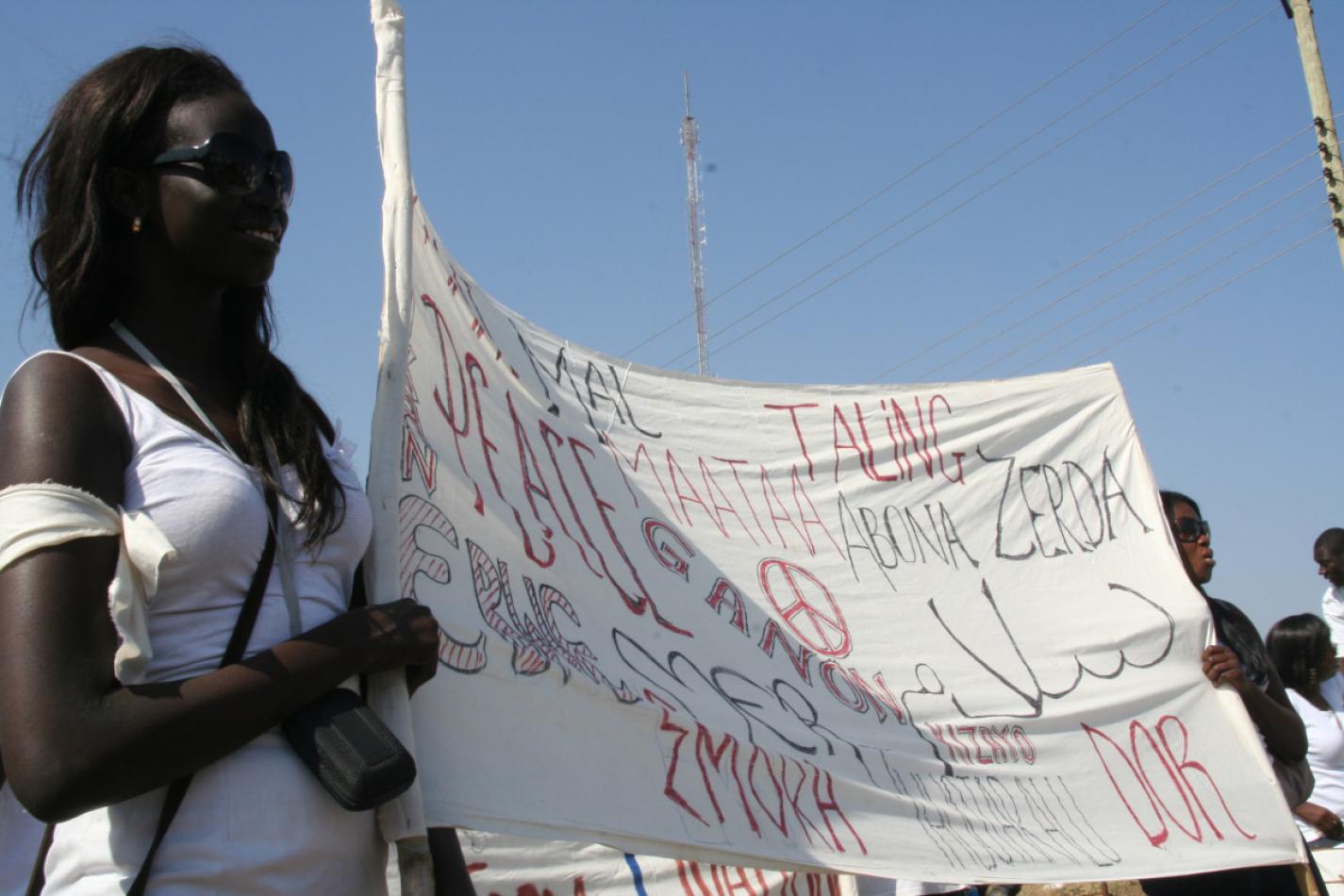
We see this concretely in the Justice and Peace Committees present in the dioceses of South Sudan and promoted by the Churches through an ecumenical approach. They are not simply people who talk about peace. They are people who seek to build it wherever relationships have been wounded. They enter communities. They listen. They gather people’s fears and suffering. They foster dialogue. They try to prevent a conflict from becoming revenge, and revenge from becoming a new war.
They do not enter saying: I have come to defeat someone. They enter saying: I have come to listen. They do not carry a weapon; they carry a word. They do not seek a winner. They seek a path by which people can once again live together. And here we see concretely what it means to be lambs among wolves.
Peace does not begin only at the great political negotiating tables. It begins when, in a small community, someone finds the courage to say: Let us stop. Let us listen to one another. We do not want our children to continue paying the price for our hatred. That is already the Gospel. That is already evangelization. That is already the Kingdom of God drawing near.
Even rejection can become a witness
Jesus does not hide from his disciples the fact that they may be rejected. This is important. In mission, we may think that success consists in being welcomed. But Jesus teaches us that even rejection can become a place of witness. Jesus himself was rejected. And on the cross, God takes upon himself humanity’s rejection without responding with another rejection.
Evil falls upon the Lamb, and the Lamb does not return evil. This is the power of the cross. It does not mean seeking suffering. It means that true love remains faithful even when it is not reciprocated. For this reason, rejection is not necessarily a failure of mission. It can become the place where love demonstrates that it is stronger than hatred.
Evangelizing means changing our mindset
For this reason, the vocation of the Church in South Sudan is a great one. We are called not only to preach peace. We are called to become a community of peace. Evangelizing means sowing a new mindset: from revenge to reconciliation; from fear to trust; from division to fraternity; from hatred to responsibility for the common good.
Because a war can continue even when the weapons fall silent, if resentment, suspicion, and the desire for revenge continue to live within us.
Peace is not simply the silence of weapons. It is the transformation of the heart. And this transformation must reach young people above all. We cannot allow one generation to inherit the war of the previous generation. A mother who teaches her children not to hate the children of their enemies is already building peace. A young person who lays down his weapon is already building peace. Two communities that, after years of conflict, agree to sit at the same table are already building peace. A Church that creates such a space for encounter is already evangelizing. The Kingdom of God draws near when a person decides not to take revenge.
Blessed are the peacemakers
For this reason, we can better understand Jesus’ beatitude: Blessed are the peacemakers, for they shall be called children of God. He does not say: blessed are those who talk about peace. He says: blessed are the peacemakers. Peace is a verb. It is work. It is a vocation. It is a journey. And peacemakers are the lambs Jesus speaks about. Not because they are weak, but because they have discovered a power greater than violence: the power not to return evil for evil; the power to remain faithful to love; the power to see a brother where others see an enemy.
This is perhaps one of the greatest testimonies the Church can offer to South Sudan and to the world. We cannot build peace by eliminating the other. We build peace when we recognize that the other belongs to our same humanity. And here we arrive at the heart of the Gospel. The Lamb does not kill the wolf. The Lamb offers his own life. This is the logic of the cross. This is the logic of mission. This is the logic of peace.
The Church is called to be a lamb among wolves. Not a resigned lamb. A lamb that, with the disarming power of love, truth, justice, and fraternity, opens a new path. Because perhaps the decisive question is not: How can we become stronger than our enemies? But: How can we make sure that there are no more enemies? The Gospel’s answer is simple and radical: by recognizing one another as brothers and sisters. This is the peace we must sow. This is the peace we must witness to. This is the peace for which it is worth giving one’s life.
Blessed are the peacemakers. Blessed are the lambs who do not become wolves. Blessed are those who give their lives so that the world may have life. They shall be called children of God.
+ Christian Carlassare, mccj
Bishop of Bentiu (South Sudan)