
Daniel Comboni
Comboni Missionaries
Institutional area
Other links
Newsletter
30th Sunday in Ordinary Time – Year A: Outside love there is no salvation!
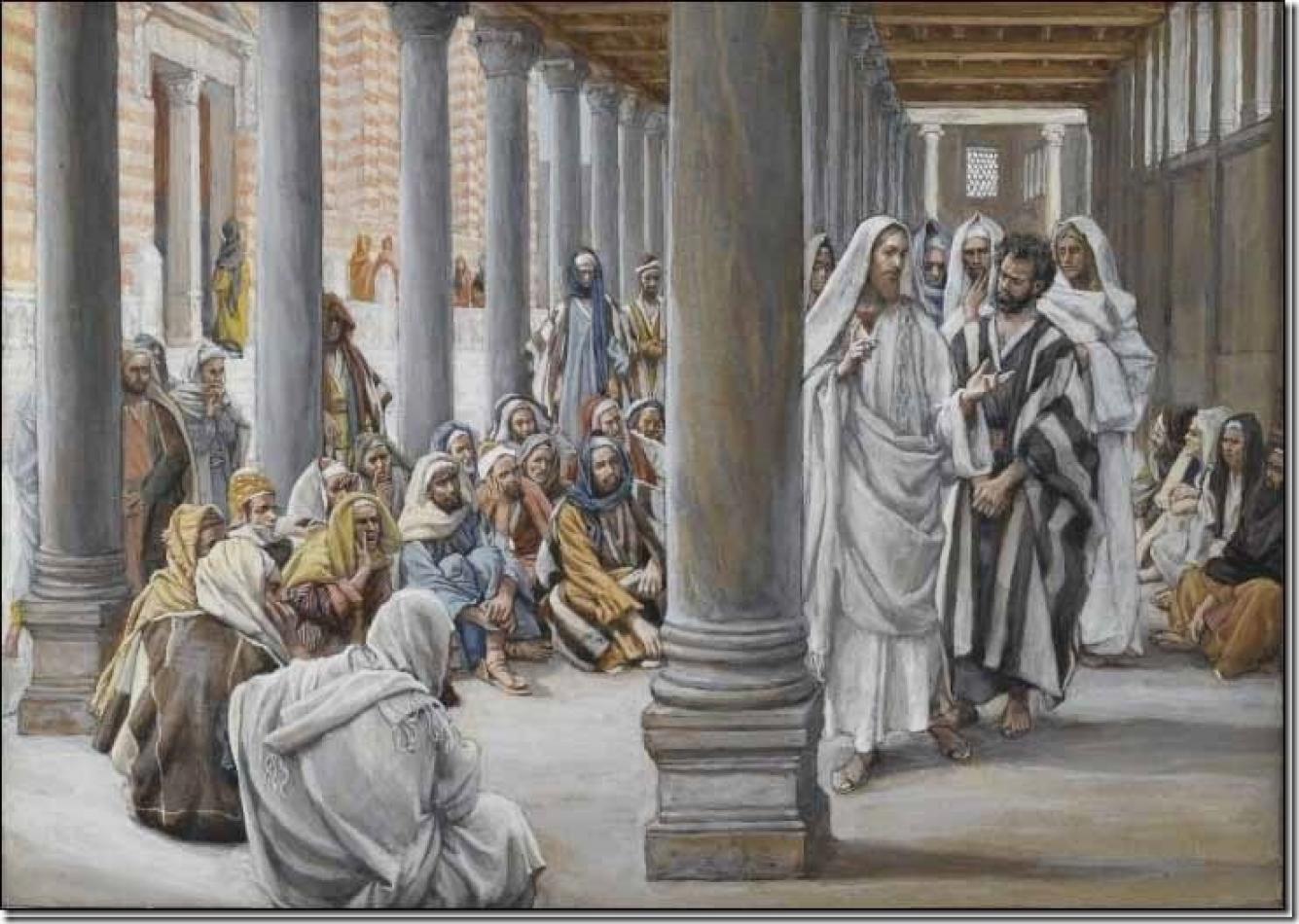


Last Sunday we witnessed a dispute between Jesus and the Pharisees, who had joined forces with the Herodians and tried to trap him over the question of paying tax to Caesar.
Outside love there is no salvation!
‘Teacher, which is the greatest commandment in the Law?’
Matthew 22:34-40
This Sunday’s Gospel presents another controversy, once again with the Pharisees.
A) An innocent and relevant question?
Today’s controversy centres on a theological question: ‘Teacher, which is the greatest commandment in the Law?’ The question is asked by a doctor of the Law, an expert in the Torah, a theologian, so to speak, who steps forward to test Jesus’ orthodoxy.
But where is the trap this time?
The question seems innocent and relevant. Indeed, seeking to regulate every aspect of life according to God’s will, rabbinic tradition had identified no fewer than 613 precepts in the Torah — the Pentateuch, that is, the first five books of the Bible — including the Ten Commandments.
According to a tradition recorded in the Talmud, these precepts were divided into 365 negative precepts, meaning prohibitions — things not to do — corresponding to the days of the solar year, and 248 positive precepts, meaning injunctions — things to do — corresponding to the parts of the human body as understood in ancient times. An evocative symbolism: every day of the year and every part of the body were called to observe God’s will! Within this dense network of precepts, however, people felt the need to discern what was essential.
The attempt to establish a hierarchy among the commandments was far from uncontroversial. Different approaches to interpretation existed within the Judaism of the time. The debate between the schools of two great teachers, Hillel and Shammai, was renowned. They lived around the turn of the first century BC and the first century AD.
Hillel’s school, generally more open and conciliatory, favoured a reading of the Law attentive to mercy and human relationships. This famous summary is attributed to Hillel: ‘What is hateful to you, do not do to your neighbour. This is the whole Torah; the rest is commentary’ (Babylonian Talmud). Shammai’s school, by contrast, was generally stricter in its interpretation and application of the precepts.
But if the question was relevant, where was the snare?
In Israel’s tradition, observance of the Sabbath held a central place because it recalled God’s own rest after the work of creation. Perhaps Jesus’ opponents expected him to name the Sabbath commandment as the most important. They could then have replied: ‘Why, then, do you and your disciples not observe the Sabbath?’ This was, indeed, one of the accusations they had already made against him (cf. Mt 12:1–14).
Jesus, however, takes them by surprise once again! He cites none of the Ten Commandments. He refuses to be caught up in a dispute about which rules take precedence, but goes to the heart of the Law, to its source and fulfilment: love!
Jesus recalls the Shema Yisrael, Israel’s great profession of faith (Deuteronomy 6:4–5), recited daily in the morning and evening, and repeated before going to sleep: ‘You shall love the Lord your God with all your heart, with all your soul and with all your mind. This is the greatest and first commandment.’ He then places alongside it another passage from the Torah, taken from Leviticus (19:18): ‘The second is like it: You shall love your neighbour as yourself.’ The Teacher concludes with a solemn declaration: ‘On these two commandments hang all the Law and the Prophets.’ And that settles the matter!
Saint Augustine, who left us the famous exhortation, “Love, and do what you will”, offers us another insight of extraordinary depth: “Love of God is the first to be commanded, but love of one’s neighbour is the first to be put into practice.”
B) Some points for reflection
1. Love is the Law!
The First Letter of John offers one of the most profound commentaries on this Gospel: ‘This is the commandment we have from him: whoever loves God must also love his brother’ (1 Jn 4:21).
Remarkably, the whole letter unfolds like a spiral, constantly returning to the theme of love and exploring its demands and consequences ever more deeply: ‘We know that we have passed from death to life because we love our brothers and sisters (…) This is how we have come to know love: he laid down his life for us, and we too ought to lay down our lives for our brothers and sisters (…) Little children, let us love not in word or speech, but in deed and in truth’ (3:14–18).
Love for our brother or sister mirrors and tests the authenticity of our love for God. This is why Jesus will sum everything up in his new commandment: ‘Love one another as I have loved you’ (Jn 13:34; 15:12). Love, then, is neither a mere feeling nor one virtue among others. Love sums up the Christian life and is the key to our existence.
2. From god as master to God as Bridegroom
That God is love is by no means self-evident! Consequently, neither is the commandment to love. That ‘God is love’ is an astonishing revelation, not an obvious conclusion of human reasoning. It is a reality revealed by Scripture. The gradual journey towards the revelation of God as Love, and the transition from the rule of law to the rule of love, was a long process carried forward by the Prophets. Jesus brings it to fulfilment. And a Christian is someone who has believed in this astonishing revelation: ‘We have come to know and believe in the love God has for us. God is love’ (1 Jn 4:16).
Often, however, reality seems to contradict this revelation. Daily difficulties, the crosses and uncertainties of life, but above all the apparent triumph of evil, the suffering of the innocent and the spread of injustice, put our faith severely to the test.
Every day we are called to renew our faith in God who is Love!
On the day we truly believe in his love, Hosea’s prophecy will be fulfilled for us too: ‘On that day — declares the Lord — you will call me “My husband”, and no longer call me “My Baal, my master”’ (Hosea 2:18).
Meanwhile, we run the tragic risk of continuing to worship a ‘baal’, an idol, a false god to whom we sacrifice our energies and our very lives.
3. You shall love!
Pagan gods were often imagined as deities to be appeased through sacrifice and submission, under the rule of fear. The God revealed by Jesus Christ, however, desires free children, capable of responding to his love with love.
The verb to love — ahav in Hebrew — occurs 248 times in the Old Testament, according to the Italian biblical scholar Fernando Armellini. Regardless of the precise count, this figure attracts my attention because of its symbolic value: according to rabbinic tradition, 248 is the number of positive precepts, that is, things to do. It is almost as though this suggests that, ultimately, the only thing we are truly called to do is to love. And to do so always, every day of the year — all 365 of them, corresponding, again according to rabbinic tradition, to the negative precepts or prohibitions — and with every fibre of our being.
For reflection during the week
Read the First Letter of Saint John slowly, allowing ourselves to be drawn into its dizzying spiral of love.
Fr Manuel João Pereira Correia, MCCJ
Gospel reflection
Matthew 22:34-40
The rabbis of Jesus’ time, in studying the Bible, had come to discover 613 commandments, 365 (such as days of the year) of which were negative, i.e., forbidden actions, and 248 (like the limbs of the human body) were positive, namely, works to be done. The women were required to observe only the negative precepts. Poor “catechists”! Explaining a commandment per day, it would take almost two years to teach them all. In the end, the earlier ones would certainly have been forgotten. If it was hard to learn them, imagine how complicated it was to observe them; to avoid sins was virtually impossible. The common folks were not able to learn the subtle distinctions and endless moral casuistry and were despised by the scribes: “Only these cursed people, who have no knowledge of the Law,” as referred to by Caiaphas (Jn 7:49).
Jesus considers this variety of rules a heavy yoke which oppresses and tires, takes the breath away and the joy of living (Mt 11:28). He warns the teachers of the law, “A curse is on you! You prepare unbearable burdens and load them on the people” (Lk 11:46).
One day, one of these scribes, perhaps a little affected, approaches Jesus in a hostile manner, and to tempt Him, he asks: “What is the great commandment in the law?” (v. 36). He means to say: all the 613 precepts are great and important and must be observed with the utmost care. They are a yoke, but “it is good for a man to bear the yoke from his youth” (Lm 3:27). How dare, then, call them “unbearable burdens,” perhaps you mean to cancel part of the law (Mt 5:17-20)?
Not all rabbis were so rigid. Many made a distinction between serious and light precepts. They also felt the need to make a summary, to find one that would unify them. The text they referred to was the famous Shema’ which every Israelite recited every day, morning and evening. Jesus Himself quotes: “You shall love the Lord your God with all your heart, with all your soul and with all might” (Dt 6:5).
There were also those who put the love of neighbor in the first place. It is said that one day Hillel—a famous rabbi who lived a few years before Christ—was asked to teach the whole Torah in the time that he could stand on one leg. Hillel replied: “What you do not like, don’t do to your neighbor! This is the whole Law; the rest is commentary.”
Philo, the Jewish philosopher and man of letters, a contemporary of Jesus, who lived in Alexandria, Egypt, felt that the whole law was summed up in the Ten Commandments and that this, in turn, could be summed up in love to God and neighbor.
So was there no novelty in the response of Jesus?
Let us look at His words. The great commandment, the first, is the love of God that must involve three faculties: the heart, the soul, and the mind.
God, first of all, is to be loved with an undivided heart (with all the heart). Today we speak of believers and atheists, but in biblical times this distinction would make no sense because atheists did not exist. Discrimination was between believers and idolaters, among those who loved the living and true God, and those who were entrusted to the dead and misleading gods. Today there are believers, people in the Church, who fulfill all religious practices, but at the same time worship their bank account, social position, honorary titles, career, power and their ambitions. They have indeed a “divided heart”; they do not love with all their heart, as Jesus claims.
With all life (soul). The believer is required to have the willingness to sacrifice everything (money, interest, emotional ties, and rights), and even the courage to face martyrdom, while not failing in his/her faith. As it happens often, loving God and trusting him can lead to the need of making choices and heroic sacrifices. In this case, it is not permissible to resort to subterfuge and misinformation. Compromising solutions cannot be accepted for themselves, nor suggested to others.
With all your mind. Even the rational aspect is part of the love of God. Emotions cannot be the object of a commandment. It may instead be the requirement to employ all the intellect in search of the Lord and of His will. Anyone interested in futility, who spends more time with frivolous arguments, who gossips about celebrities rather than studies the Word of God, who ignores the theological and moral issues today, who does not undertake to investigate the reasons of his/her faith, is less involved in the love of God.
So far there is nothing new with regard to the Jewish faith, if not for the fact (essential for a Christian) that the discovery of God’s face and His will passes through the Revelation that comes from Christ and the love of God is the fruit of the gift of His Spirit.
After having stated what is the greatest commandment, Jesus adds that this is also the first. He makes this specification to introduce the second, which is like the first: “You shall love your neighbor as yourself” (v. 39), and here the more apparent novelties begin.
The qualification of “similar”—homoia in Greek—means equally large, equally important. It is equal to giving the same value to people as that of loving God. Only Jesus has placed the two commandments on the same level, giving both equal values.
In the above-mentioned response of Hillel, we certainly felt the call addressed by Jesus to His disciples: “So, do to others what you would that others do to you; there you have the Law and the Prophets” (Mt 7:12). We certainly noticed the difference: Jesus has positively turned (do …) the recommendation that Hillel negatively formulated (do not do …). The Master has been inspired by the reflections of the wisest among the rabbis to communicate the full light of His message.
With reference to the commandment of love of neighbor, He has also used the same procedure. He referred to a biblical text which the rabbis often quoted: “Do not seek revenge or nurture a grudge against one of your people, but love your neighbor as yourself” (Lev 19:18). He gave the precept a new perspective, a boundless dimension. For the Israelite “neighbor” meant the children of his people. Jesus is for every person, even the enemy (Mt 5:43-48).
The concluding statement: “The whole Law and the Prophets are founded on these two commandments”(v. 40), must be interpreted, therefore, bearing in mind similar expressions used by the rabbis. These two commandments are the point of reference for any rule. They should be taken as criteria for evaluating every precept. All laws are good if they are an expression of love. They should be rejected if they oppose it because they are a hindrance to the good of the people.
There remains one final point to clarify: the relationship between love of God and love of neighbor.
We note that in the authors of the New Testament, there is a progressive tendency to unify the two commandments. Mark, the first of the Evangelists, speaks of the first and of the second commandment. After him, Matthew retakes the same expression but adds: the second is similar, that is, equal to the first. Luke does not mention a first and a second commandment but combines them into one (Lk 10:25-28). John records the words of Jesus who speaks of only one commandment: “Now I give you a new commandment: Love one another! Just as I have loved you, you also must love one another. By this everyone will know that you are my disciples if you have love for one another” (Jn 13:34-35).
Later, and throughout the rest of the New Testament, there is no emphasis on two commandments, but only on one, love of people. “For the whole law—Paul reminds us—is summed up in this sentence: You shall love your neighbor as yourself” (Gal 5:14). Writing to the Romans, he recommends: “Do not be in debt to anyone. Let this be the only debt of one to another: Love. The one who loves his brother or his neighbor fulfilled the law. For the commandments, do not commit adultery, do not kill, do not covet and whatever else are summarized in this one: You will love your neighbor as yourself. Love cannot do the neighbor any harm; so love fulfills the whole Law” (Rom 13:8-10).
We know what it means to love others, even though it is not always easy to determine how this love can be made concrete. But how do we love God?
If one continues to keep the two commandments separated, one runs the risk of putting God and the neighbor in competition and of thinking that they contend for the human heart, his time, thoughts, and interests. In such a situation, that which is given to one is removed from the other. Loving God means not subtracting something from any one in order to give it to God. The pagan gods were the ones who had created people to be served by them through offerings, sacrifices, and prostrations. The God of Jesus has never asked anything for Himself. He puts Himself at the service of people, even to bending down to wash his feet and asks us to do the same: “If such has been the love of God—John says—we too must love one another” (1Jn 4:11).
Loving this God means to assimilate His feelings towards people; it means to love the orphan, the widow, and the stranger, as God loves and protects them.
The connection between the two commandments had been noted by various rabbis. Someone, however, has also realized the reason why they support one another. It is a sublime reason we make our own: the love for people is still love turned to God because it is directed to His image (Gen 1:27).
READ: The religious authorities in Jesus’ time took turns trying to test and trap Jesus so as to dispose of him. This time, they ask him a religious question regarding the law that has political implications which they might use against him. But Jesus answered them with a principle that is equally valid be it in the religious or civil sphere. The Law of Love is the foundation of divine and human laws.
PRAY: Love and justice should mark all our actions. Let us pray for wisdom and prudence to balance both.
REFLECT: Jesus sticks to the truth no matter what. It may offend the religious and civil authorities, ut the truth can withstand any form of scrutiny. The more the opponents of Jesus waylay him with traps, the more he unmasks their hypocrisy by the truth that he brings. No wonder they had to kill him. In this world, the truth will always and forever be lonely.
ACT: A cowardly or an indifferent life is hardly a life worth living. Today, let us decide to make a stand for the truth and act on it accordingly. Let us commit to stop even the little injustices that are done to others.
Fernando Armellini
Italian missionary and biblical scholar