
Daniel Comboni
Comboni Missionaries
Institutional area
Other links
Newsletter
Mining, Responsibility, and the Cry of Communities

Thursday, April 30, 2026
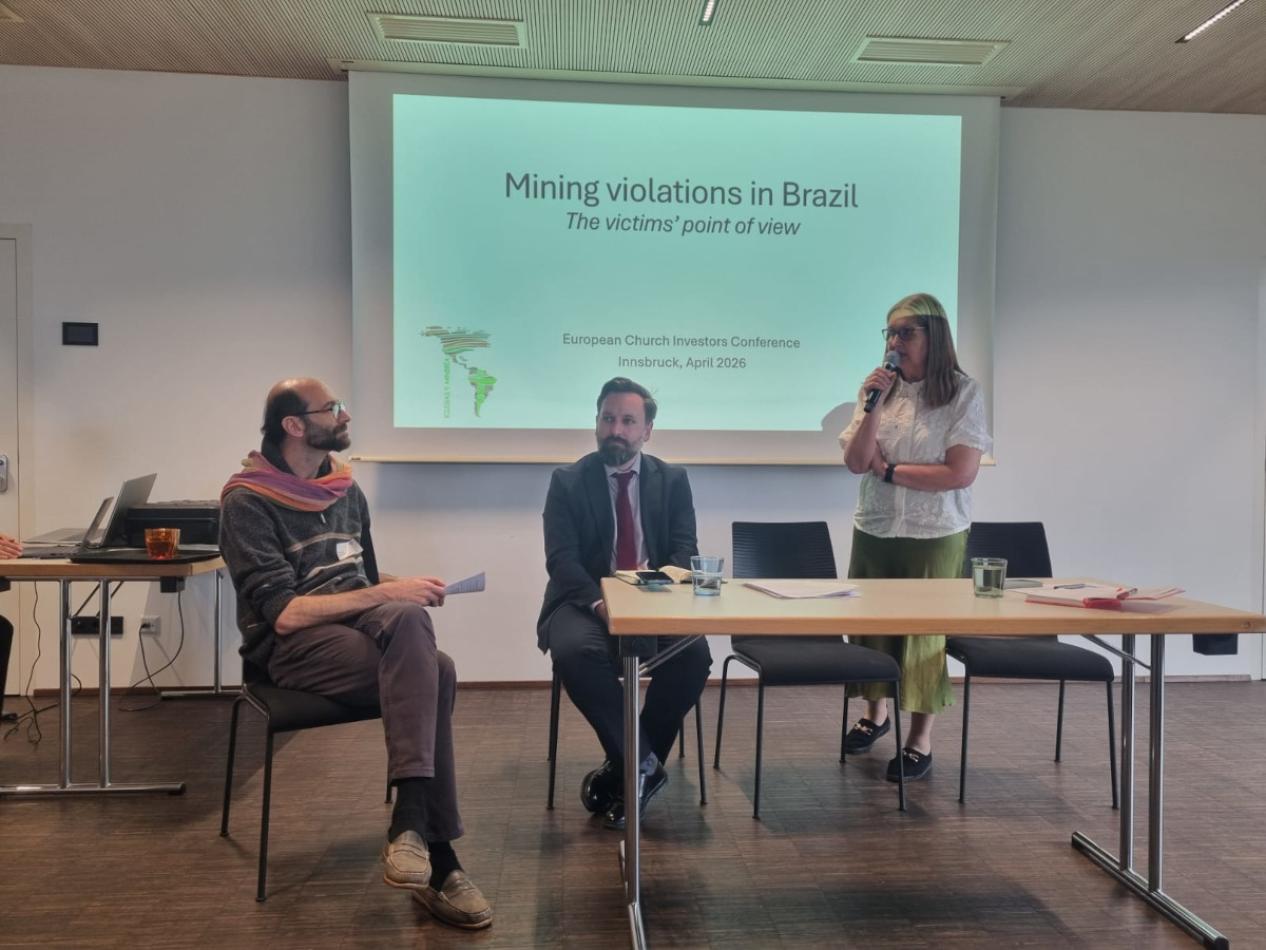
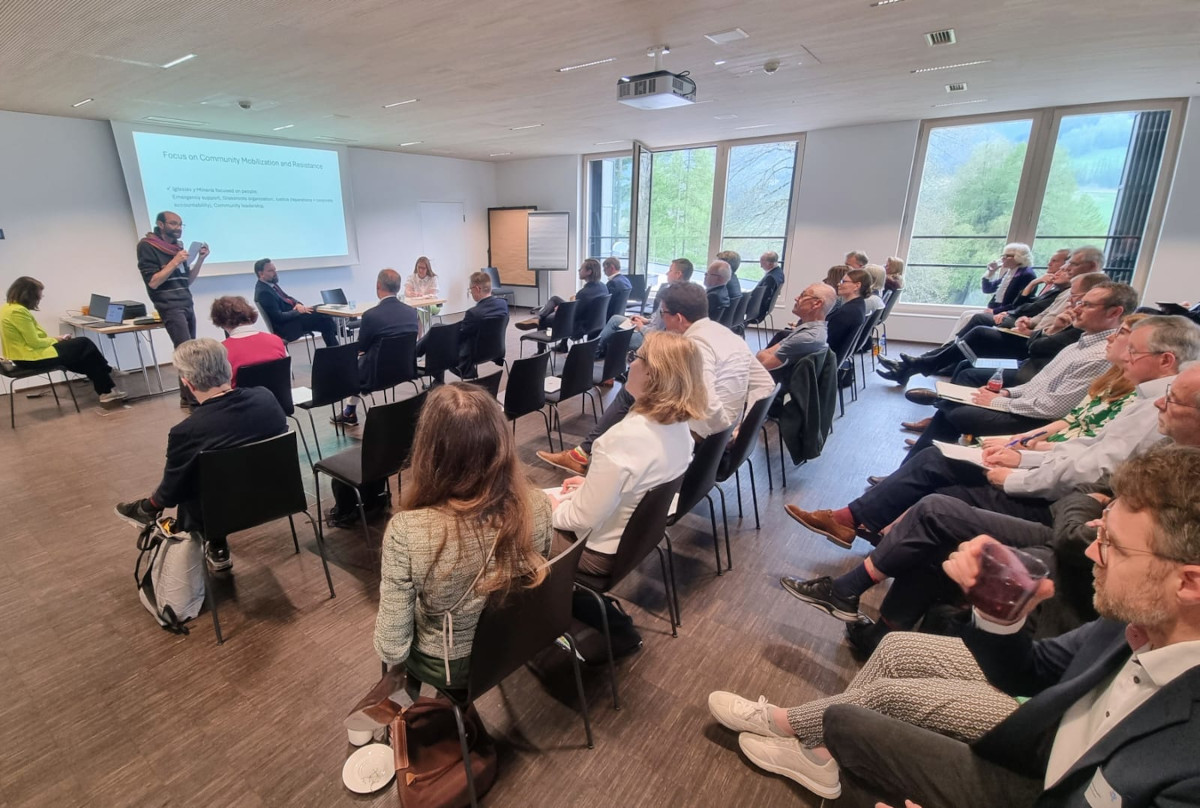
At the end of April 2026, representatives of Churches and faith-based investors gathered in the Diocese of Innsbruck, Austria, for the Second Church Investors Conference. The Churches and Mining Network, an ecumenical articulation that accompanies communities affected by mining across Latin America, was invited to share its vision and perspective.
Bringing more than twenty years of experience in Brazil, Father Dario Bossi, Comboni missionary, shared not only facts and data, but above all the voice of communities living on the frontlines of extractivism. His intervention did not focus primarily on the impacts of mining—already widely documented—but rather on corporate behavior, responsibility, and the role of Churches in this context.
Mining, Responsibility, and the Cry of Communities:
a Call to the Churches and Church investors
From Mariana to Brumadinho: When Tragedy Repeats Itself
Brazil has lived through two of the worst mining disasters in recent history: the collapse of mining tailings dams near Mariana (2015) and Brumadinho (2019), both linked to the company Vale.
Together, these tragedies caused the deaths of 291 people, devastated entire river basins, and left deep environmental and social wounds that persist to this day.
After Mariana, the slogan “Mariana Never Again” was widely promoted. Yet, just a few years later, Brumadinho revealed a disturbing reality: not only had lessons not been learned, but serious responsibilities had been concealed. Investigations pointed to manipulated audits, misleading safety reports, and the omission of critical information about dam stability. Evidence suggests that the company was aware of risks and failed to act.
Brumadinho, therefore, cannot be seen as an isolated accident. It represents a form of corporate recidivism—where profit is prioritized over human life.
Even more scandalous is what followed: instead of definitively closing the projects responsible for such devastation, mining activities have continued in these same territories, perpetuating risk, uncertainty, and suffering for affected communities.
Beyond Major Disasters: The Silent Violence of Mining
While Mariana and Brumadinho captured global attention, many other forms of mining-related violence remain largely invisible.
In regions like Carajás, in the Brazilian Amazon, there are no headline disasters. Instead, communities endure a slow and cumulative form of harm: contamination of soil and water, deterioration of public health, and the gradual erosion of traditional livelihoods. It is a “homeopathic violence”, persistent and often ignored.
At the same time, the global energy transition is accelerating the demand for minerals, leading to an expansion of mining frontiers and an increase in conflicts. In the Brazilian Amazon alone, there are around 1,300 mining requests affecting Indigenous territories.
This expansion is often accompanied, in several regions of the world, by militarization and territorial occupation, where “security” is defined in terms of access to natural resources. Corporate interests increasingly shape political decisions, raising a fundamental question: who decides that mining is a “national interest,” while the protection of Indigenous territories is not?
The Strength of Communities and the Role of the Churches
In this context, the Churches and Mining Network has focused its efforts on supporting communities in their struggles for life and justice.
This includes emergency support in times of crisis, grassroots organization, and the promotion of community leadership in negotiations with companies and the State. One important achievement was the approval, through popular initiative, of the “Mar de Lama Nunca Mais” law in the state of Minas Gerais, which established stricter rules for dam safety and prohibited certain high-risk structures.
But beyond concrete results, the central commitment remains pastoral: to be close to the victims—human and non-human—and to safeguard their perspective and their struggle.
This proximity is essential, especially when so-called “dialogue” processes with companies often prove to be fragile, inconsistent, or even manipulative, lacking real accountability.
A Necessary Distrust
One of the strongest messages emerging from these experiences is the need for critical distance from corporate narratives.
Too often, investors and institutions rely on company declarations, voluntary standards, and ESG frameworks. However, the gap between discourse and reality on the ground remains wide. In Brazil, communities have learned in the most painful way that corporate “good faith” cannot be taken for granted.
This is why binding regulations—such as robust due diligence mechanisms—are essential. Recent efforts to weaken such legislation, particularly in Europe, raise serious concerns.
Investors and Co-Responsibility
A key point addressed in Innsbruck was the responsibility of investors.
Investors are not neutral actors. By financing mining companies, they become co-responsible for the damages caused. The dividends they receive are often linked to cost-cutting measures that compromise safety and environmental protection.
After the Brumadinho disaster, the Church of England decided to divest from Vale, recognizing this ethical responsibility. This decision stands as an important example. Similarly, the Austrian Bishop’s Conference recently published a binding Ethical Investment Guideline which excludes investments in gold, gold mining and gold assets, due to the severe environmental and social impacts associated with gold extraction, as well as its links to conflicts in various parts of the world.
However, there remains a broader challenge: too often, harmful companies are supported simply because they are perceived as “less bad” than others. Yet in many cases, the core business model itself remains inherently dangerous.
The strategy of conscious and organized investors to influence corporate behavior through active dialogue—known as “engagement”—can play a role. However, as noted above, companies often manage to mask their lack of genuine commitment. In this context, divestment should be seen not merely as a last resort, but as a coherent ethical choice.
There is also a growing concern about the risk of “faith-washing,” where companies seek legitimacy through proximity to religious institutions. For this reason, the Churches and Mining Network maintains a clear principle: not to accept financial support from mining companies. Likewise, the Brazilian Conference of Bishops has recently included in its Pastoral Guidelines the principle of not accepting donations, investments, or sponsorships from activities and sectors that harm the environment and life.
Recent Vatican guidance, such as the document Mensuram Bonam, explicitly recognizes mining as a sector requiring careful ethical discernment and, in certain cases, exclusion from investment portfolios.
Is Another Model Possible?
Beyond these tools, a deeper question remains.
The ecological crisis invites us to look beyond technical fixes and incremental improvements. As Pope Francis has repeatedly affirmed in Laudato Si’, what is needed is a “radical change,” a “bold cultural revolution,” and a redefinition of progress itself.
Pope Leo XIV has echoed this concern, warning that the current paradigm—driven by extraction, accumulation, and inequality—ultimately leads to death and conflict.
As Laudato Si’ reminds us, it is no longer enough to seek a balance between environmental protection and financial profit. Half-measures risk delaying collapse rather than preventing it.
For Churches, this is a moment of discernment and courage. Are we willing to question the economic model that underpins extractivism? Are we ready to stand clearly with affected communities, even when this challenges powerful interests?
The experience of Latin American communities offers a clear answer: another path is not only necessary—it is already being lived, in resistance, in solidarity, and in the defense of life.