Daniel Comboni
Comboni Missionaries
Institutional area
Other links
Newsletter
At Lokichar with eagles’ wings: A mission growing together with the Turkana people
Tuesday, 10 November 2026
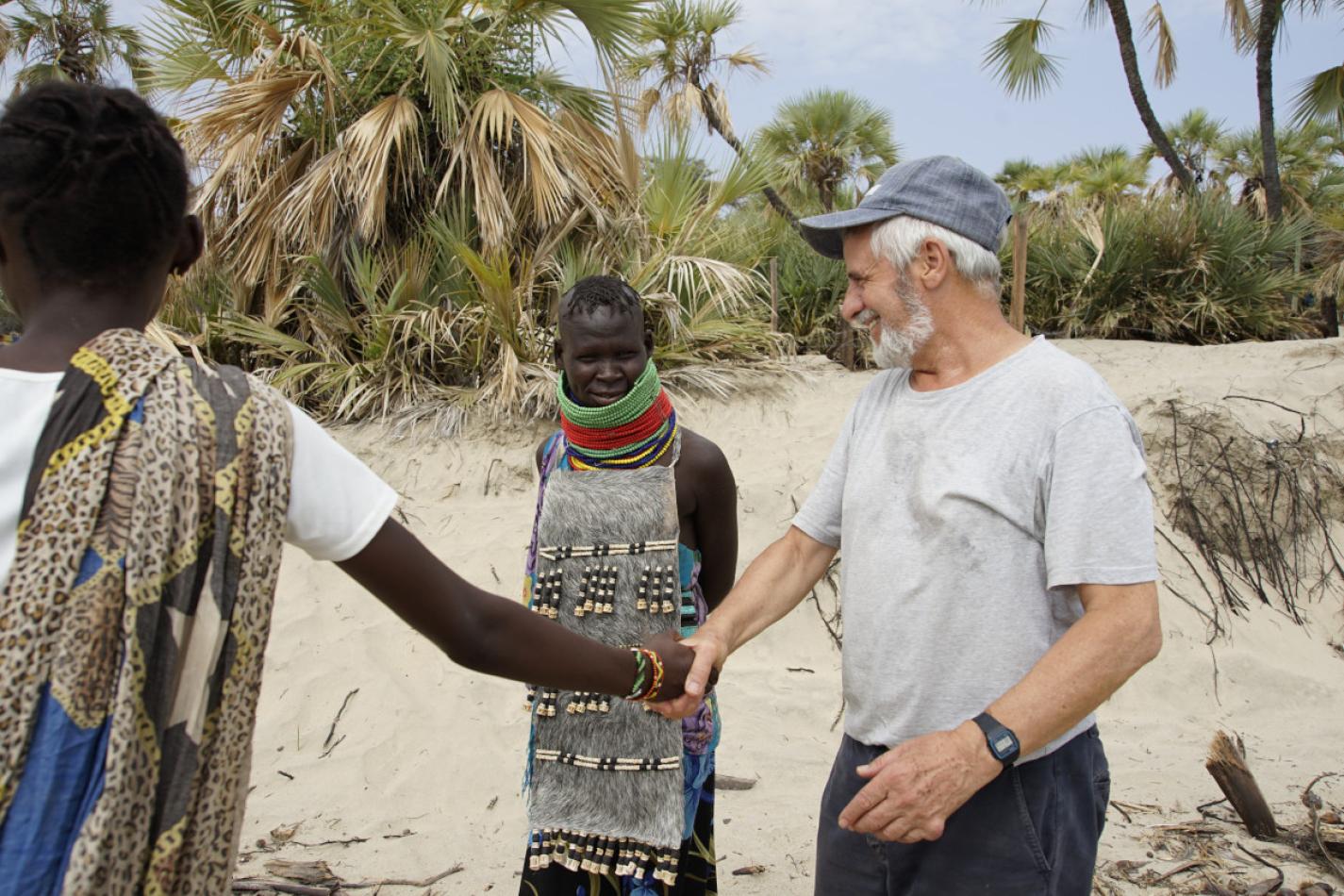
Father Daniel Villaverde, a Spanish Comboni missionary, has spent a large part of his life serving the Church in Kenya. His is a story of departures, returns, encounters and deep bonds, above all with the Turkana people, who have always held a special place in his heart. In January 2022, after a few years in Spain, he had the joy of returning once more to Kenya, to his beloved Turkana. His new destination was Lokichar, a small town in the heart of Turkana, where he continues to live and share in the mission.
Life here follows particular rhythms. In November and December, when schools close for the holidays, the mission comes alive with a lively, colourful presence: children, teenagers and young people arrive from early morning and wander around the compound.
Some come to say hello, some stop to chat, some look for odd jobs, some meet up with friends to play. There is no shortage of occasions… But in the end there is one passion that brings everyone together: sport, and above all football!
It is a simple, everyday scene, but it says a lot about the relationship that has grown between the mission and the people. The mission is first and foremost an open house, a meeting place where everyone can feel welcome and find someone willing to listen.
A land, a people, a history
We are in north-western Kenya, in a semi-desert region where the Turkana have lived for generations, a people of nomadic and semi-nomadic herders, used to coping with a harsh environment and the many challenges of scarce water and resources.
My story with this land began in 1988. From 1988 to 1995 I worked in the diocese of Lodwar, coming into contact with the culture, traditions and life of the Turkana people.
After a couple of years in other assignments within the Comboni communities in Kenya, I was sent to Spain, to Santiago de Compostela, as a missionary animator.
In 2001 I returned to Kenya, this time to the diocese of Marsabit, where I stayed for three years. In 2005 I was entrusted with service at the Comboni postulancy in Ongata Rongai, until 2010; afterwards I went back to the diocese of Marsabit, where I worked until December 2014. Another seven years in Spain followed, first in Madrid and then in Granada.
On 21 January 2022, at last, I returned to Kenya. And once again among the Turkana, in the parish of Lokichar. I experienced this return as a gift: finding familiar faces, places and relationships again, but also discovering new situations and new challenges to respond to.
The Christ the King mission: a house with open doors
Our mission, dedicated to Christ the King, is located in the centre of Lokichar, a fast-growing town crossed by the main road connecting Nairobi to Lodwar, the regional capital.
The Comboni community is made up of three priests: Father Pablo Simón Rodríguez, from Mexico, the parish priest, who has served the Turkana population for many years; Father Daniel Babley, from Togo, the community’s bursar, who arrived about two years ago; and myself, Daniel Villaverde Marcos, from Spain, the superior of the community.
The Church of Lodwar has played, and continues to play, a fundamental role in the life of this region, marked by great hardship, poverty and scarcity of resources.
Over the years it has helped build a network of essential services for the population: schools, dispensaries, rehabilitation centres for blind, deaf and disabled people, and support initiatives for widows, orphans and street children.
There have also been interventions in emergencies, from famines to epidemics, as well as vaccination campaigns and activities to prevent and treat malaria, pneumonia, typhoid and other diseases.
But this story is not only that of institutions and missionaries. It is also, and above all, the story of our people: of their industrious hands, their generosity, their ability to endure and start again even in the most difficult situations.
Alongside the Turkana population, missionaries, local priests, fidei donum priests and numerous male and female religious congregations have worked and continue to work. Each has left a mark, helping to build a living Church, present and close to the people.
The parish of Lokichar too extends over a vast territory. Its chapels, spread over an area of 50 x 100 kilometres, make it possible to keep in touch with the most distant communities.
Two years ago, moreover, the new parish of Lochwa was born in the northern part of the territory, entrusted to two fidei donum priests.
The pastoral work is therefore enormous and the needs are many. The harvest is plentiful and the labourers are still few, even if, thank God, their number continues to grow.
It is in this reality that we try to find, every day, the strength to go on: in the Word of God celebrated and shared, in the prayer that rises from the heart in the silence of dawn and dusk, in our passion for the Gospel and for the poorest and most abandoned.
These are the roots that allow us to look far ahead without losing touch with the concrete life of the people. These are, to use a biblical image, the eagles’ wings that help us renew our strength and continue on our way.
The parish compound, dedicated to Christ the King, is meanwhile beginning to become too small to welcome all those who visit: local people, friends, neighbours and those who arrive through one of the four or five entrances to our centre.
And we do not want to limit ourselves to offering them a greeting or a formal welcome. We want them to find spaces, opportunities for growth, formation, friendship and sharing.
For this reason, day after day, we try to make available to the population the facilities and activities we have built and continue to develop.
First of all there is the church, with its characteristic hexagonal shape, and beside it the grotto dedicated to Our Lady. Then there are the nursery school and the primary school, which welcome the youngest and accompany their first steps into the world of education.
A special place is held by the St. John Paul II Centre, dedicated to children and teenagers with disabilities. Many of them also attend the primary school just a few metres away.
It is an important experience of welcome and inclusion, so that every child, with their own abilities and difficulties, can find an environment in which to grow and feel part of the community.
There is also a space for young people, with a library, rooms for games and meetings, a five-a-side football pitch, a basketball court and a handball court.
These are places of meeting and socializing, where young people can spend their free time, develop their abilities and learn to be together.
The complex is completed by the residences of the fathers and the sisters, who share with us the daily life and work of the mission.
Four sisters are currently present – Agnes, Hellen, Noven and Beatriz – belonging to the congregation of the Evangelizing Sisters of Mary, founded by a Comboni bishop and a Comboni priest.
We collaborate with them in many areas: from pastoral work to formation, from education to the various projects and services for the population. It is a precious collaboration, made of shared responsibilities, concrete commitment and fraternity.
Alongside the most vulnerable children
Among the many activities of the mission, I would like to mention in particular a project begun about two years ago to accompany street children, offering them concrete help and, where possible, the chance to find a different path.
It is delicate work, requiring patience, continuity and above all the ability to build relationships of trust. Some local groups and individuals collaborate generously in the initiative.
Four or five local workers help us identify the boys, follow them over time and accompany them on their path to recovery, also seeking to encourage their return to local schools.
It is not only a matter of offering immediate help, but of giving these children back the possibility of looking to the future with greater trust, feeling welcomed and accompanied once again.
Along this journey we also received truly providential help: the visit and presence of a family of eight from Burgos, in Spain.
During their stay, its members immersed themselves completely in the life of the mission, taking part enthusiastically in the activities already under way and letting themselves be drawn into initiatives and proposals that arose almost spontaneously.
Their presence opened up new possibilities, especially regarding food support for children and the most vulnerable people.
Thanks to their generosity and that of many volunteers in Spain, we can now count on valuable help to respond to some of the population’s basic needs.
With eagles’ wings, toward new horizons
Looking at everything that is lived in the mission of Lokichar, I realize how long the road still ahead is. The needs are many, resources are often limited, and the people engaged in pastoral and social work are never enough.
And yet there is no lack of reasons to give thanks and keep hoping. We find them in the children who fill the mission’s courtyard with voices and games, in the young people who gather around a ball, in the families who knock at our door, in the people who generously put themselves at the service of others.
We find them in the collaboration among missionaries, sisters, local workers and so many friends who, even from afar, share our commitment.
It is this network of relationships, faith and solidarity that gives strength to our mission. We are not alone and we do not walk alone.
I therefore wish to greet all of you on behalf of our community, so diverse and international, yet united by the desire to serve the Gospel and the people entrusted to us.
Receive my fraternal and affectionate embrace. May the good God continue to bless and sustain us, through the intercession of Saint Daniel Comboni and all the Saints.
Father Daniel Villaverde Marcos, MCCJ