
Daniel Comboni
Comboni Missionaries
Institutional area
Other links
Newsletter
In Pace Christi
Di Gennaro Giuseppe
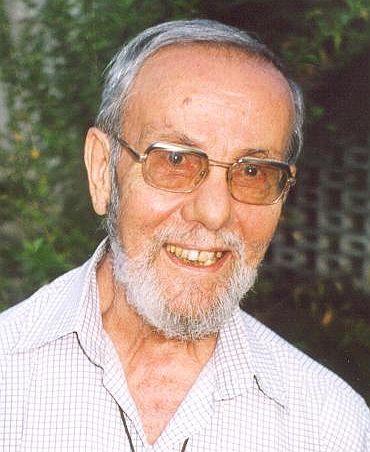
After finishing primary school, Fr. Giuseppe Di Gennaro entered the diocesan seminary, intending to become a priest. According to the rector, we know that this young man’s training was serene and very committed, both in terms of school achievement as well as of good behaviour and piety.
In those days (1942), missionaries visited the seminaries of Italy for the purpose of vocations promotion. Giuseppe surrendered to the missionary ideal and, in August 1942, wrote to the Superior General of the Comboni Missionaries: “I, the undersigned seminarian Giuseppe Di Gennaro, wish to join your apostolic ranks. I have passed the entrance exams to high school and I am eighteen years old. Please tell me what I must do. Confident that your fatherly goodness will not deny me this, I kiss your hand and declare myself your illustrious lordship’s most obedient son in Jesus Christ…”
His parents, Raffaele and Giuseppina Infinito, accepted in faith their son’s decision and gave him their blessing. In his letter of presentation, the parish priest wrote: Giuseppe’s behaviour has always been edifying, serious and prudent. He is well regarded here at home. He has done very well in his apostolate among the very young and has always served Mass with great love and concentration.
In the summer of 1942 Giuseppe entered the noviciate in Florence, where Fr. Stefano Patroni was novice master. This was a happy coincidence as the young seminarian, with simplicity and love, absorbed the good spirit which the saintly novice master shared with him. It was a time of war, and of food shortages. On 7 October Giuseppe took his first vows and then spent two years studying philosophy at the Rebbio scholasticate. He went to Verona in June 1946 and was ordained priest on 3 June 1950. He was then sent to Pesaro as vocation promoter. Fr. Giuseppe searched the district for boys willing to become missionaries while, at the same time, he kept asking his superiors to send him to the missions. Finally the time to depart came also for him.
He did his missionary work first in Southern Sudan, from 1955 to 1964 and then in Congo, from 1974 to 2005. In Sudan he had a very difficult time. The missionaries were troubled by war and the lack of supplies, with many missions in need of being restored or rebuilt. Fr. Giuseppe rolled up his sleeves and set to work with enthusiasm. In a letter from Naandi on 27 August 1963 he wrote: “Here I am at Naandi, alone like a monk. Morale is high and I try to cope. I feel deep gratitude in my heart to God for having given me such times of missionary life as these. I hope to carry on as long as God wants.”
The expulsions of the missionaries from Southern Sudan had already begun and the Church was being persecuted. The missionaries lived in continual tension, so Fr. Giuseppe asked the Superior General if he could smoke just one cigarette a day, “just to calm my nerves” and to speed up the holiday rota, “otherwise we will all end up in the madhouse.” He worked as assistant priest at Tombura and Naandi, teacher at Mupoi and later, local superior at Naandi.
After the mass expulsion from Southern Sudan of the missionaries, male and female (1964), Fr. Giuseppe was sent to Bari. This “mission” was no easier than that of Africa. First he had to see to the purchase of the site for the new Comboni house. Then he had to cope with the new formation methods for the youth.
In 1971 he managed to go to Naples where he engaged in mission promotion until 1974. During that period he obtained a licentiate in theology at the Angelicum University (Rome).
His next mission appointment was to Congo, in the missions of Dakwa, Rungu, Dungu, Kinshasa, Rungu, Kingabwa, where he worked as parish priest, teacher, formator in the seminary, professor, vocations promoter and in charge of pastoral work.
Fr. Giuseppe’s missionary ministry was full of enthusiasm, optimism and love for the people. He truly loved the African people and understood their limits. He hid their failings under the mantle of charity.
When his health began to fail, he had to return to Italy. Since he later felt quite well, he went to Casavatore, Naples, where he made himself useful hearing confessions and engaging in ministry.
His death from cancer took place as he was being brought to hospital. His remains now rest in the cemetery of his home town, Scisciano, where the funeral took place. Fr. Giuseppe leaves behind the memory of a missionary who was enthusiastic about his vocation, loved the mission and had a great heart especially for the African people: a true son of Comboni.
Da Mccj Bulletin n. 232 suppl. In Memoriam, ottobre 2006, pp. 85-94