
Daniel Comboni
Comboni Missionaries
Institutional area
Other links
Newsletter
In Pace Christi
Sandri Giuseppe
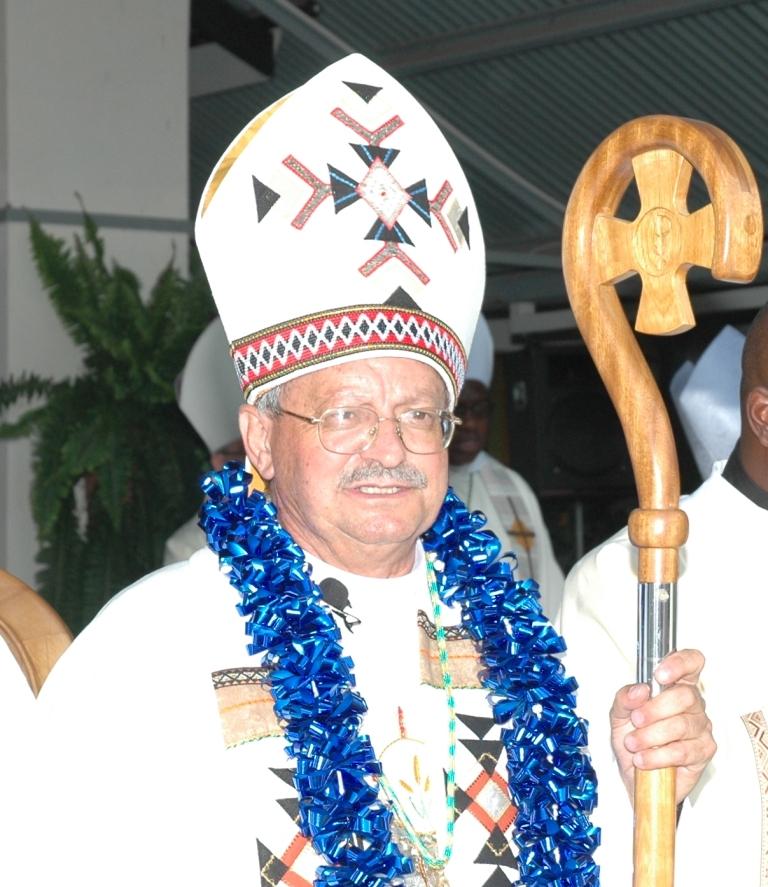
Mons. Giuseppe Sandri was born at Faedo, in the Italian diocese of Trent, on 26 August 1946. He was sent to the United States where he did the novitiate in Monroe and made his first profession on 15 August 1968. He continued his studies at the scholasticate of Cincinnati where he made his perpetual profession on 15 August 1971 and was ordained priest on 27 May 1972. While in Cincinnati, he obtained a Masters in theology at Xavier University. He was later assigned to South Africa.
After spending some months at the parish of Acornhoek (Witbank diocese) learning the Tsonga language, he was made parish priest of Waterval Bushbuckridge (1973-1978). He later helped in the parishes of Luchau and Acornhoek (1978-1980) and was placed in charge of the Maria Trost Pastoral Centre, at Lydenburg (1981-1986), and later became parish priest of Acornhoek (1986-1991).
“I met Fr. Sandri in 1987” – Writes Bro. Artur Pinto, who lived with him during his final years – “when he first welcomed me to the mission of Acornhoek, the most rural and remote mission in the diocese of Witbank. The effect he had on my life as a young man, scarcely twenty years old, was a determining factor for my missionary consecration”.
He was Provincial Superior of South Africa for two mandates (1993-1995 and 1996-1998) and was later appointed General Secretary of the Institute in Rome (1999-2007). He was re-elected provincial of South Africa in 2008 and, on 6 November 2009, he was appointed Bishop of Witbank. His episcopal ordination took place on 31 January 2010 at the Maria Trost Pastoral Centre, Lydenburg.
Mons. Sandri considered it important to know the country where he had been sent, its customs and traditions. Besides English, he spoke the Northern Sotho, Tsonga and Zulu languages. Right from 1973 he collaborated in the work of translating and publishing liturgical texts, hymn books and the Bible in Tsonga-Shangaan which were published, under his direction, by the Episcopal conference of South Africa, in 1996.
Furthermore, from the time he arrived in South Africa, he regularly collaborated, at local and national level, on matters of justice and peace, with the Department of Justice and Peace of the Episcopal Conference and the South African Council of Churches. He was a member of the Johannesburg Institute of Contextual Theology and of the South African Academy of Religion.
The Provincial of South Africa, Fr Jude Eugene Burgers writes: “His sound pastoral identity was appreciated in particular in the areas of catechesis, the formation of adults and the promotion of local vocations. He worked tirelessly for a self-supporting Church. His ability to work in a team made him available to all while his ability to listen, his kindness and his frank manner and the Christian faith he lived, made him the good missionary priest he was.
He was a humble person. He had a deep love for the Church and was meticulous in the service of the Gospel in conformity with the desires and directives of the Church.
He built up sound and lasting relations with everyone. He had a great capacity for friendship with people of all ages. He had a special place in his heart for the priests of the diocese of Witbank and his Comboni confreres. He was a collaborator by nature. He would meet people in their own environment, in their own needs, in their joys and in their sorrows”.
Bro. Artur Pinto continues: “Since the diocese was so vast, Mons. Sandri had to travel more than 40,000 kilometres each year as he went about his pastoral work. He was the sort of bishop who was present everywhere, so totally dedicated to his duties that he neglected his own health … and, during his visits, he would accept whatever food or drink the people had to offer. It may have been due to this that he developed an ulcer which, on 27 March, perforated his stomach. Before I took him to hospital that morning, he simply said to me ‘Pinto, call the doctor immediately, I am in unbearable pain’. He was writhing in pain at the door of the chapel where every morning we would prepare to celebrate the Eucharist. He underwent emergency surgery that same day. I went to visit him twice a day at the intensive care unit of the Cosmos private hospital in Witbank. On 7 April, we transferred him to the best private hospital in South Africa, close to Pretoria where he was well attended by kidney specialists and a doctor friend of his who kept us informed about his condition.
On 11 April, he had a second stomach operation but the infection had spread and was out of control. On 30 May, at 4.30 am, the telephone rang and the doctor friend gave us the sad news: ‘Our Bishop has just passed away’”.
“If we could sum up his life in a few works – we read in the message of the General Council – we would say that he possessed three distinguishing characteristics: his joy, his unconditional service to the People of God and his deep sense of belonging to the Comboni Family.
Mons. Sandri was a joyful person and he expressed his joy through his good humour, his readiness for a laugh and his sense of wittiness. His joy was rooted in God, in the certainty of his vocation and in his deep awareness of the presence of God.
His episcopal motto Venio Ministrare, ‘I Have Come to Serve’, sums up his dedication and his journey of identification with Christ the Good Shepherd. We may say that it was his generosity and his unconditional dedication to the Kingdom of God that consumed the strength of one who grew up in the mountains of Trent that led to his untimely death.
His sense of belonging to the Institute was expressed in his love for the Comboni Family which he served in various ministries, incarnating the charism of Saint Daniel Comboni and especially his dedication to the peoples of Africa. The words of Comboni, addressed to the African people of Khartoum: “The happiest day of my life will be the day on which I will give my life for you”‘, apply very well to the life of Bishop Sandri. To the people of the diocese of Tent he used to say: ‘My native Trent is dear to me but now South Africa has won my heart’”.
Da Mccj Bulletin n. 282 Suppl. In Memoriam, gennaio 2020 pp. 65-73