
Daniel Comboni
Comboni Missionaries
Institutional area
Other links
Newsletter
In Pace Christi
Lukudu Loro Paulino
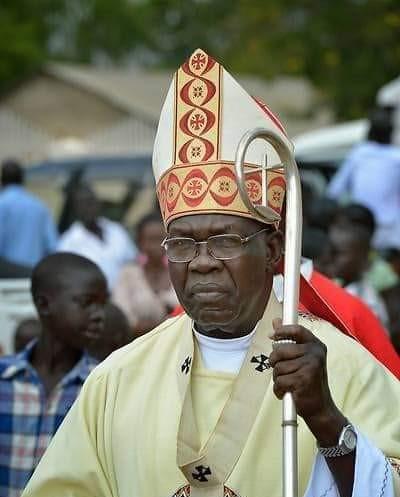
I met Mons. Paulino Lukudu Loro in 1975, when I was Apostolic Administrator of the diocese of El Obeid. It was my first mission in Sudan. Both of us were 35 years old and we immediately became friends. We remained friends even when I went to other missions: Nyala, in Darfur and Abyei among the Denka of South Sudan. Our friendship continued also when I again met him in Juba in 2010: he was the Metropolitan Archbishop of Juba and I was the Comboni Provincial of South Sudan.
I have to use my imagination to describe the early part of his life; he never liked to speak of his personal past. His attention and concerns were concentrated on the sad situation of his country that was engaged in a civil war that lasted until 1955.
He was born in Juba (South Sudan) on 23 August 1940. During his childhood and his youth – he completed his schooling in the mission schools – the missionaries had, since the thirties, begun many projects for the development of the country: schools of all sorts and levels, programmes for the control of tropical diseases, large hospitals and small dispensaries everywhere, coffee and tea plantations, teak, and many other projects. In 1964, the Khartoum government expelled them all: in South Sudan there were many Catholics, only a few priests who were young and overworked; there was confusion everywhere.
In that sad situation, young Paulino will have recalled how life in his village of Kwerijik, near Juba, was very different before the expulsion of the missionaries and felt the call of God who was inviting him to become a Comboni missionary. It cannot have been easy to move from his simple hut in Kwerijik to the Comboni novitiate in Florence; in fact, some of his companions soon returned home, but he remained. He took temporary vows on 9 September 1967, perpetual vows on 9 September 1969 and was ordained priest on 12 April 1970, in Verna Cathedral.
He afterwards returned to his own country and, for a short time, served the Church in South Sudan together with the other Sudanese priests. Then, in 1974, after the Addis Ababa Accord, the Congregation of Propaganda Fide decided to reconstitute the hierarchy of the Catholic Church in Sudan. Fr. Paulino became Mons. Paulino, Apostolic Administrator of El Obeid. He was 32 years old and from one day to the next became a ‘bishop’ (he would be consecrated on 27 May 1979) of a diocese three times the size of Italy.
The diocese of El Obeid is located in the north of Sudan, and one of the first duties of the bishop was, therefore, to learn the Arabic spoken in the north which was very different from that spoken in the south.
The diocesan structures were still in their beginnings and much had to be improvised. The world of Islam certainly was of no help to the life of the Church and most Christians were immigrants from the south of the country, homeless and uprooted from their tribal culture.
During that period, he came twice to visit the mission of Nyala where I was. He really was a shepherd visiting his flock. He took an interest even in the small things of the confreres entrusted to him: their health, serenity and whether they were happy to be in that mission. In 1983, he became Metropolitan Archbishop of Juba while I was then asked to direct the Course of spiritual orientation at the national seminary in Khartoum. Even though far from each other, our friendship and fraternal spirit were very much alive; we met again in 2010 when I was sent to Juba as Provincial of the Comboni Missionaries in South Sudan.
Like all the other Sudanese dioceses, Juba was in a pitiable state; the civil war had prevented any sort of stable organisation or even minimal progress in the various diocesan institutions. Even the national seminary in Juba had been abandoned and had become infested with monkeys and rats. But the people were still there, as always. The institutions and buildings could wait for better times. Consequently, his attention, at the start of his episcopal ministry in Juba, concentrated on the people: the religious, his priests and the many poor people who came knocking at his door every day.
He reorganised the life of the Sisters of the Sacred Heart and the Brothers of Saint Martin de Porres, two local congregations of diocesan right. During the civil war, the life of the diocesan priests had been rather difficult. The new archbishop made them feel again like a family where he was the elder brother. Also to the poor, Mons. Paulino was always a good father who never sent anyone away empty-handed.
He intensified the educational programme of the diocese. Each parish had, and still has, its own primary and middle schools with thousands of pupils. Each parish also had a small dispensary where the poor could find a nurse and free medicine for the commonest diseases.
With the help of some religious congregations, he opened, also in Juba, an excellent school for nurses which today continues to train paramedical personnel for the whole of South Sudan.
In 2011, at the end of the civil war which led South Sudan to independence from the north of the country, with the help of some Combonis, he erected a diocesan FM radio station to inform, instruct, to heal the wounds of war and to help discern the path to follow. 55 years of civil war had left everything and everybody worn out. In an almost inhuman condition, with his closeness to the people, his courage to hope against hope ad his openness and humility to collaborate with those who had more energy than him, he succeeded in bringing courage and hope to an entire people that had been deprived of all hope and abused for so many years.
South Sudan has always been the victim of blatant injustice; for example, there was only one secondary school in the whole country, in Rumbek. To counter this situation that actually paralysed the youth of South Sudan for many years, Mons. Paulino, in the early 2000s, fostered the opening of the Catholic University of Sudan in Wau. It was a humble beginning but it opened the hearts of many young people.
On the contrary, he cared nothing for himself. His house remained exactly as the Italian Comboni bishop had left it when he was expelled, with no renovation works, until 2019. It consisted of a sort of reception and a low house with a small veranda.
During the 36 years that Mons. Paulino was Archbishop of Juba, the reception area had altered its purpose: it became a refuge for poor people looking for help, a meeting place when there was a dispute to be settled and a place of listening for people who had problems and did not know which way to turn. A Sister took care of the poor while the bishop saw to others personally. The people wanted it that way and he did this very willingly and always.
One final meaningful aspect of his identity was his love for his priests. There was as yet no House of the Clergy and so the Archbishop took the elderly and sick priests into his house. I happened, on a few occasions, to have breakfast with them. There was a real sense of family among them. An old priest is not always the nicest person to meet or with whom to live. This was true also at the Archbishop’s house in Juba. “But they are my priests”, he said to me. “They have given their lives for the Church like myself and, in good times and in bad, we are still brothers”.
The way I see it, this was Mons. Paulino: a Comboni, a man of God, a bishop of the Catholic Church which, in times that were not easy for the Church in South Sudan, spent himself entirely for the good of his people, of his country and the Church that God entrusted to him.
The apostles who saw the Risen Lord were the pillars of the primitive Church, a completely new reality. Mons. Paulino, having seen that the Church could make his country revive and bring it into a completely new phase, was a pillar of the young Catholic Church in El Obeid and in Juba.
Significantly, the Lord called him to Himself on Easter Monday, 5 April 2021. The example he leaves us will help these two Churches to follow the Lord for many years with confidence, optimism and joy, as they learned to do under his guidance for all those years.
(Fr. Luciano Perina, mccj)